





Beginning teacher jobs NZ eligibility should be checked before you write a long application. Two adverts can share the same broad job title and still seek different applicants. Start with the suitability label, the professional requirements and the evidence the school actually requests.
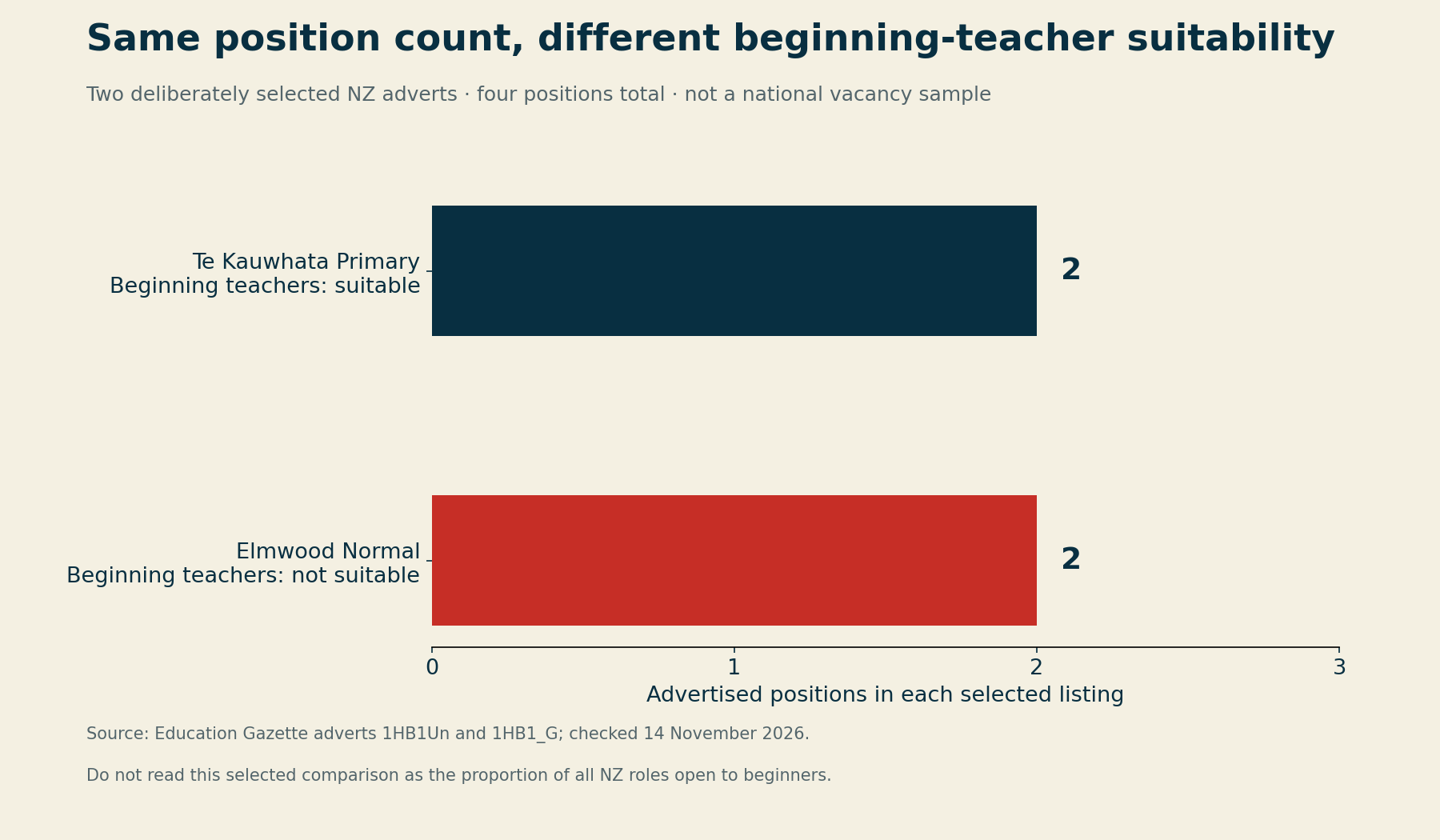
We compare two selected Education Gazette listings published in November 2026. Together, they advertise four positions. This is a practical screening exercise, not a representative survey of New Zealand teaching vacancies or a measure of your selection chances.
Beginning teacher jobs NZ eligibility: two contrasting adverts
Te Kauwhata Primary School’s advert 1HB1Un, listed on 9 November, offers two full-time permanent Year 4–6 roles from Term 1 2027. It welcomes beginning teachers and asks for New Zealand-registered teachers. The advertised closing time is 28 November 2026 at 5pm.
By contrast, Elmwood Normal School’s advert 1HB1_G, listed on 11 November, offers two full-time permanent Year 3/4 positions. It explicitly says the roles are not suitable for beginning teachers. It seeks experience and strengths in structured literacy and maths. Applications close on 23 November 2026 at noon.
Examples checked: 14 November 2026. These are dated case studies. After their closing dates, use them as historical examples of screening requirements. Reopen the live listing and application pack before spending time on an application; the school may amend or withdraw a vacancy.
| Check | Te Kauwhata Primary | Elmwood Normal |
|---|---|---|
| Advert reference | 1HB1Un | 1HB1_G |
| Advertised positions | 2 | 2 |
| Beginning-teacher suitability | Suitable | Not suitable |
| Year levels | 4–6 | 3/4 |
| Allowance field | None listed | Normal School Allowance; amount not stated |
Equal position counts do not mean equal eligibility. Nor does “none listed” establish that a teacher has no allowance entitlement. Record the wording you can verify and keep an unanswered question separate from a confirmed zero.
Keep professional status separate from suitability
The Teaching Council’s practising-certificate guidance distinguishes registration from holding a current practising certificate. A school’s beginner-suitability label does not replace those professional checks. Use the Council’s guidance for your own circumstances rather than inferring a route from a job advert.
If you trained overseas, follow the official overseas-trained teacher guidance. Describe your status accurately in the application. Do not describe an application still being assessed as a completed registration or assume that a vacancy guarantees a work-authorisation outcome.
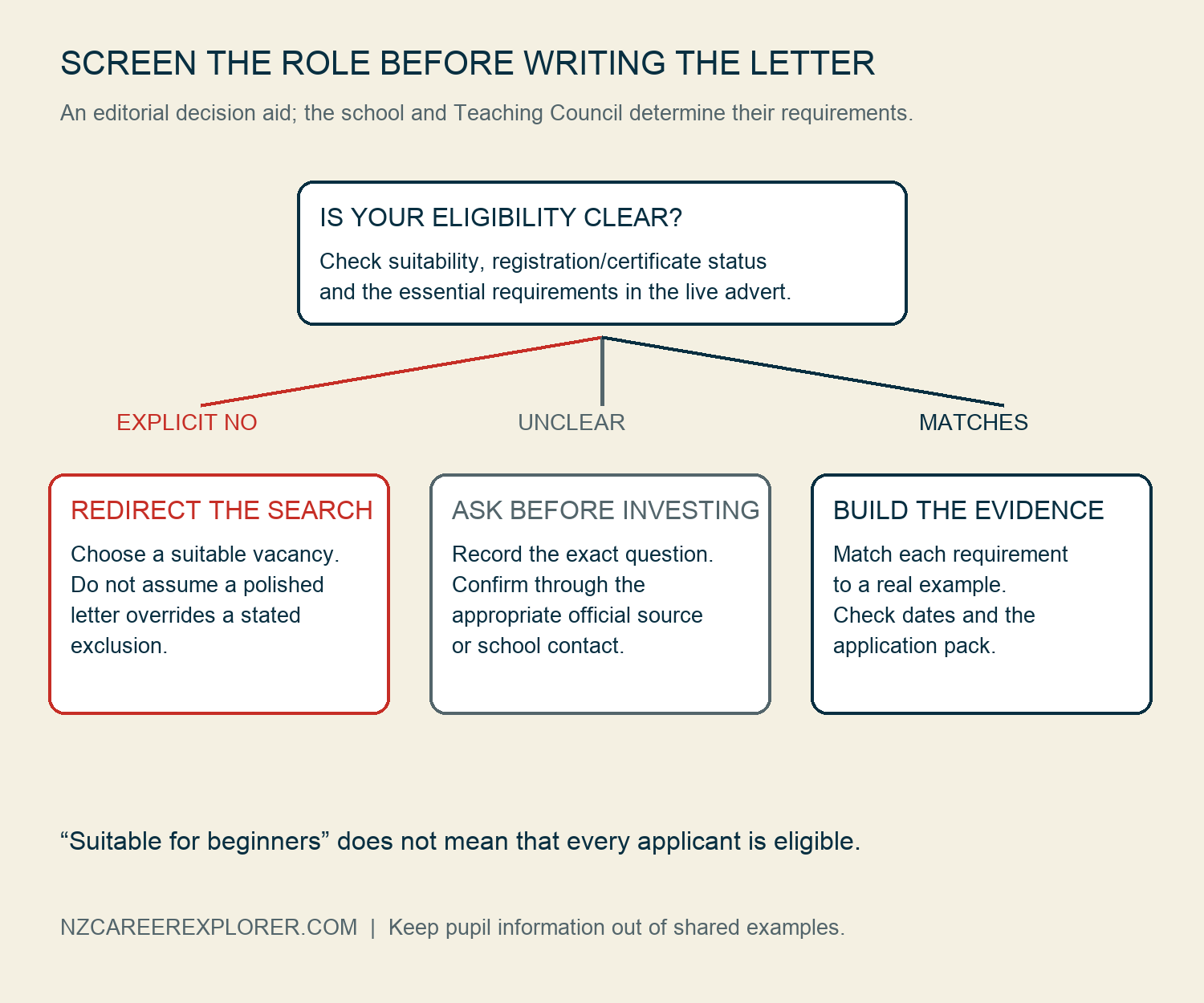
Use three decisions: apply, clarify or redirect
Apply when the essential gates match
Begin with the requirements you can substantiate. Save the advert reference, checked date and application instructions in your private planner. Then connect each essential requirement to a genuine placement or teaching example.
For example, if an advert asks for assessment-informed practice, explain how you used an assessment to change your teaching. State the context, your action and what you could observe. Avoid inventing a measured pupil outcome or implying that you acted independently when you worked under supervision.
Clarify when a material point is genuinely unclear
Write down the exact uncertainty before contacting the appropriate source. A useful question names the requirement and the evidence you hold. It does not ask a school to judge your entire application in advance.
Keep professional-status questions for the appropriate authority and role-specific questions for the school. Do not send identity documents or pupil records merely to obtain an informal answer. Follow the school’s stated application process when you are ready to apply.
Redirect when the advert explicitly excludes your situation
A strong cover letter does not remove an explicit eligibility restriction. If a role says it is not suitable for beginning teachers and that describes your situation, focus your effort on a more appropriate vacancy. Do not treat the exclusion as a challenge to overcome through persuasive wording.
However, avoid turning one school’s requirement into a rule about every vacancy with that title. The selected comparison shows why reading each advert matters. It does not establish how common either requirement is nationally.
Plan the application around the actual deadline
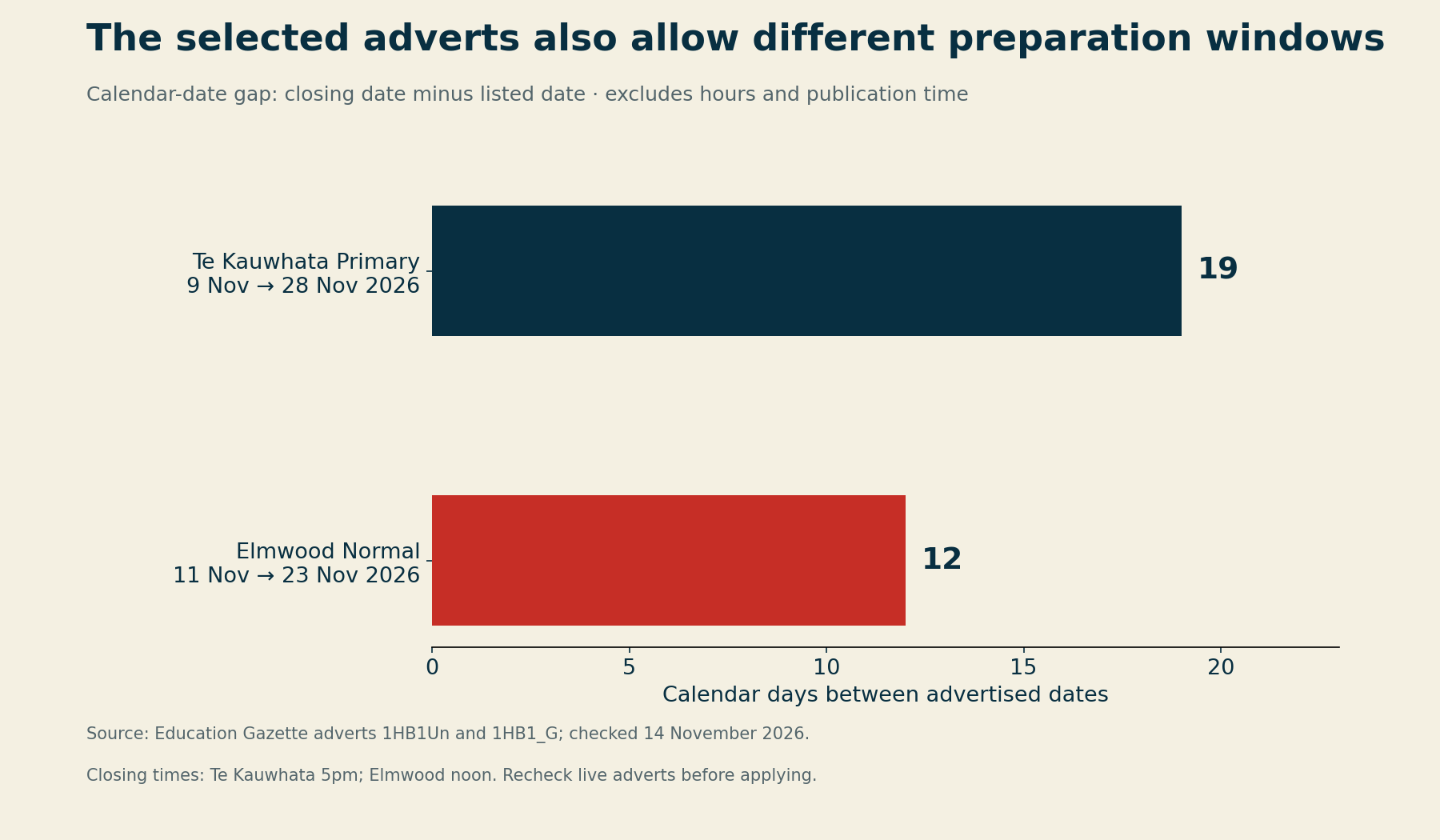
We calculate the calendar-date gaps as 28 November minus 9 November, or 19 days, and 23 November minus 11 November, or 12 days. These gaps exclude listing times and are not exact elapsed-hour windows. They also do not measure the time remaining when you read this article.
Personalized Career Consulting
Unlock your potential with expert career advice tailored to your goals. Get personalized guidance and actionable steps toward your dream career in New Zealand.
Get StartedPut the advertised closing date and time in your own calendar. Then work backwards from the documents requested, referee availability and time for a careful check. Do not assume that a later date compensates for a missed eligibility gate.
Elmwood’s application pack supplies further instructions and an appointment timetable. Read the original pack rather than relying on a short summary. Record any conflict between an advert and its pack, and ask the school to clarify before relying on an uncertain instruction.
Build an evidence-led teaching application
Use one row per requirement in the evidence planner. Separate essential requirements from desirable strengths. A useful row records what the advert asks, your real example, your personal action, the evidence available and any limitation.
For instance, “worked collaboratively” is too broad on its own. Explain what you planned with colleagues, what you contributed and how you adjusted after feedback. If a mentor made the final decision, say so. The point is to show relevant practice accurately, not to inflate responsibility.
Likewise, a school’s stated interest in a subject does not justify claiming expertise you lack. Identify a genuine strength and a development need. Check whether the gap concerns an essential requirement or something the advert describes as an advantage.
Our structured-literacy professional-learning guide covers a separate development decision. A course opportunity should not be presented as proof that you meet an employer’s experience requirement. Recheck both the learning offer and the vacancy on their own terms.
Download the screening and evidence tools
The beginning teacher jobs NZ eligibility tools help organise your own checks. They do not assess professional registration, determine suitability or guarantee an interview. Keep pupil names, identifying records and confidential school material out of shared examples.
- Selected vacancy source data (CSV)
- Blank beginning-teacher eligibility screen (CSV)
- Blank teaching-application evidence planner (CSV)
The source CSV contains two selected advert records and their original URLs. The blank screening sheet separates live status, suitability, professional checks, uncertainty and your next action. The evidence planner contains blank rows, not invented applicant results.
Method and limitations
We selected two contrasting adverts to demonstrate a decision process. We checked the position counts, suitability wording, dates and stated requirements against their primary listings. Calendar-day calculations use dates only. We did not crawl all vacancies or calculate a national beginner-access rate.
Four selected positions are not a labour-market sample. Their advertised terms do not establish salary, workload, mentoring quality, selection odds or the experience of all new teachers. This article is an editorial planning resource; official authorities and individual schools determine their respective requirements.
Suggested citation: NZ Career Explorer, Beginning Teacher Jobs NZ: Check Eligibility Before Applying, 14 November 2026. Sources: Education Gazette adverts 1HB1Un and 1HB1_G, with Teaching Council guidance. Cite the checked date when reusing the comparison.
Before writing your next application, reopen the advert and complete the eligibility screen. If the gates match, use the evidence planner to make each claim specific. If a gate is unclear, clarify it. If the advert explicitly excludes your situation, redirect your effort.


