





A regulatory affairs NZ portfolio can demonstrate how you handle evidence without pretending you can approve a medicine. Start with a small, clearly fictional product-verification exercise. Show the claim, the document version, the comparison and the question that still needs review.
A fresh Medsafe announcement provides the context. However, the portfolio below is our editorial proposal. It is not a real dossier, an official training programme or a substitute for qualifications and employer requirements.
Regulatory affairs NZ portfolio: what the new approval shows
The government’s 12 November 2026 announcement identifies paliperidone as the first medicine approved through the Rule of Two pathway. It reports 25 working days for that approval. The Ministry of Health’s accompanying release corroborates the figure and describes verification of the proposed product against overseas approvals, alongside New Zealand-specific factors.
That is a reported result for one approval, not a distribution of processing times. It does not establish a future applicant’s timeline, a hiring shortage or a salary premium. Nor does discussion with interested companies prove that jobs are currently advertised.
Keep units and sources intact. The ministerial release separately uses “30 days” without specifying the same unit. The in-force rules specify working-day periods for particular decisions. Do not subtract headline numbers and advertise a five-day saving without establishing the same clock, scope and comparison.
Choose a narrow evidence-handling exercise
The Ministry’s pathway explanation describes material product identity and further requirements. This is more than finding two pages that mention a similar product name. A trainee should not decide clinical equivalence or treat a simple matching table as regulatory consent.
For a portfolio, practise the narrower task of making a document comparison traceable. Use invented product and organisation codes. Label the entire pack “fictional exercise” so a recruiter cannot mistake it for confidential industry work or a real approval.
Define the scope in one sentence: “I compared six fields in two invented records, recorded unresolved differences and prepared a reviewer memo.” This is specific, testable and honest. It avoids implying that you conducted a complete regulatory assessment.
Inspect the fictional six-field comparison
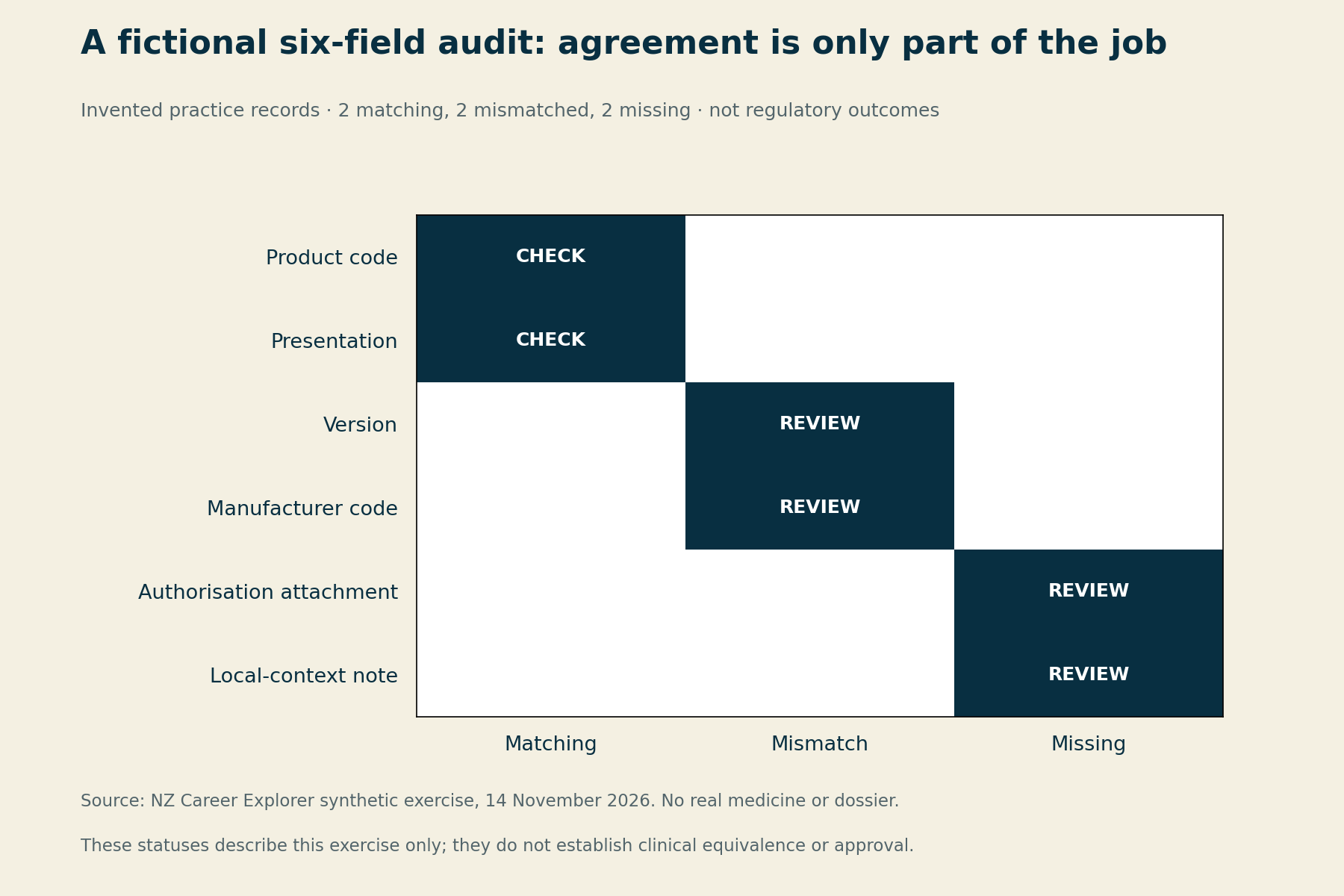
Our downloadable worked example contains six checks: two matching fields, two mismatches and two missing items. Those counts describe the invented exercise only. They are not a regulator’s error rate, an industry benchmark or evidence about paliperidone.
The fictional product code and presentation agree. The document version and manufacturer code differ. An authorisation attachment and a local-context note have not been supplied. Each row includes an observation and a review action; none contains an approval decision.
| Practice field | Invented observation | Useful next action |
|---|---|---|
| Product code | DEMO-A matches DEMO-A | Retain both source locations |
| Version | v2 differs from v1 | Identify the correct current version |
| Manufacturer code | ORG-X differs from ORG-Y | Escalate the identity discrepancy |
| Attachment | Listed but not supplied | Record the missing evidence |
Matching is a limited observation. For example, equal invented codes do not prove that every material product feature agrees. Likewise, a missing document is an unanswered check, not proof that the underlying requirement failed.
Build the regulatory affairs NZ portfolio audit trail
Make the claim small enough to verify
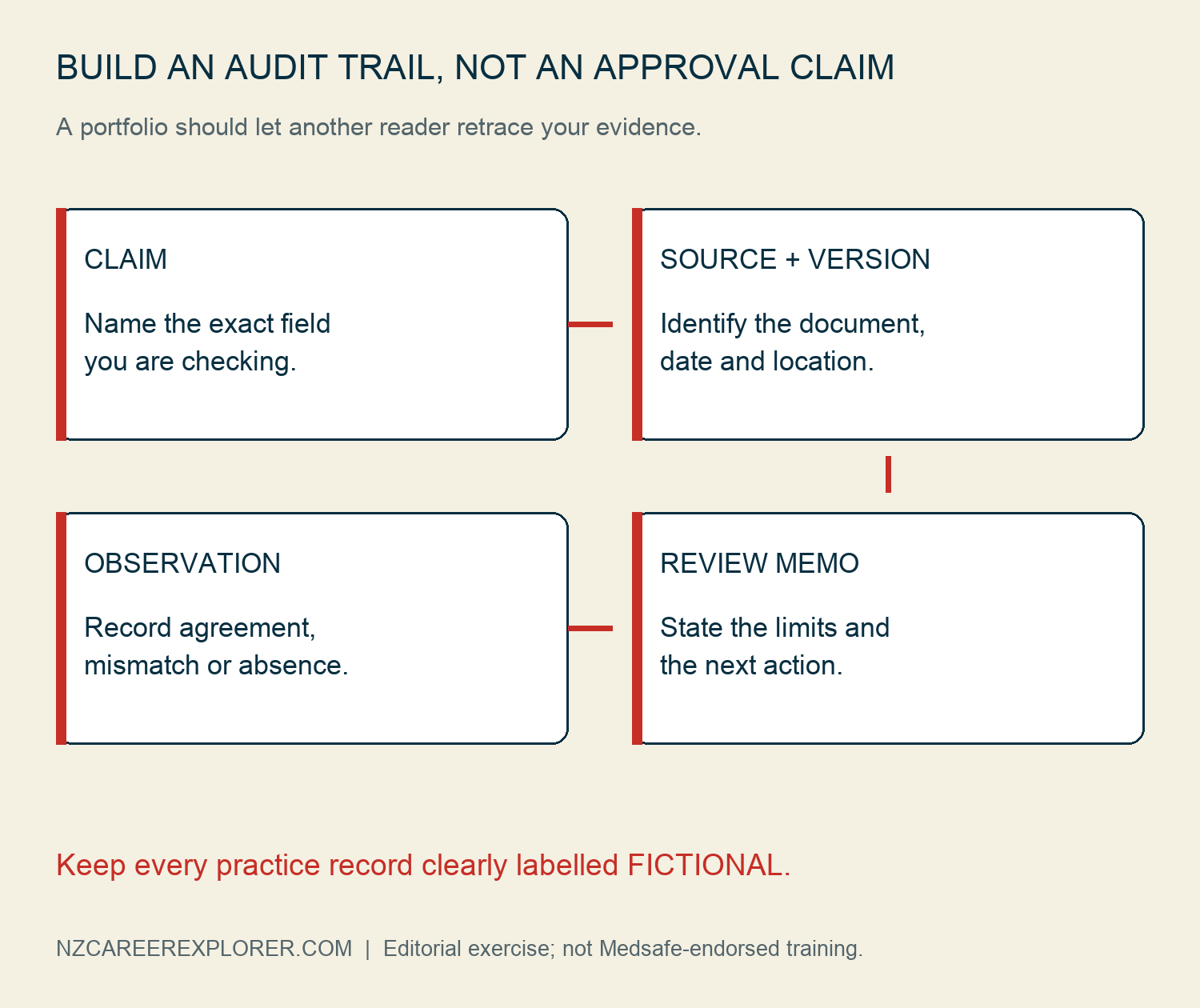
Use one field per row. Avoid a broad statement such as “the products are identical” when you checked only a code and a presentation label. Instead, state what the two records actually show and what your comparison did not cover.
This helps a reviewer retrace your work. It also makes corrections easier: when a source changes, you can identify the affected claim rather than rewriting an unexplained conclusion.
Record the source, version and location
For real public research, retain the authoritative URL, document title, version, date and exact page or section. For this fictional exercise, use explicit mock-document identifiers. Never invent an official URL, authorisation number or regulator endorsement.
Keep current rules separate from old consultation drafts. Our example source list points to the in-force rules, while the portfolio remains a limited practice exercise. A polished PDF should not conceal an uncertain document version.
Personalized Career Consulting
Unlock your potential with expert career advice tailored to your goals. Get personalized guidance and actionable steps toward your dream career in New Zealand.
Get StartedLog issues without silently fixing them
If two records differ, describe the difference. Do not edit one value to make the pack agree. Record what additional evidence or appropriate review would resolve the issue, then retain the resolution trail if it arrives.
Similarly, separate missing evidence from a confirmed mismatch. These states require different next actions. The issue log therefore includes the affected claim, why it matters, the review route, resolution evidence and status.
Write a memo that explains the limits
A short memo can state the exercise scope, sources checked, unresolved discrepancies and conclusions that the evidence cannot support. Include one next action for each open item. This shows judgement about uncertainty rather than confidence without evidence.
Do not add patient records, employer-confidential documents or genuine application materials to make the portfolio look authentic. Public evidence and invented practice records are sufficient for this exercise. Obtain permission before using any material you do not own or may not disclose.
Explain the exercise in an interview
Walk through one row from claim to source, observation and reviewer question. Then explain how you would handle a corrected version. A recruiter can assess your clarity and care without being asked to accept an unsupported approval claim.
Our privacy portfolio guide offers a separate example of documenting controls and uncertainty. Use the same discipline, but keep this product-identity exercise distinct. Neither article guarantees that an employer will accept the portfolio.
Finally, compare your preparation with actual job requirements. The announcement does not replace checks on relevant education, experience, professional responsibilities or a vacancy’s duties. Present the exercise as evidence of a skill you practised, not a credential you earned.
Download the worked example and blank tools
- Fictional six-field evidence comparison (CSV)
- Blank product-evidence register (CSV)
- Blank mismatch and missing-evidence log (CSV)
- Blank reviewer-memo planner (CSV)
The worked data are entirely synthetic. The other three files are blank templates. Keep that distinction visible if you adapt or share them, and preserve the source and version information for any public facts you add.
Method and limitations
We checked the two 12 November releases and official pathway material on 14 November 2026. The 25-working-day figure is attributed to those releases. All six portfolio rows and their two/two/two status split were constructed for teaching; they were not observed in a real regulatory dossier.
This article provides career preparation and evidence-literacy guidance. It gives no treatment advice, certification or regulatory judgement. Suggested citation: NZ Career Explorer, Regulatory Affairs NZ: Build a Product-Verification Portfolio, 14 November 2026. Distinguish the reported approval from the fictional exercise when citing either.


