





Structured literacy PLD 2027 offers a practical professional-learning decision for New Zealand teachers. Cohort 10 applications close on 4 December 2026, but checking the deadline is only the start. You also need to confirm eligibility, provider enrolment, release cover and the work across four terms.
The Ministry of Education’s programme page specifies at least four full-day workshops and eight communities of practice. Those are twelve activities, not twelve full days. Community-session durations, preparation and travel need their own estimates.
This guide turns the official requirements into a dated timeline, workload grid and questions for your school. It reflects the Ministry page checked on 6 November 2026. Recheck the official structured literacy and te reo matatini PLD page before acting, because arrangements can change.
Structured literacy PLD 2027: the decision at a glance
The programme supports structured approaches to literacy and te reo matatini. Its stated content spans oral language, phonemic knowledge, decoding and spelling, handwriting, vocabulary, morphology, syntax, fluency, writing and comprehension.
For Cohort 10, delivery starts in Term 1 2027 and finishes at the end of Term 4 2027. The Ministry describes face-to-face and virtual or remote delivery options. However, your chosen provider’s actual timetable determines how those activities fit around teaching.
| Decision | Official position checked 6 November | What to verify locally |
|---|---|---|
| Apply | Applications close 4 December 2026 | School approval and relevant eligibility evidence |
| Await outcome | Outcomes notified 11 December 2026 | Approval email and application reference number |
| Enrol | Provider enrolment deadline 12 February 2027 | Provider capacity, dates and confirmed place |
| Participate | Minimum four full-day workshops plus eight communities of practice | Session lengths, preparation, travel and cover |
| Fund release | Specified roles receive workshop release funding through the school | Eligibility and timing; payment is in the third term |
Use the official Cohort 10 application route when your school is ready. This article does not apply, reserve a place or assess your eligibility.
Eligibility and priority are separate from acceptance
The Ministry welcomes applications from state and state-integrated schools and kura nationwide with teachers of Years 0–8 who meet its criteria. Accessible roles include full-time and part-time teachers, principals and tumuaki, staff with a Limited Authority to Teach, regular relieving teachers and specified specialist staff attached to a school.
Priority focuses on teachers and schools without prior access. The Ministry identifies schools and kura that have not participated, Years 7–8 teachers without previous access, and Years 0–6 teachers without previous access. Regional teams also identify greatest need.
Importantly, a school with some trained teachers can still apply for its untrained teachers. Therefore, record the applicant’s own training history rather than treating any school participation as an automatic exclusion.
Still, an eligible role or priority characteristic does not guarantee approval. Nor does Ministry approval replace provider enrolment. Keep those decisions separate in your planning notes.
For teachers who trained overseas, this PLD also should not be treated as a substitute for registration or an employment requirement check. Discuss your circumstances with your school and the relevant official bodies. Our education and training guides provide broader career context, while the Ministry page controls this programme’s rules.
Follow the application-to-enrolment timeline
Applications opened on 2 November 2026. The subsequent milestones apply to both English-medium and Māori-medium provision in the official table.
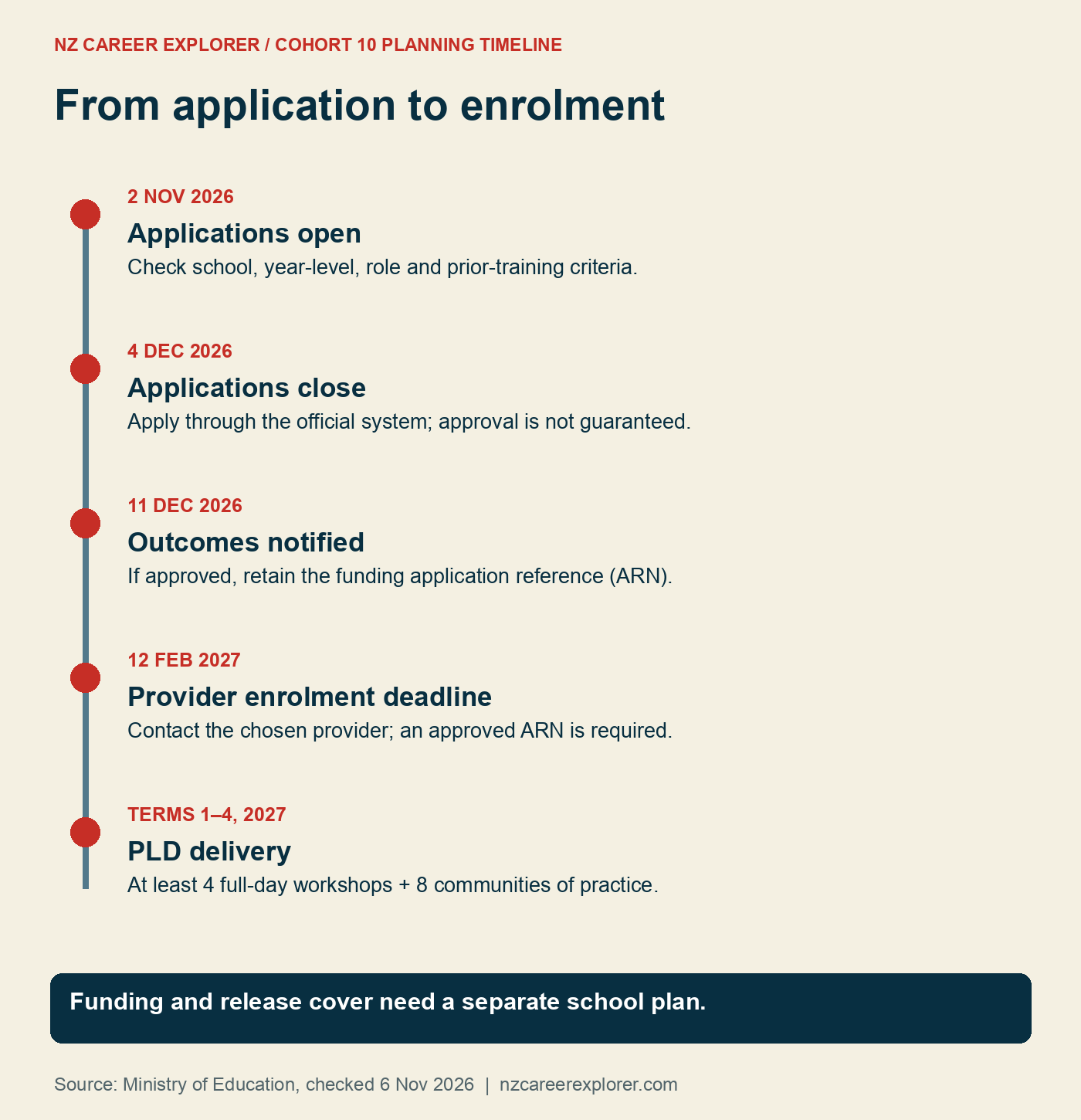
If approved, your school needs the funding application reference number, or ARN, to enrol with the chosen provider. The provider requires that approved reference. Save the approval email and confirm who at school will complete enrolment.
If teachers will attend different providers, the Ministry asks for one application per intended provider. This creates separate references: the same ARN cannot be used to enrol with more than one provider.
If you cannot enrol, contact the Ministry about waitlisting. The programme page warns that failing to inform it may lead to cancellation and a need to reapply. Do not assume an approval email means a place remains reserved indefinitely.
Personalized Career Consulting
Unlock your potential with expert career advice tailored to your goals. Get personalized guidance and actionable steps toward your dream career in New Zealand.
Get Started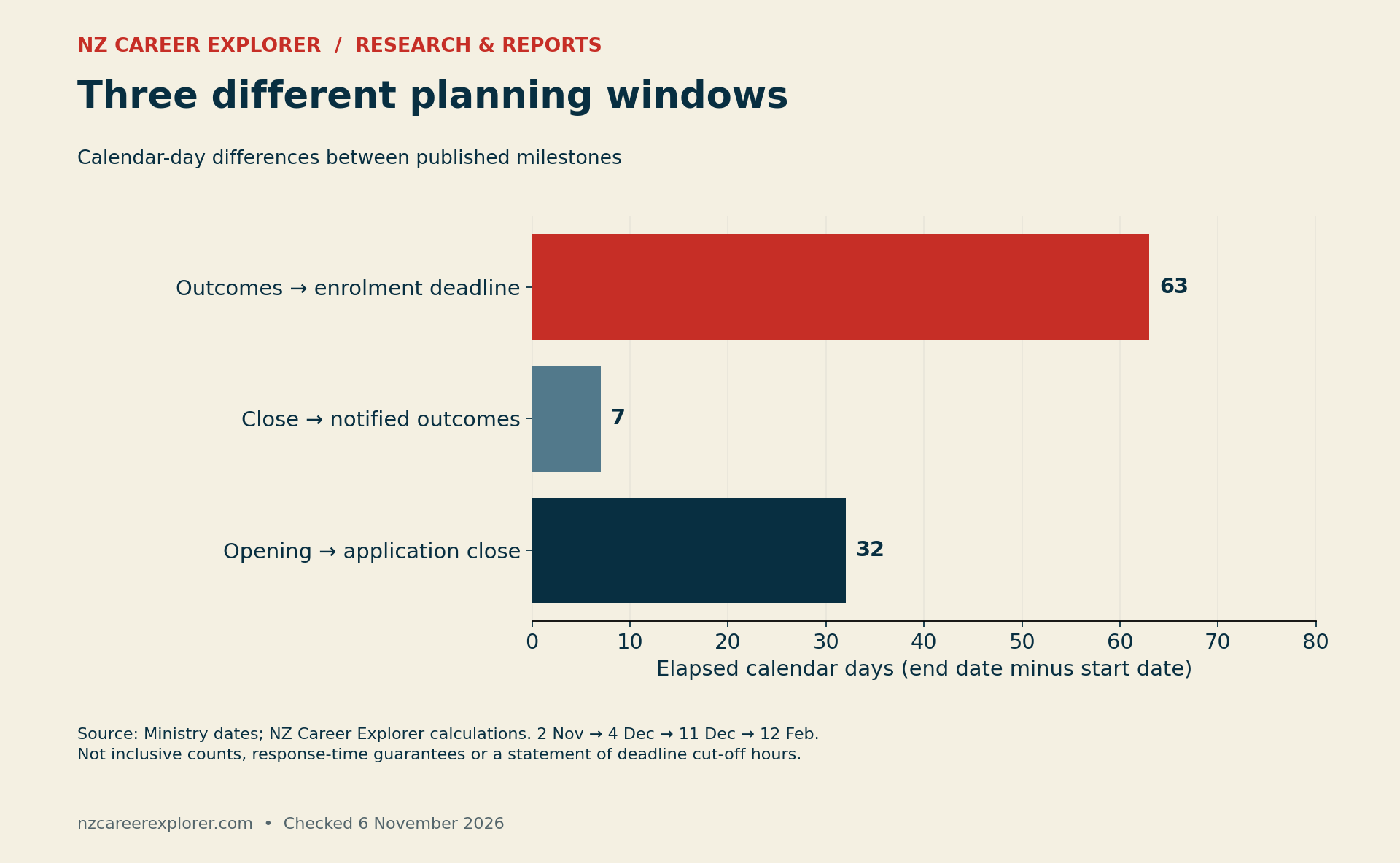
The 63-day interval includes the summer period. As a practical planning measure, agree a school contact and follow-up date before the holiday break. The interval itself does not prove a provider will have space throughout that period.
Count activities without inventing teaching-release days
The official minimum combines two different activity types. Four workshops are full days; the eight communities of practice are sessions whose durations need confirmation.
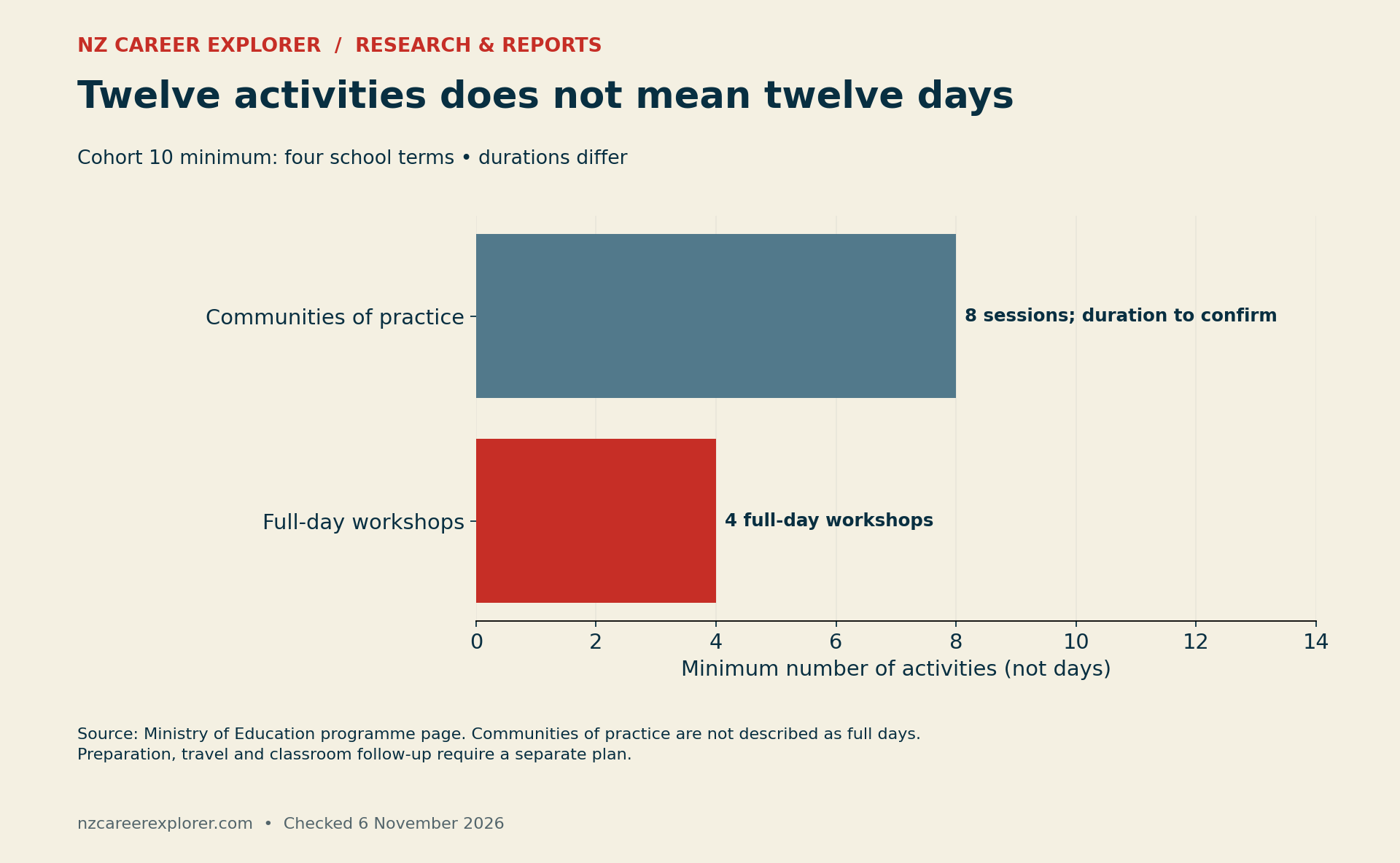
Ask your provider for the dates and lengths before promising attendance. Also ask about preparation, classroom follow-up, catch-up arrangements and delivery format. A virtual session may remove travel while still requiring protected time and a suitable space.
For example, eight one-hour community sessions would total eight hours. Eight sessions of 90 minutes would total twelve hours. Two-hour sessions would total sixteen hours. These are illustrative assumptions, not reported provider durations or measured teacher workload.
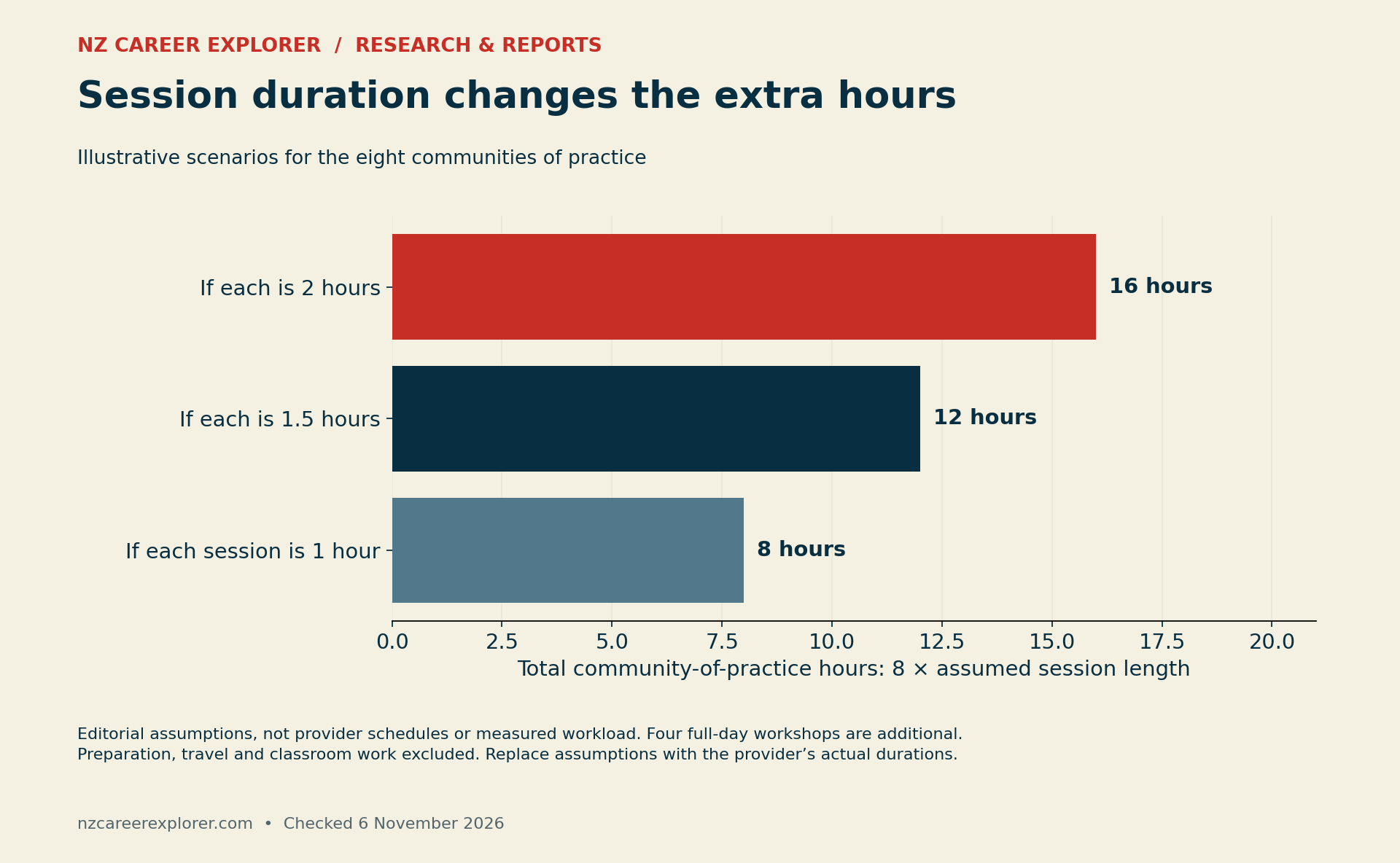
Do not convert a full day into an assumed number of hours without explaining the convention. Our worksheet keeps workshop days and other hours in different fields. This avoids a precise-looking total built from missing information.
Funding: separate the provider fee from school release
The Ministry says it pays PLD costs directly to providers. It also provides teacher release funding for the four full-day facilitated workshops, paid directly to schools and kura in the third term of the PLD.
However, release funding has a narrower role rule than the programme’s general accessible-role list. It applies to full-time or part-time teachers and staff employed at the school under a Limited Authority to Teach. Do not infer that every eligible specialist, principal or reliever automatically receives the same release funding.
Therefore, ask your school to confirm the participant’s funding position and its cover arrangements. Payment in Term 3 also creates a timing question: how will the school organise earlier workshops? This is a planning question, not evidence that the programme is unfunded.
The programme page does not establish every travel, accommodation, material or community-session release cost. Keep those entries as unknown until confirmed, rather than entering zero. Seek written inclusions from your provider and a school agreement about any remaining costs.
Compare providers on fit, rather than list size
Our count of the official tables found 15 English-medium provider rows and seven Māori-medium provider rows. Nested facilitator organisations under a single provider row remain within that row.
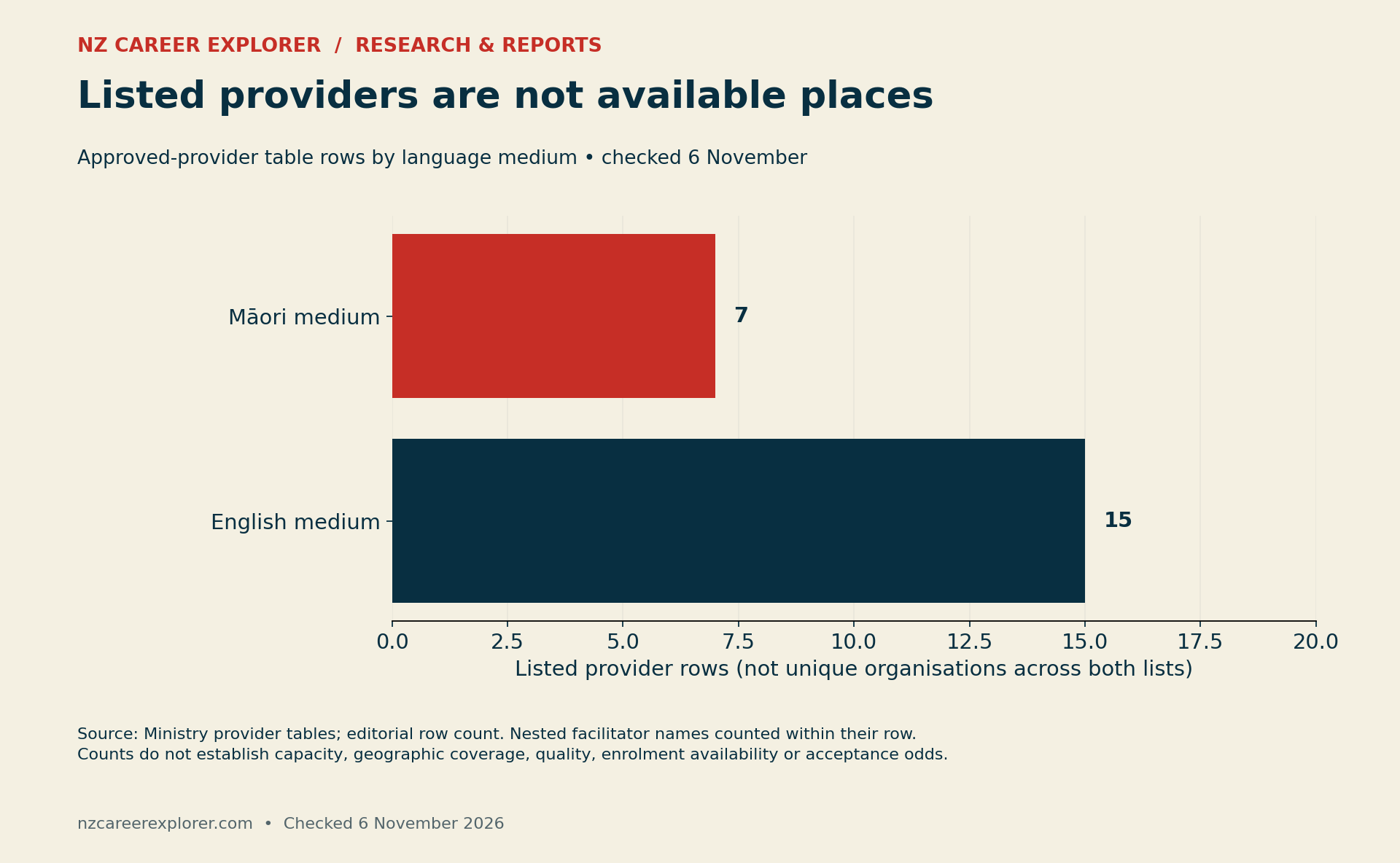
Start with the language medium and your teaching context. Next, compare actual locations, dates, remote options and how the provider supports implementation. A long list does not establish local availability or make one provider the best choice for your school.
Ask the same questions of each plausible option. That creates a fair comparison without turning an incomplete directory into a quality league table. The official programme page links to each provider’s own offering.
Download the planning pack
The four files below are reusable editorial tools, not Ministry forms. They contain official facts, explicit calculations or blank fields. No school, teacher or provider has been assessed through these worksheets.
- Official dates, requirements and calculation data (CSV) records the checked source, units and whether each value is official, counted or illustrative.
- Four-term workload grid (CSV) leaves provider dates, workshop days, other hours, cover and costs blank for confirmation.
- Eligibility and enrolment checklist (CSV) begins with unknown answers so an unchecked field cannot look approved.
- Funding and provider questions (CSV) separates verified funding statements from questions your school still needs to resolve.
First, enter the provider’s confirmed schedule. Then record the school’s release plan and any unresolved costs. Finally, check the application and enrolment milestones against the official page again. Keep participant information private and avoid adding pupil data to a professional-learning planner.
Transform Your Career with a Professional CV and Cover Letter
Stand out to employers with an ATS-optimized resume and tailored cover letter designed to match your dream role. Let us craft your job application materials for success!
Get StartedQuestions to settle before committing
- Which school, year-level, role and prior-training criteria apply to this participant?
- Who will apply, retain the ARN and confirm provider enrolment?
- What are the exact workshop dates and community-session durations?
- What preparation, implementation and travel time should the school plan?
- Does the participant meet the separate teacher-release funding rule?
- How will cover be arranged before the third-term release payment?
- Which costs remain unconfirmed, and who will give a written answer?
These questions make structured literacy PLD 2027 easier to evaluate as a professional commitment. They do not establish an acceptance rate, a salary increase or a particular classroom outcome. None of those outcomes was verified for this cohort.
Sources and method
The Ministry programme page is the controlling source for dates, eligibility, minimum structure, provider listings and funding statements in this guide. We checked it on 6 November 2026 and retained the source text. The Ministry’s PLD news listing dates the Cohort 10 announcement to 3 November; the programme table gives the opening date as 2 November.
We counted table rows rather than nested facilitator names. Calendar intervals use ordinary end-date-minus-start-date arithmetic. Community-session scenarios multiply eight by explicitly assumed durations. The workload grid is a proposed planning aid, not a record of observed attendance or costs.
The featured artwork is a stylised conceptual scene. The interior timeline explains the actual application and enrolment sequence; the charts distinguish official counts from illustrative hours. Readers may reuse our original calculations and graphics with attribution to NZ Career Explorer and links to the official source and this article. Official source material remains subject to its own terms.


