







Casual vs fixed-term jobs NZ searches often start with the hourly rate. The more useful comparison also asks how many hours are confirmed, how long the work lasts and whether the actual work pattern matches the contract. However, a higher rate with uncertain shifts may not provide the income you expect.
Stats NZ’s September 2026 release reports growth in both casual and fixed-term paid employees. Our three charts separate those survey estimates from a fictional offer comparison. A free 13-week calculator, comparison infographic and four CSV downloads help you record evidence without turning expected hours into guaranteed earnings.
Casual vs fixed-term jobs NZ: what changed in the data
The Stats NZ release published 4 November 2026 reports 116,900 casual paid employees, up 19,100 over the year. Fixed-term paid employees reached 50,900, up 8,100. The reported annual increases were 19.5% and 18.9% respectively. These employment-type estimates are not seasonally adjusted.
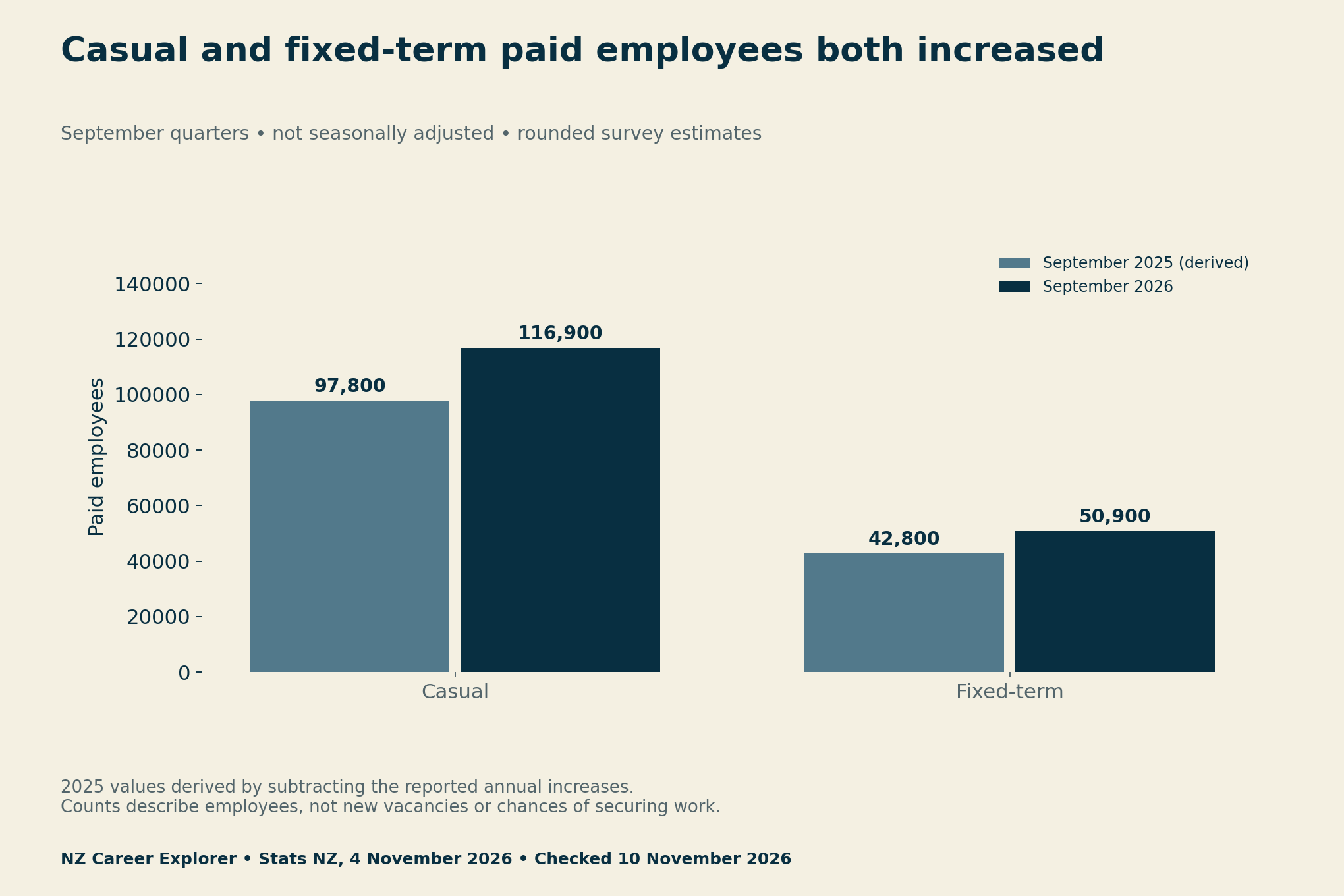
Together, these two types rose from a derived 140,600 to 167,800: an increase of 27,200, or about 19.3%. That combined calculation does not cover every non-permanent category. It also does not mean 27,200 additional vacancies are available now. Survey estimates describe people already employed at the measurement point.
The source’s wider labour-market release has other measures with different definitions and adjustments. Do not mix an unadjusted employment-type count with a seasonally adjusted unemployment rate to estimate your personal hiring chance. Therefore, a national movement cannot establish the conditions of a particular offer.
Most paid employees were still permanent
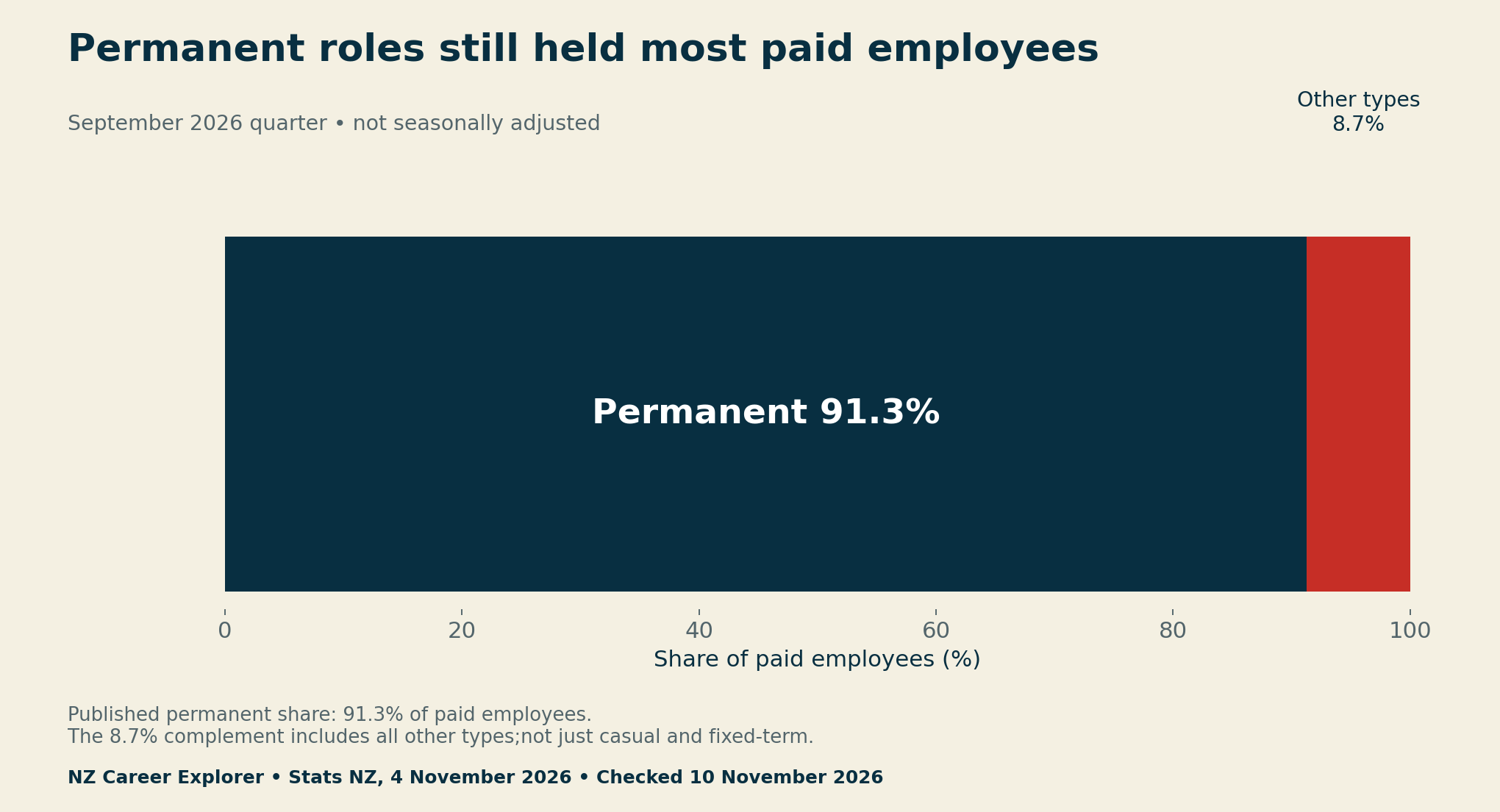
Permanent positions accounted for 91.3% of paid employees in the September 2026 quarter, not seasonally adjusted. The denominator is paid employees, rather than every employed person. Self-employment and employee status are different questions. The 8.7% arithmetic complement includes all other paid-employee types, not only casual and fixed-term.
Check the arrangement rather than relying on its label
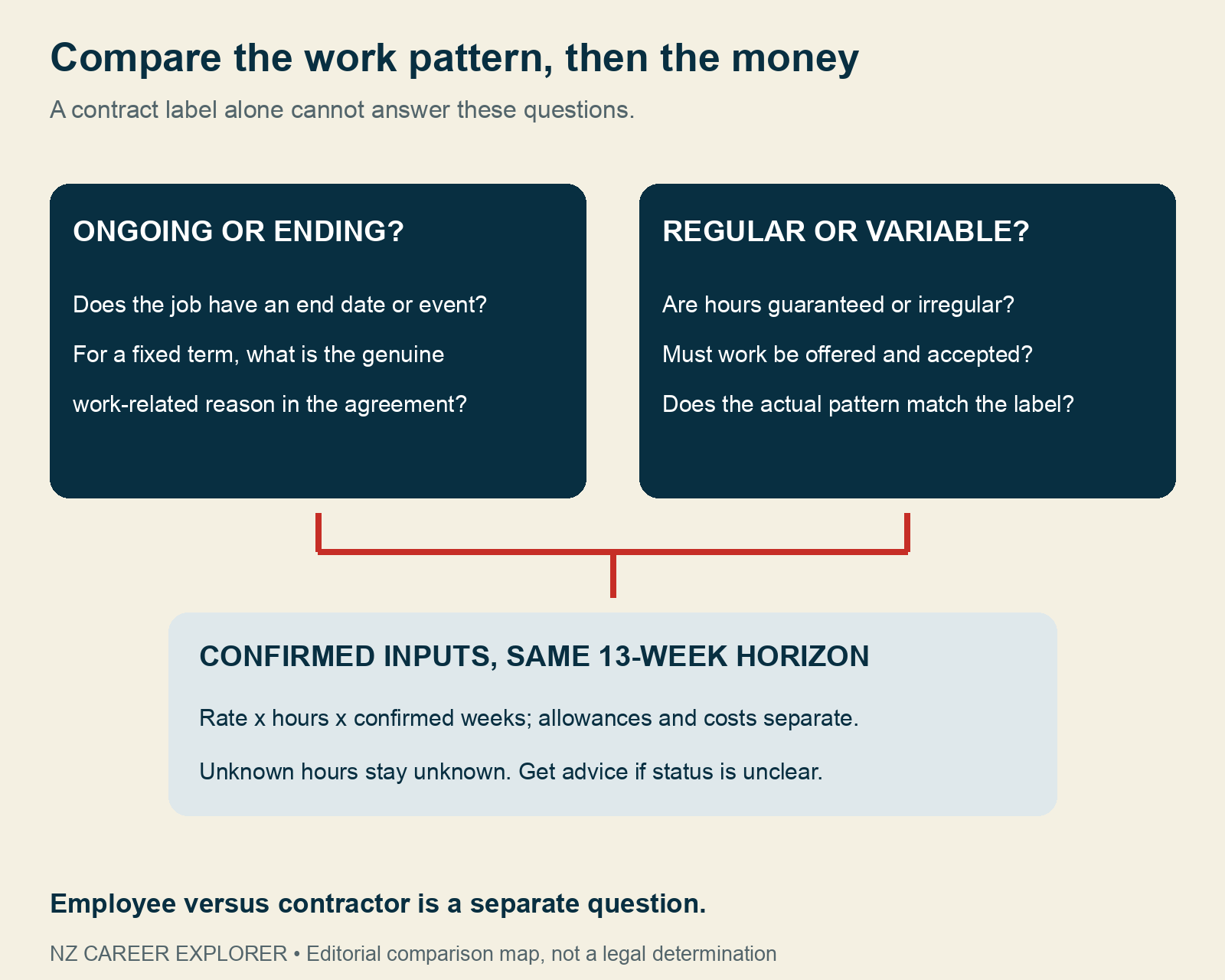
Employment New Zealand’s permanent and fixed-term guidance distinguishes ongoing employment from work ending at a specified date or event. Either can be part-time or full-time. A fixed term needs a genuine work-related reason on reasonable grounds, recorded in the agreement with how the employment will end.
A fixed-term employee is also different from an independent contractor. Do not decide that classification by using this calculator. Likewise, a trial of someone’s suitability is not itself a genuine reason for a fixed term. If the arrangement is unclear, obtain advice about the actual agreement and work circumstances.
The official casual-employment guidance focuses on the real pattern: irregular work, no expectation of ongoing employment, and the ability to decline offered work. A consistent roster or required availability can point to a different arrangement. In other words, calling a role casual does not settle its legal status.
Holiday treatment also needs a separate check. Casual status does not automatically justify pay-as-you-go holiday pay. For a qualifying fixed term of less than twelve months, the official guidance requires agreement and applicable conditions. We therefore do not add 8% automatically or use the tool to calculate leave entitlements.
Compare confirmed earnings over the same 13weeks
For the fictional examples, Offer A pays NZ$30 per hour for 20 confirmed weekly hours across 13 weeks. Its gross base pay is NZ$7,800. Offer B pays NZ$28 for 30 confirmed weekly hours across 10 weeks, giving NZ$8,400. In this example, the lower hourly rate produces more confirmed gross base pay because the other inputs differ.
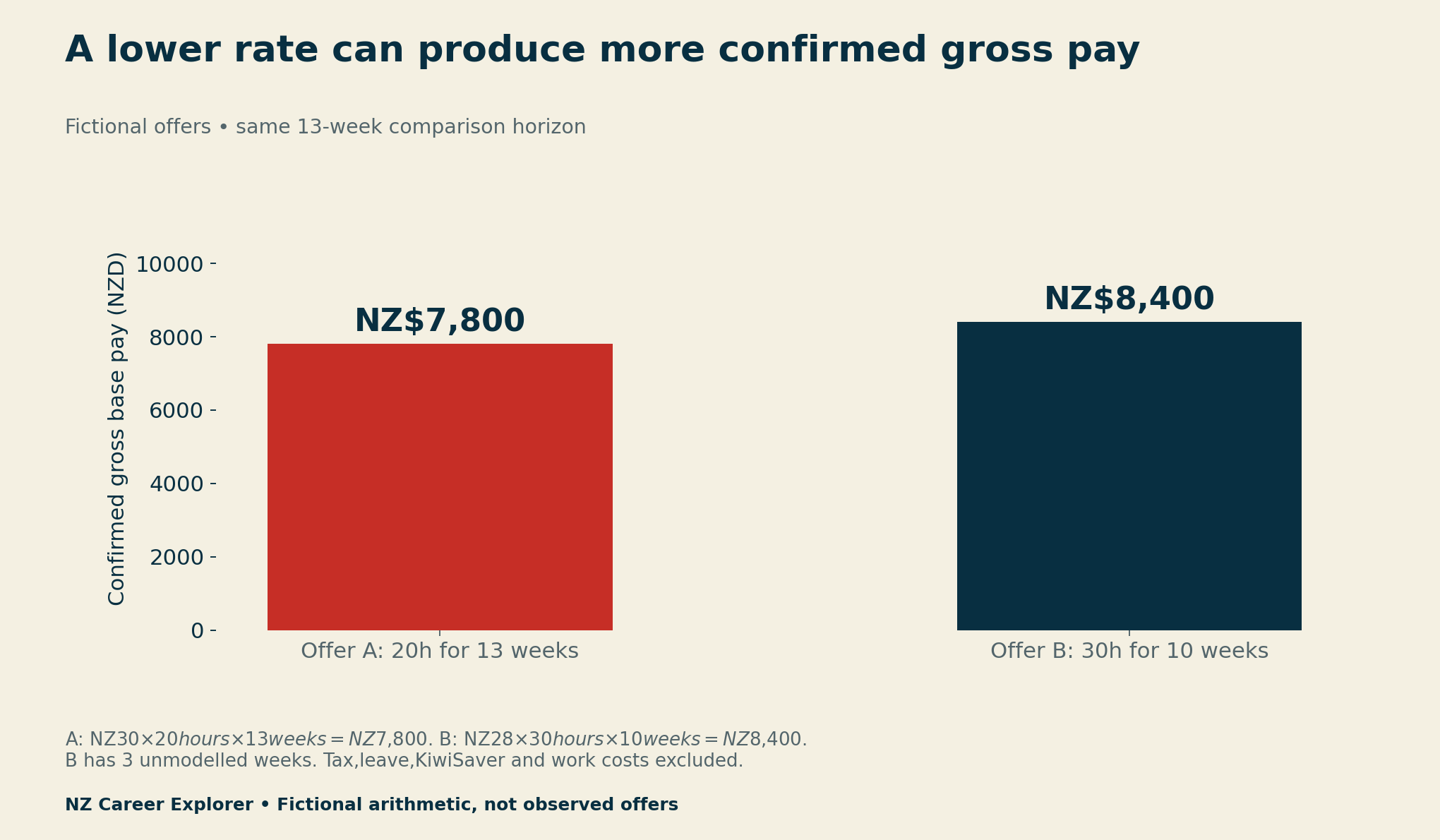
The formula is rate×confirmed weekly hours×confirmed weeks within thirteen. Then list entered allowances and work costs separately. The displayed subtotal adds the allowances and subtracts those costs from gross base pay. It is a comparison aid, not net wages, disposable income or a full measure of employment value.
If hours or weeks are unknown, leave the field blank. Instead, the calculator shows an unresolved result instead of substituting expected shifts. Zero is a valid confirmed value with a different meaning from missing information. You can enter fractional weeks, but every estimate should have a dated written basis.
13-week confirmed-pay comparison
Illustrative planning only. Enter confirmed inputs for each offer. Blank or invalid inputs produce no estimate. Weeks must be between 0 and 13. Allowances and costs cover those entered weeks.
Excludes tax, annual holiday and other leave entitlements, KiwiSaver, benefits and termination payments. The comparison subtotal is not take-home pay. We assume no earnings for weeks outside the entered confirmed period.
Personalized Career Consulting
Unlock your potential with expert career advice tailored to your goals. Get personalized guidance and actionable steps toward your dream career in New Zealand.
Get StartedTo compare an irregular pattern, enter a clearly documented equivalent only if it faithfully describes confirmed work over the period. Otherwise use the blank ledger to list shifts separately and keep the total unresolved. Do not invent a stable weekly pattern just to make two offers fit the same input fields.
Questions to settle before relying on either offer
Ask the employer to confirm guaranteed hours, the end date or event, any fixed-term reason, cancellation arrangements and how additional shifts are offered. Also, record the source and checked date. A verbal expectation of extensions is different from confirmed work. Therefore, the tool gives no earnings credit for an extension that has not been agreed.
Commute, equipment and other work costs can change the practical comparison. For consistency, enter costs for the same confirmed period as the pay, keeping a note of how you estimated them. Personal preferences, training, wellbeing and time commitments also matter, but this calculation does not assign them a fabricated money value.
Our NZ job-ad guide helps research where to look. Our construction pipeline guide shows why a headline does not confirm hours. Relevant newcomers should check work conditions and any occupation-specific requirements against the actual role, separately from this earnings arithmetic.
Download the evidence and comparison tools
- Employment-type source estimates and derived prior values (CSV)
- Fictional thirteen-week offer calculations (CSV)
- Blank offer evidence and hours ledger (CSV)
- Employment comparison measure dictionary (CSV)
Method, limitations and update trigger
Research checked 10 November 2026. For reproducibility, we retained the current Stats NZ release and Employment New Zealand guidance. Previous-year employment-type values are current count minus reported annual increase. The combined percentage uses the two derived prior counts as its denominator. Published counts are rounded survey estimates, so derived ratios need not reproduce every published percentage exactly.
The calculator processes inputs in the browser and sends no offer details to this site. Its fictional defaults are not researched pay offers. The tool excludes tax, KiwiSaver, benefits, leave and termination payments. Recheck the official guidance and source release when rules or data change; get individual advice for a disputed arrangement.
Suggested citation: NZ Career Explorer, “Casual vs Fixed-Term Jobs NZ: Compare Hours, Rights and 13-Week Pay,”10 November 2026. Credit Stats NZ for the survey estimates and this report for the calculations and tools. Use our contact page for corrections, without sending private employment documents publicly.


