







NZ construction jobs and building consents measure different things. Stats NZ reports 41,091 homes consented in the year ended September 2026, an 18% rounded annual increase. That is a useful pipeline signal. However, it does not tell an applicant which contractor has funded work, when a site will start or how many hours a job will provide.
This report checks the annual increase, housing mix and weaker monthly reading side by side. Four charts and a project-to-offer infographic explain the evidence. Four free CSV tools help you ask a contractor practical questions before paying for training, relocating or relying on a future start date.
What the September building-consent release measures
Stats NZ published its September 2026 building-consents release on 3 November. The figures count proposed work approved for construction. They are not a record of completed homes or a register of current vacancies. Some projects change timing after approval, and a consent does not identify the eventual workforce.
The annual total increased from 34,882 in the September 2025 year to 41,091 a year later. Our calculation gives 6,209 additional dwellings, or 17.8%. Stats NZ rounds the annual percentage to 18%. Both describe the same change at different precision; neither is a percentage rise in construction employment.
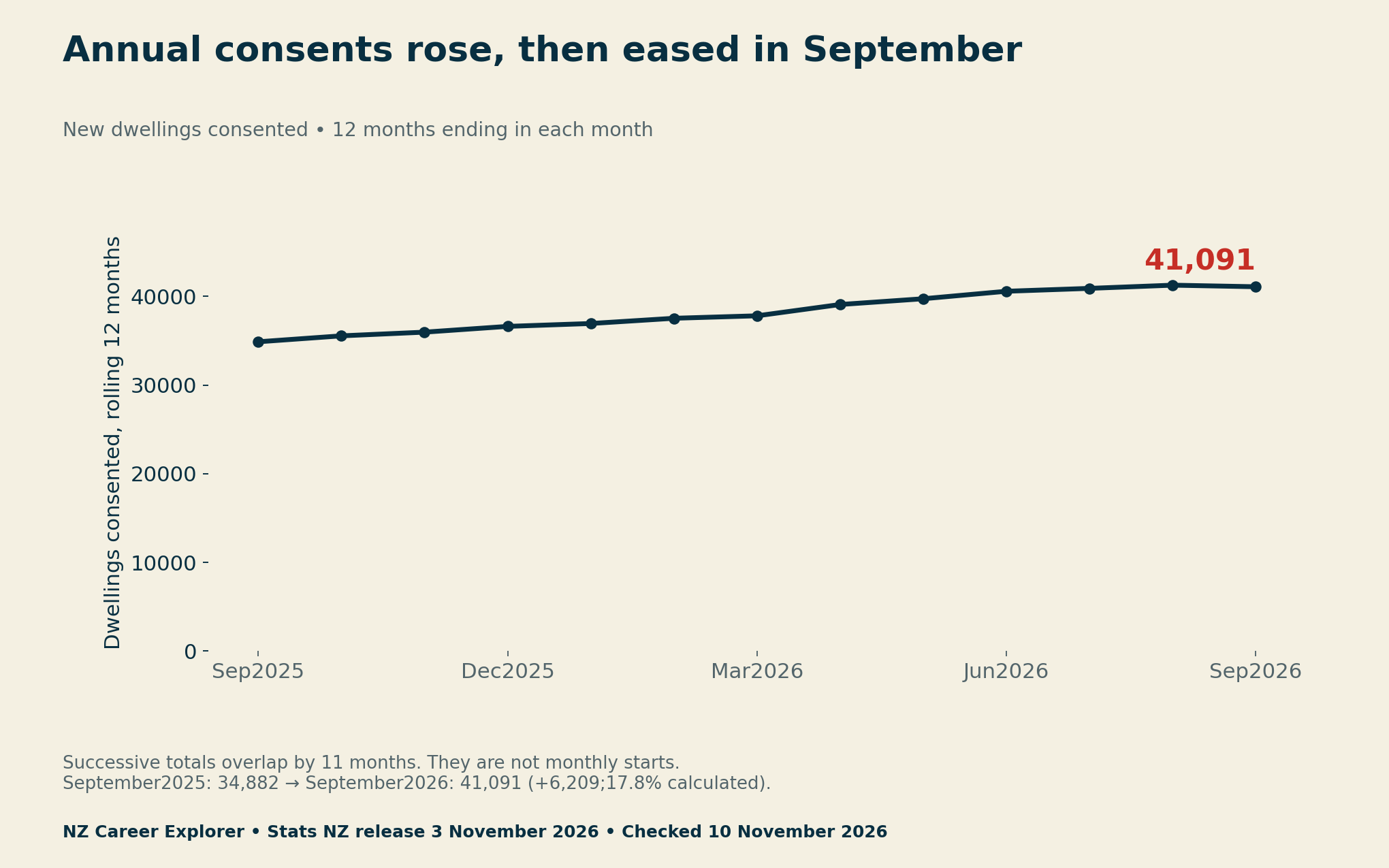
The chart uses the current table on the official stand-alone house news release. We retained the rendered values so readers can reproduce the series. A rolling annual line smooths monthly movement, but that also means it can stay strong while the latest month weakens.
Housing mix changes what you should investigate
The annual total includes 19,228 stand-alone houses and 21,863 multi-unit homes. The latter comprise 17,756 townhouses, flats and units, 2,356 apartments and 1,751 retirement-village units. These four exclusive categories sum to 41,091. Stand-alone houses account for 46.8% of the total, using unrounded counts.
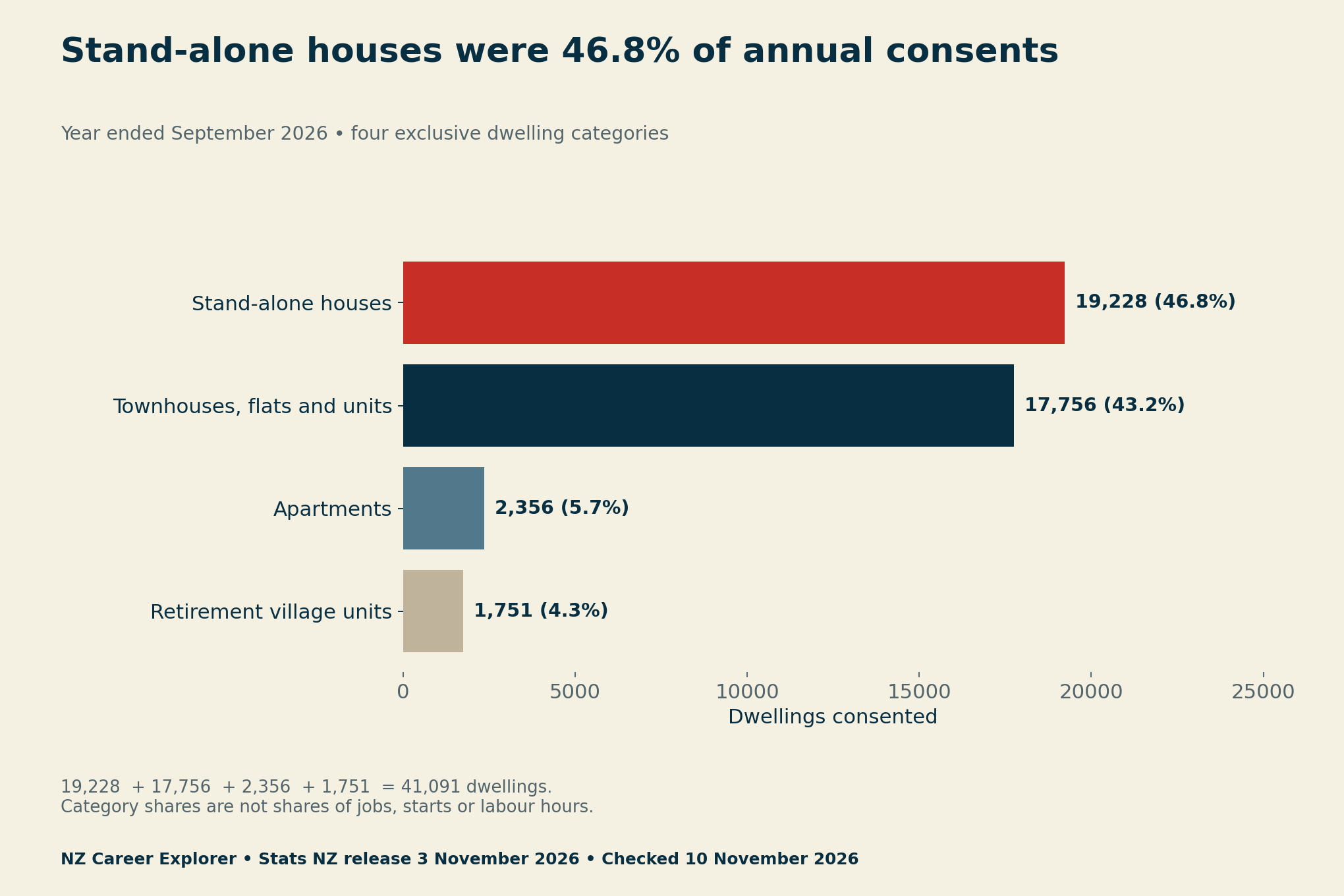
A residential carpenter, services apprentice and apartment-project coordinator should not assume an identical pipeline from the same national total. Instead, ask which project types the employer actually undertakes. A dwelling count does not convert into a reliable trade-hours estimate without project-level scope, stage and staffing information.
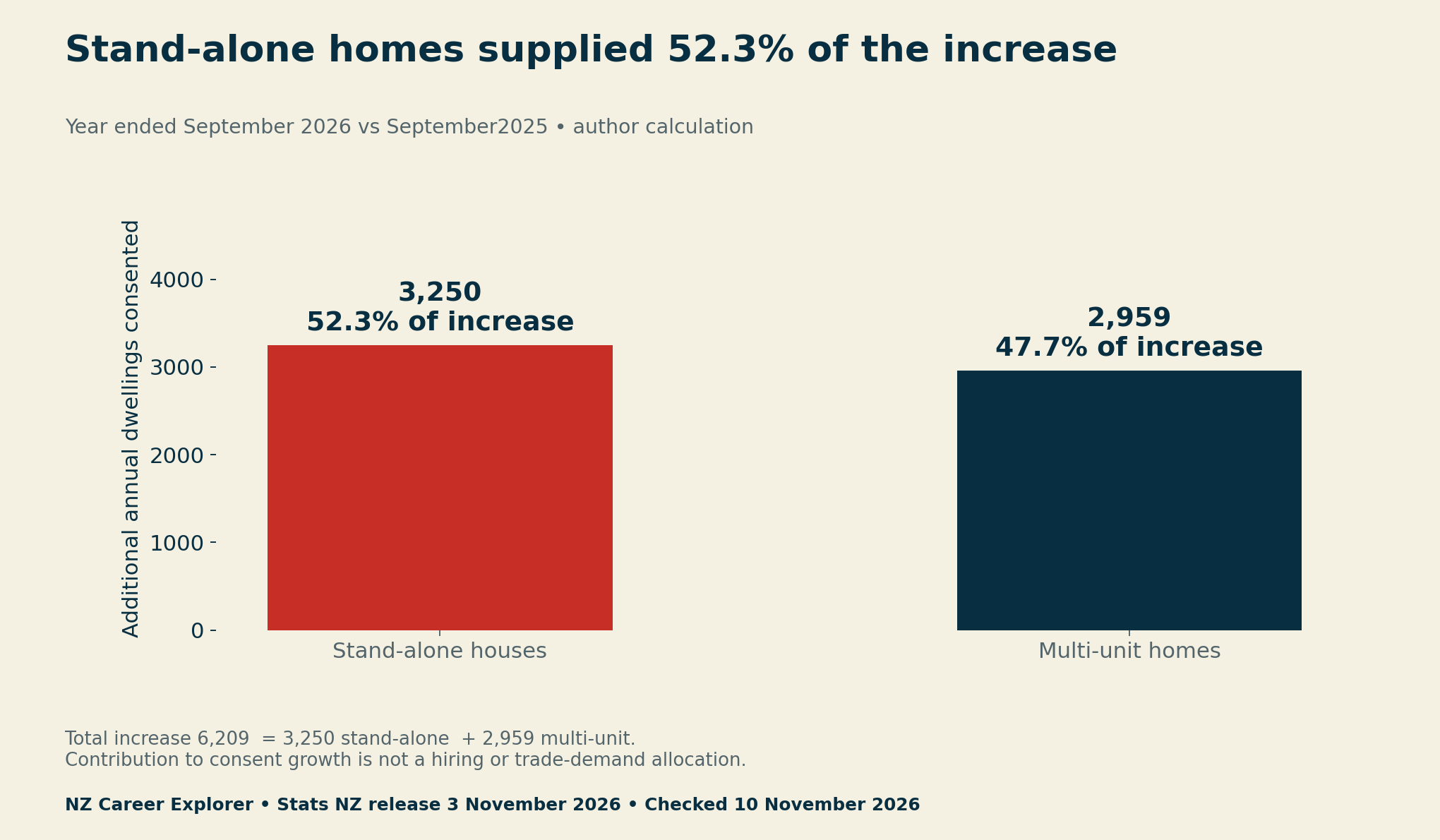
Stand-alone annual consents increased from 15,978 to 19,228, a gain of 3,250. Multi-unit consents increased from 18,904 to 21,863, a gain of 2,959. Dividing each gain by 6,209 gives 52.3% and 47.7% respectively. These are contributions to the increase, rather than shares of all current consents.
Why a monthly fall does not contradict annual growth
September’s seasonally adjusted new-dwelling count fell 7.9% from August, following a 5.3% rise in August. Meanwhile, the September rolling annual total remained above the previous September year. One comparison concerns neighbouring months after seasonal adjustment; the other compares actual twelve-month totals a year apart.
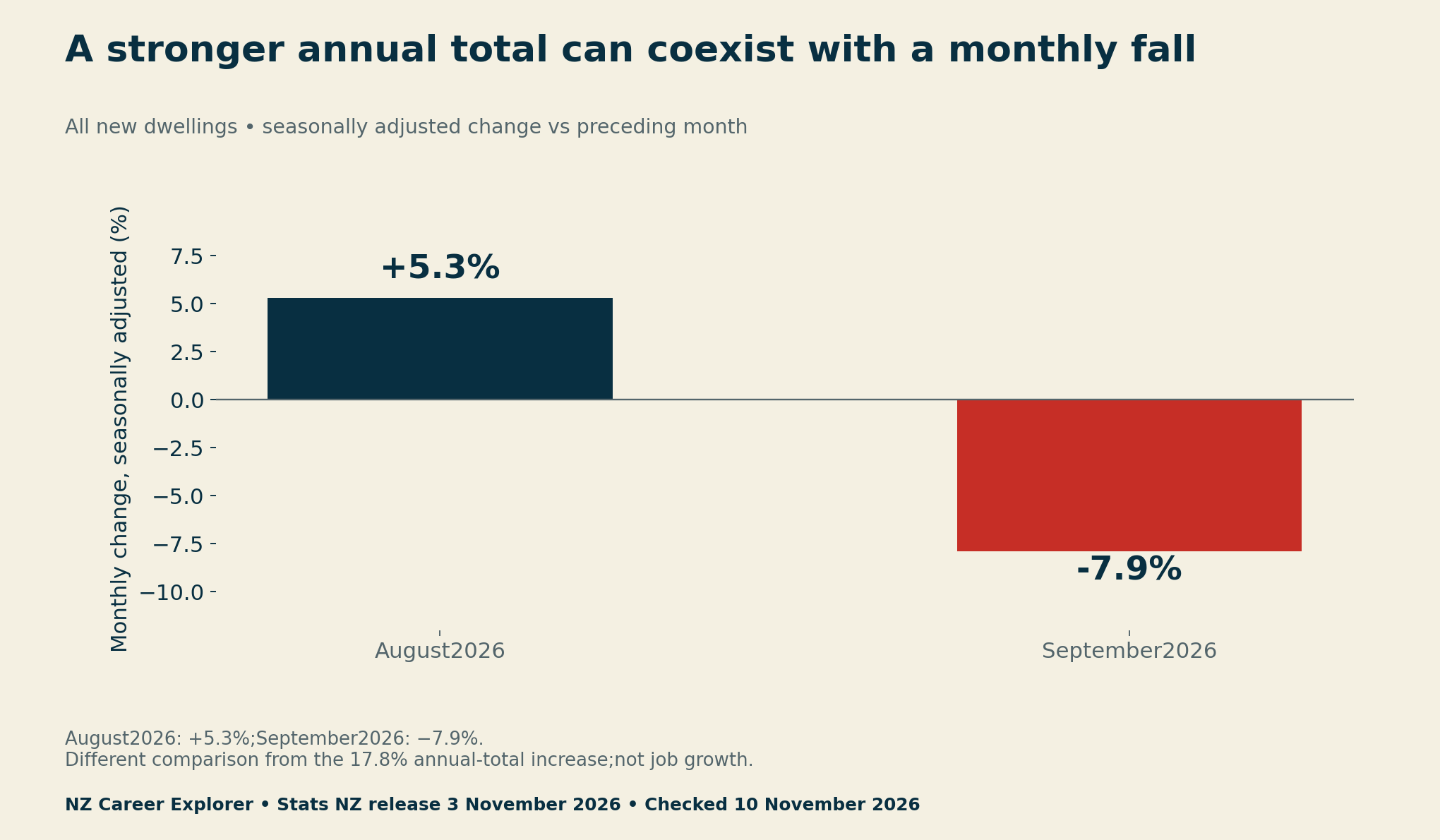
Stats NZ notes that large multi-dwelling projects can make monthly numbers vary. Consequently, a single strong month is a weak basis for a long training or relocation commitment. Read the series alongside an employer’s dated project evidence. Avoid turning a percentage headline into an assumed start date.
Use regional evidence without inventing a jobs ranking
Auckland recorded 6,426 stand-alone house consents in the annual period, while Canterbury recorded 4,831. Canterbury’s total across all dwelling types was 8,906. The denominators matter: the Canterbury all-home total cannot be compared with Auckland’s stand-alone number as if they measured the same housing category.
Regional consents can help select contractors to research. They cannot establish that an applicant should move, that a specific employer is hiring, or that a project is fully financed. Check the location of the actual work, travel expectations and whether hours are guaranteed in writing. Keep unanswered fields visibly unresolved.
Non-residential consents provide a separate context: their annual nominal value was NZ$8.7 billion, down 3.1%. This is money value, not a residential dwelling count. It can reflect price changes as well as project mix. Do not combine it with the dwelling totals or use it to infer employment growth.
A practical contractor interview for NZ construction jobs
Start with the consent or project reference, then ask whether the contract has been awarded and what evidence supports the expected start. Ask how much funded backlog relates to your actual trade package. A contractor may know more than the national release, but its answer still needs a date and a clear scope.
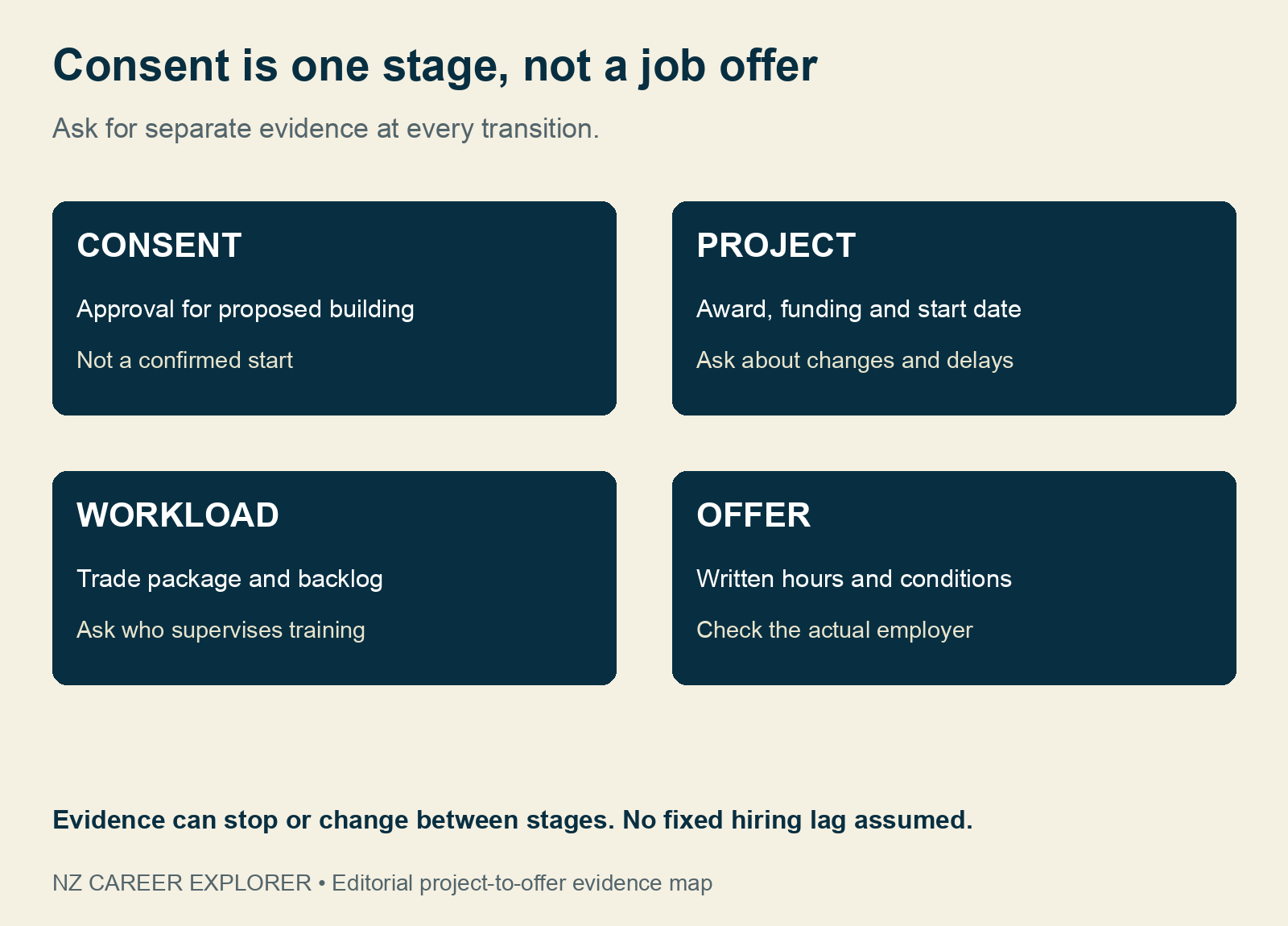
For an apprenticeship, ask who will supervise you and whether the work can support the required learning. Confirm paid hours, site travel, tools, training costs and who pays each cost. A promise of future work is different from an employment agreement. Do not fill an unknown start or hours field with a convenient estimate.
Personalized Career Consulting
Unlock your potential with expert career advice tailored to your goals. Get personalized guidance and actionable steps toward your dream career in New Zealand.
Get StartedOur Warkworth to Te Hana project-stage guide uses the same distinction between an announcement and a verified role. Our regional job-ad analysis adds another signal, but advertisements and consents still have different populations and purposes.
Relevant newcomers should also check work permission, qualification recognition and any occupational licensing attached to the actual role. A rising consent series does not remove these requirements. Confirm the employer, duties and written terms before making a financial commitment based on expected construction work.
Download the data and contractor interview tools
- Rolling annual building-consent source data (CSV)
- Consent growth, mix and monthly calculations (CSV)
- Blank contractor workload and supervision interview sheet (CSV)
- Construction signal and evidence dictionary (CSV)
Method, limits and next update
Research checked 10 November 2026. We extracted the 13 rolling annual observations from September 2025 through September 2026 from the current official chart table. We checked all-home totals against stand-alone plus multi-unit values, reconciled the four annual categories, and calculated growth and contribution percentages before rounding to one decimal.
This is desk research, with no contractor interviews, vacancy census or measured consent-to-start lag. The blank interview sheet is a tool to collect evidence, not evidence already collected. Stats NZ schedules its October 2026 release for 2 December 2026; any revision or new release should trigger a fresh source check and recalculation.
Suggested citation: NZ Career Explorer, “NZ Construction Jobs: What September Building Consents Really Signal,”10 November 2026. Credit Stats NZ for the underlying consent counts and this report for its calculations and interview framework. Send a correction through our contact page with the measure, period and original source.


