





Interest in natural hydrogen careers NZ has a fresh research hook: a government announcement of up to NZ$17.8 million for early-stage exploration. For someone considering study or a career change, however, funding is a reason to investigate the work—not proof that a suitable job is available.
This guide separates the funding arithmetic from an editorial skills map. It compares subsurface, laboratory and data work with green-hydrogen electrolysis research. You can then use the downloadable evidence register to decide which existing skills deserve a closer look before paying for retraining.
We checked the sources on 6 November 2026. No vacancy count, salary sample, individual hiring requirement or retraining return was verified for the funded project. The matrix below is an interpretation of research methods, not a list supplied by its employers.
What the new funding announcement establishes
The 5 November government release announces an up-to-NZ$17.8-million grant from the Regional Infrastructure Fund. Earth Sciences New Zealand leads the two-phase programme with the University of Canterbury and University of Auckland.
The release describes natural and orange hydrogen exploration beginning near Bluff, plus investigation of a prospective North Island drilling location. It places the grant within a NZ$30-million hydrogen package. Research data is intended to be open access; that intention does not establish when a particular dataset will become available.
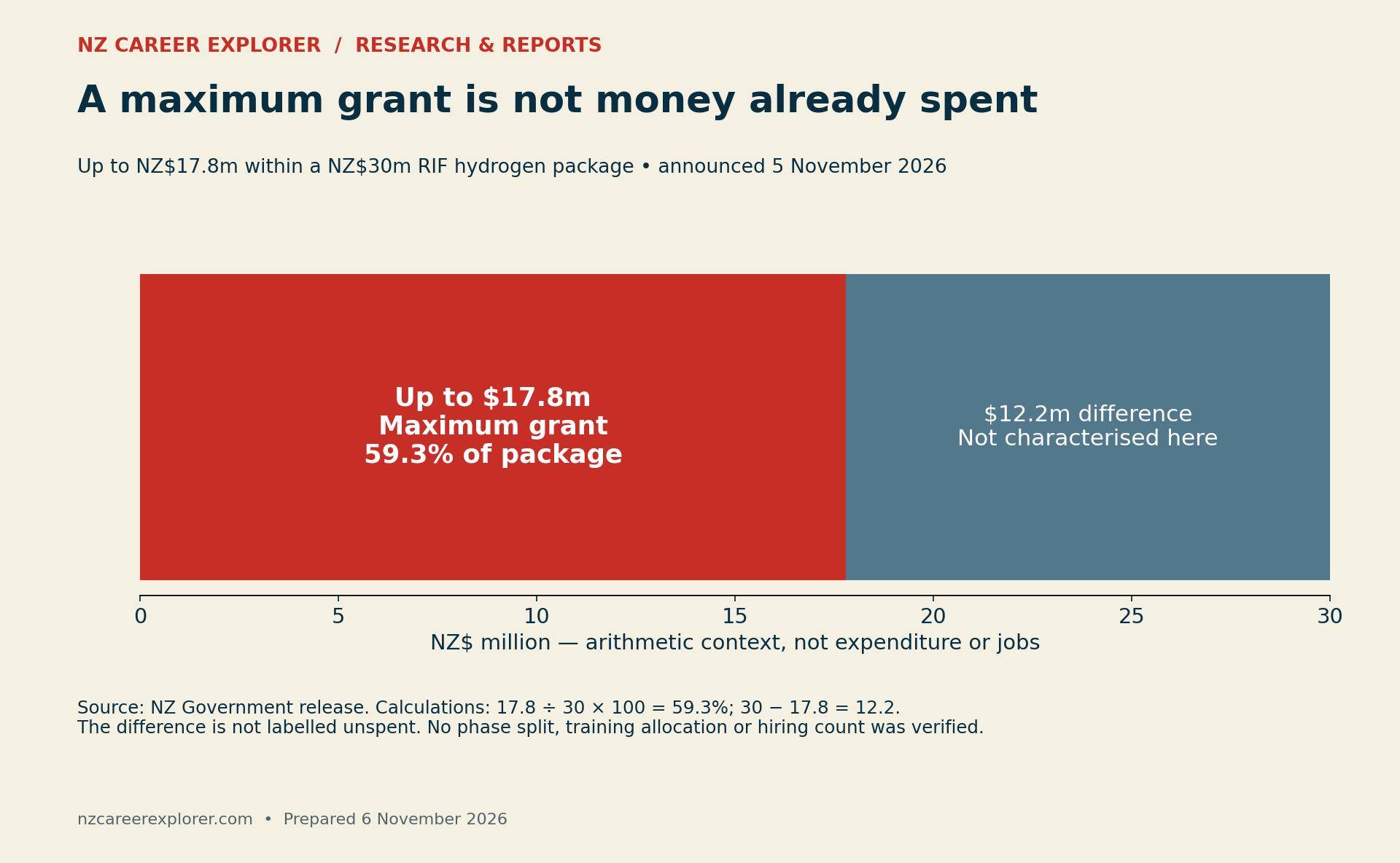
The arithmetic is straightforward: 17.8 ÷ 30 × 100 = 59.3%, rounded to one decimal place. Yet its meaning is narrow. It compares a maximum grant with an announced package. It cannot show how much has already been paid, what each research phase costs or how much supports recruitment.
Similarly, NZ$12.2 million is the difference between those two figures. We label it not characterised here, rather than unspent. Turning an unexplained difference into a spending claim would add information that this analysis has not verified.
For a career decision, keep a separate row for actual opportunities. Record a current employer advert, its requirements and its closing date. A funding headline belongs in the context column, not the confirmed-vacancy column.
Natural, orange and green hydrogen involve different questions
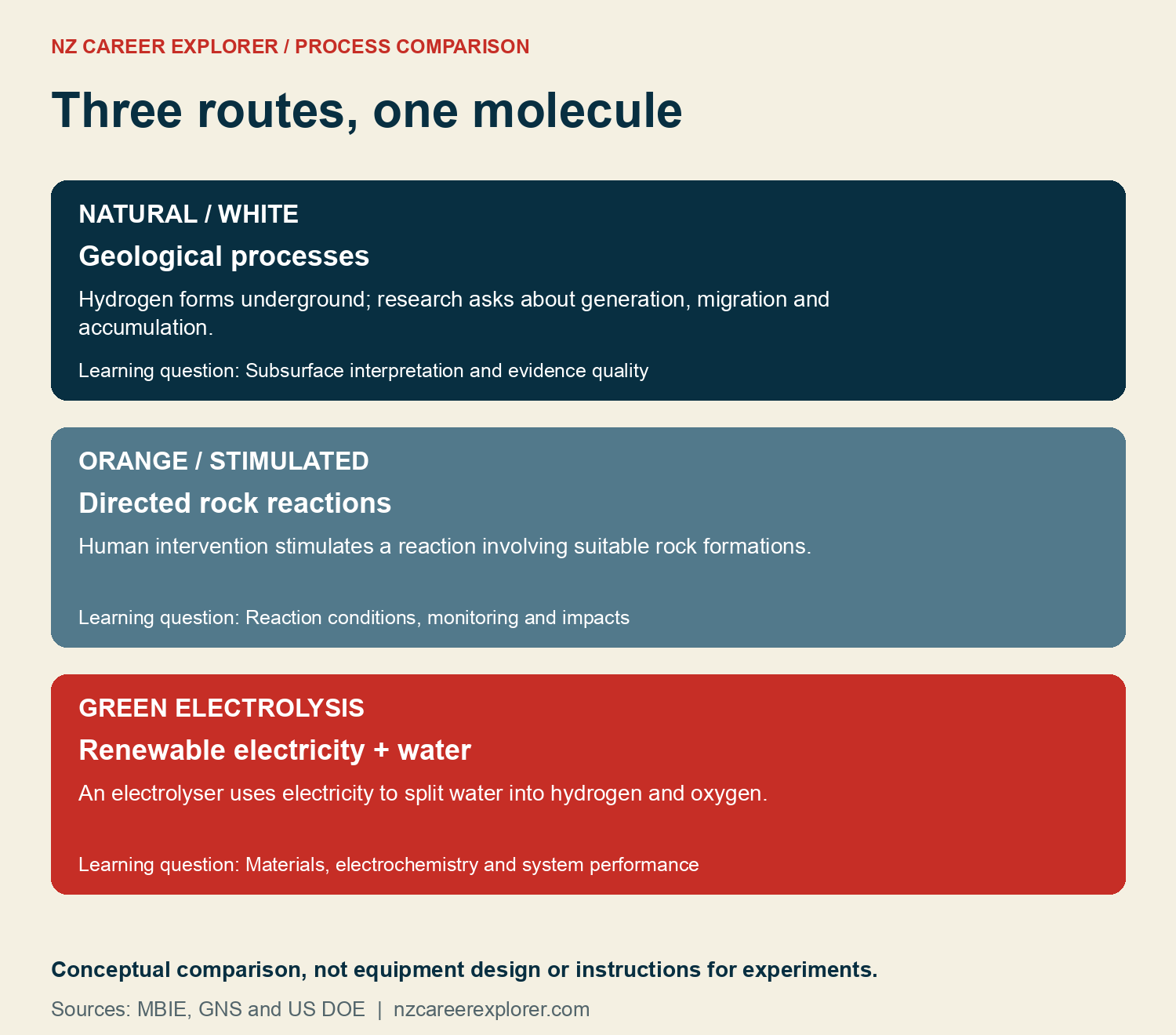
Hydrogen colour labels describe production routes; they are not occupational qualifications. The same molecule can be studied through different processes, instruments and evidence.
In its natural-hydrogen background, GNS describes hydrogen generated through underground rock-and-water processes. Its April 2025 explanation predates the new funding announcement. It supplies scientific context, not a current recruitment notice.
The MBIE discussion-document introduction, last updated in May 2025, distinguishes natural generation from stimulated orange-hydrogen production. It also identifies limited understanding of economic resources and evolving exploration methods. This is dated background, not a statement that all proposed regulatory arrangements are already final law.
For green hydrogen, the defining link is renewable electricity used in electrolysis. GNS’s green-hydrogen explainer describes that route. The US Department of Energy electrolysis guide explains the equipment’s water-splitting process and differing electrolyser technologies.
Consequently, “I have worked with hydrogen” is too broad a career claim on its own. Describe the method, your responsibility, the quality controls and the evidence you produced. Then compare that record with the specific work you want to pursue.
Natural hydrogen careers NZ: a transferable-skills matrix
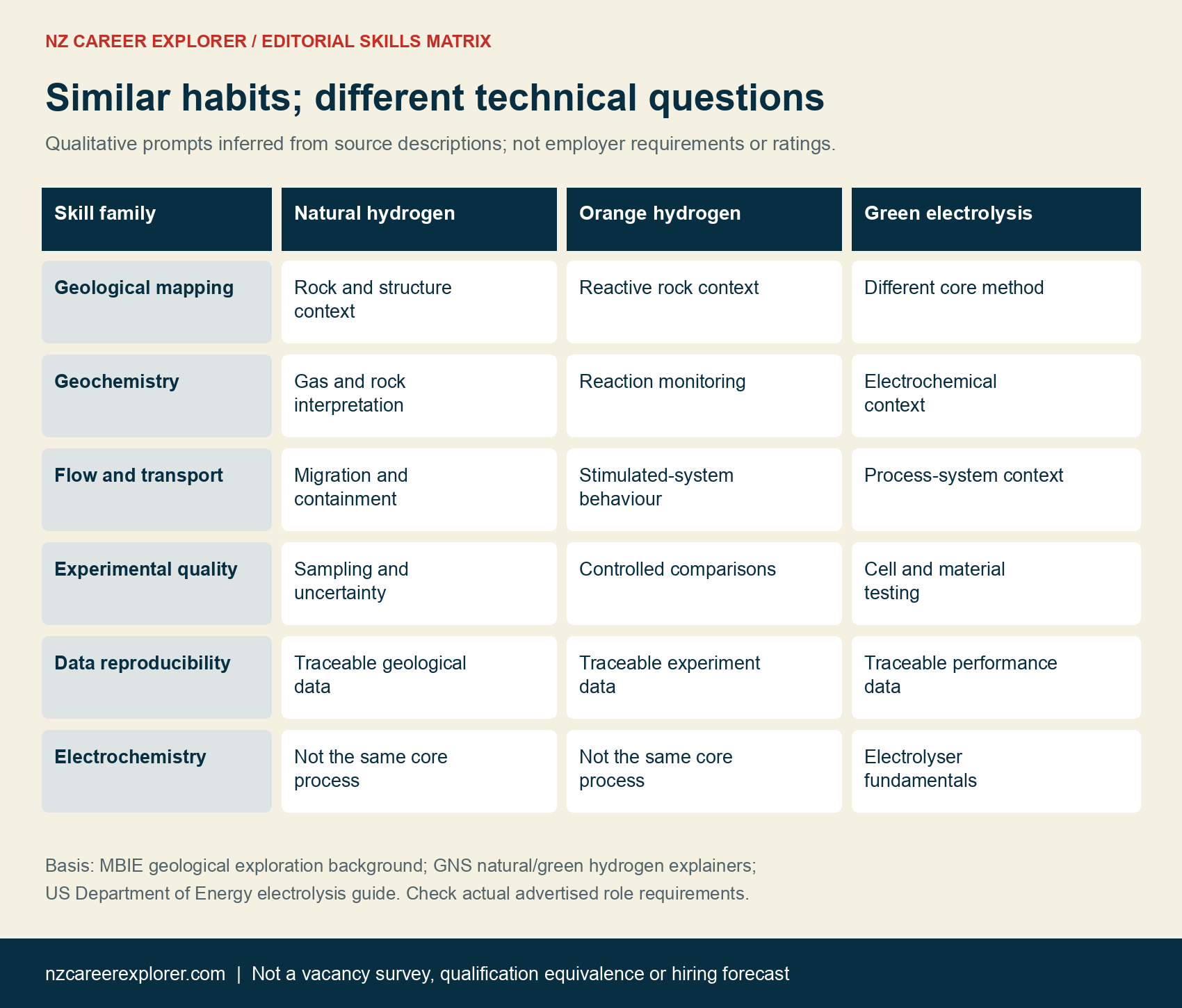
The matrix organises six skill families across three research routes. Its cells are qualitative prompts. They do not score people, rank courses or establish that a hiring manager will accept a particular background.
Subsurface and geological experience
If your background involves geological maps, rock descriptions or subsurface models, identify the exact evidence you can show. For example, a documented interpretation can explain the source, scale, assumptions and uncertainty in a geological dataset.
Personalized Career Consulting
Unlock your potential with expert career advice tailored to your goals. Get personalized guidance and actionable steps toward your dream career in New Zealand.
Get StartedThe transfer question is whether you understand how a geological explanation is tested. A general map does not prove the presence of a commercially recoverable resource. Nor does experience with one resource automatically qualify someone to plan drilling or approve a different project.
For a desk-based learning sample, compare public source descriptions and write an uncertainty note. State what the material can support and what new observations would be needed. Avoid presenting an illustrative cross-section as a verified model of the Bluff site.
Laboratory and geochemical experience
Laboratory work can offer transferable habits such as sample traceability, calibration records, controlled comparisons and careful reporting. However, the relevant instruments, materials and safety requirements depend on the actual work.
Your portfolio might explain a past, authorised quality-control task without disclosing confidential data. Alternatively, create a clearly labelled mock record to show how you would document uncertainty. Keep a mock result separate from a measurement you actually made.
Do not attempt hydrogen generation, gas handling or unsupervised experiments for a portfolio. A safe desk-based exercise can demonstrate reasoning. Practical work belongs within appropriate training, facilities, supervision and authorisation.
Data, coding and reproducibility
Data skills can help make assumptions and transformations visible. A useful sample might show a small, openly licensed dataset, a data dictionary, reproducible cleaning steps and a short explanation of missing values.
Choose a task whose provenance you can verify. If you cannot obtain suitable project data, do not invent a project dataset and present it as released research. Instead, label a synthetic example and explain what it demonstrates.
The skills map therefore treats data reproducibility as a shared habit across routes. That does not establish equal demand for analysts in each route. A current role may require substantial domain knowledge alongside programming or statistics.
Electrochemistry and process-system experience
Electrolysis research brings a different core process into view. Materials, cells, electrical inputs and system performance may matter in ways that a geological map does not capture. The DOE guide provides a starting point for understanding those distinctions.
If you already have relevant engineering or chemistry experience, document the particular methods you used. Then ask an adviser which gaps need formal study and which can be explored through introductory reading. Do not assume that a general hydrogen course covers every pathway equally well.
Build evidence before buying a new qualification
A useful next step should remain valuable even if this specific project never advertises a role that fits you. Begin with one skill claim, one evidence item and one unresolved question.
For instance, “I can document a reproducible data transformation” is more testable than “I am ready for the hydrogen sector.” Attach a small work sample and explain its limits. If your evidence concerns an unrelated dataset, say so clearly.
Our employer-shortlist guide helps separate employer context from actual advertised roles. The Mātai research-career analysis offers another example of keeping future research ambitions distinct from current opportunities.
Before paying for study, compare prerequisites, cost, time, assessment and access to supervised practical work. Ask whether the learning outcome addresses a verified gap. A programme’s broad branding is not enough to establish that fit.
Transform Your Career with a Professional CV and Cover Letter
Stand out to employers with an ATS-optimized resume and tailored cover letter designed to match your dream role. Let us craft your job application materials for success!
Get StartedFor newcomers, check work rights, qualification recognition and any role-specific requirements independently. Neither a funding announcement nor a work sample establishes visa eligibility, professional recognition or New Zealand work experience. Keep these checks separate from your technical learning plan.
Download the research-skills planning pack
These four CSVs preserve the distinction between sourced facts, editorial interpretation and your own blank planning fields. They contain no assessed candidates, live job listings or measured career outcomes.
- Funding figures and calculation data (CSV) records the grant ceiling, package, derived share and uncharacterised difference with units and cautions.
- Transferable-skills matrix (CSV) provides the six qualitative skill families, three pathway prompts and source basis.
- Blank portfolio evidence register (CSV) leaves six entries for your claims, evidence, assumptions and next questions.
- Study and careers adviser questions (CSV) keeps unanswered questions visibly unknown until you verify them.
First, choose one claim you can support today. Next, add a safe evidence item and identify the gap. Finally, decide whether the next action is reading, a discussion, a supervised learning opportunity or a relevant application. The worksheet does not calculate a probability of employment.
What the evidence cannot tell you
The announcement does not establish a vacancy total, salary distribution or a job guarantee. Our review also did not verify an individual recruitment specification, course endorsement or retraining return for the programme.
Research funding does not prove commercial viability. Likewise, finding a geological process is different from demonstrating a commercially recoverable resource. Environmental impacts, operating conditions and economic questions require their own evidence; the skills matrix does not resolve them.
Use natural hydrogen careers NZ research as a way to ask better questions. A stronger decision rests on your actual evidence, the requirements of a real opportunity and a learning step that remains useful under uncertainty.
Sources and method
The fresh news hook is the government’s 5 November 2026 funding release. Scientific background comes from the April 2025 GNS natural-hydrogen article, the May 2025 MBIE discussion-document introduction, the GNS green-hydrogen explainer and the US DOE electrolysis guide. We distinguish their dates and purposes rather than presenting older context as new project results.
The funding chart uses simple arithmetic on the announced maximum and package. The qualitative matrix and comparison infographic are our interpretations of source-described methods. No vacancy scraping, salary survey, candidate assessment, laboratory experiment or employer consultation was performed.
The featured image is stylised conceptual artwork, not a photograph of the funded project or a named researcher. Cite the official bodies for their source findings and NZ Career Explorer for the original skills framework and worksheets. Our original graphics may be reused with attribution and a link to this article; underlying sources retain their own terms.


