





Rural allied health jobs NZ employers advertise deserve a closer look than the salary alone. Before accepting, check who supports your practice, how travel fits into paid hours and what happens during leave. Then compare development opportunities with the practical demands of living in the area.
This report brings together national workforce data, rural workforce research and one current employer advertisement. Our original comparison worksheet helps you turn broad promises into specific questions. It does not rank employers or predict whether an individual job will suit you.
Checked 24 October 2026. Five visuals distinguish reported figures, older research, an advertisement example and invented workweek scenarios. The downloadable worksheet lets you compare two offers without treating missing information as a positive answer.
Rural allied health jobs NZ: what the numbers show
The Health and Independence Report 2025, Table 9 counts 36,638 practitioners across selected allied health professions in 2025. That is 1,001 more than in 2024 and 5,577 more than in 2020. Subtraction gives earlier totals of 35,637 and 31,061 respectively.
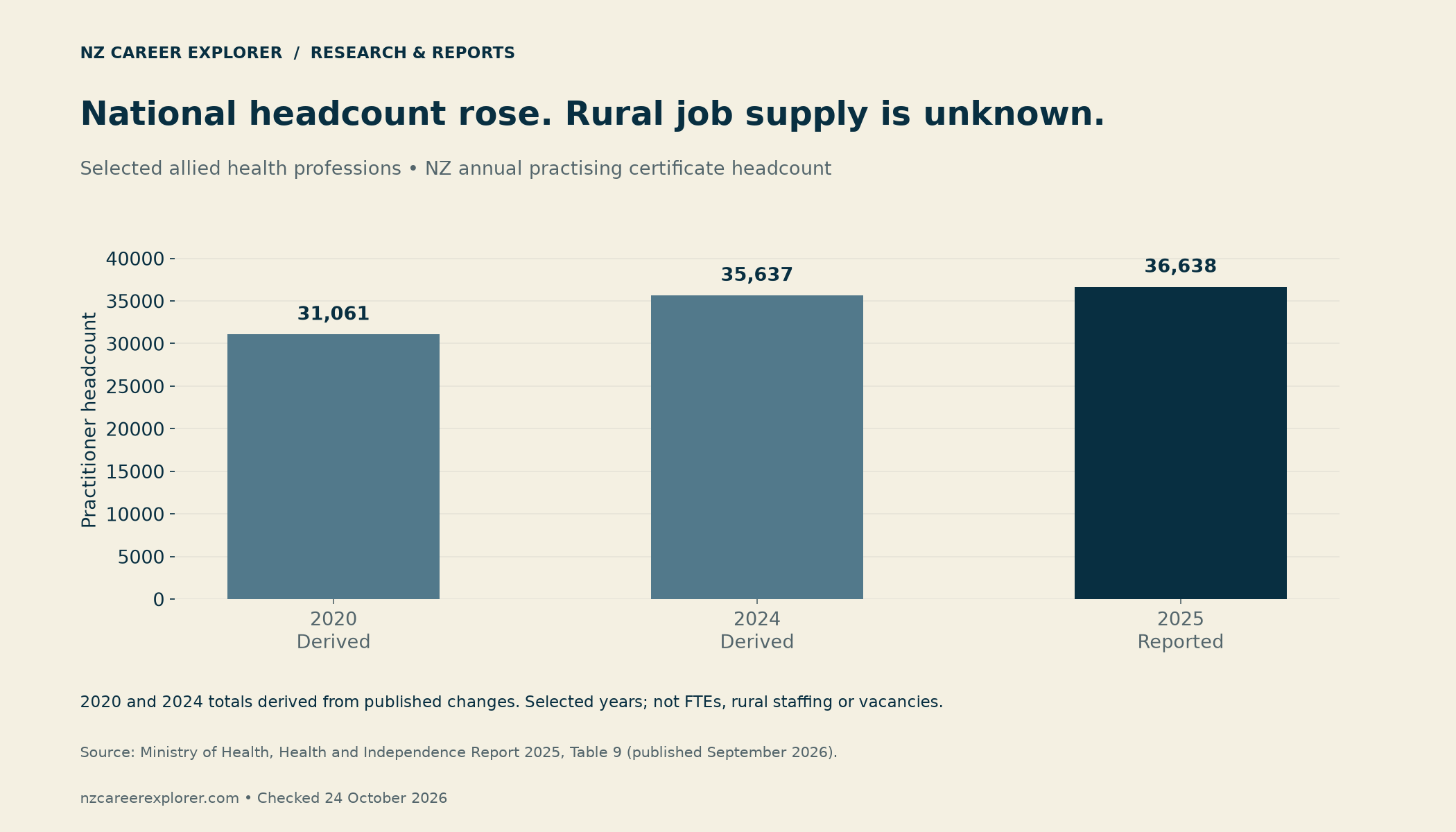
The report records growth of 2.8% over one year and 18.0% over five years. However, these are annual practising certificate headcounts, including self-employed practitioners. The series excludes addiction practitioners, paramedics, speech-language therapists and social workers employed in health because their time series are incomplete.
Consequently, do not describe 36,638 as the entire allied health workforce. Nor can national growth tell you whether a particular rural team has enough staff. Ask the employer for the current team structure, vacancies and cover arrangements instead. Our broader guide to allied health professions in New Zealand provides context for the different roles.
What rural workforce research adds
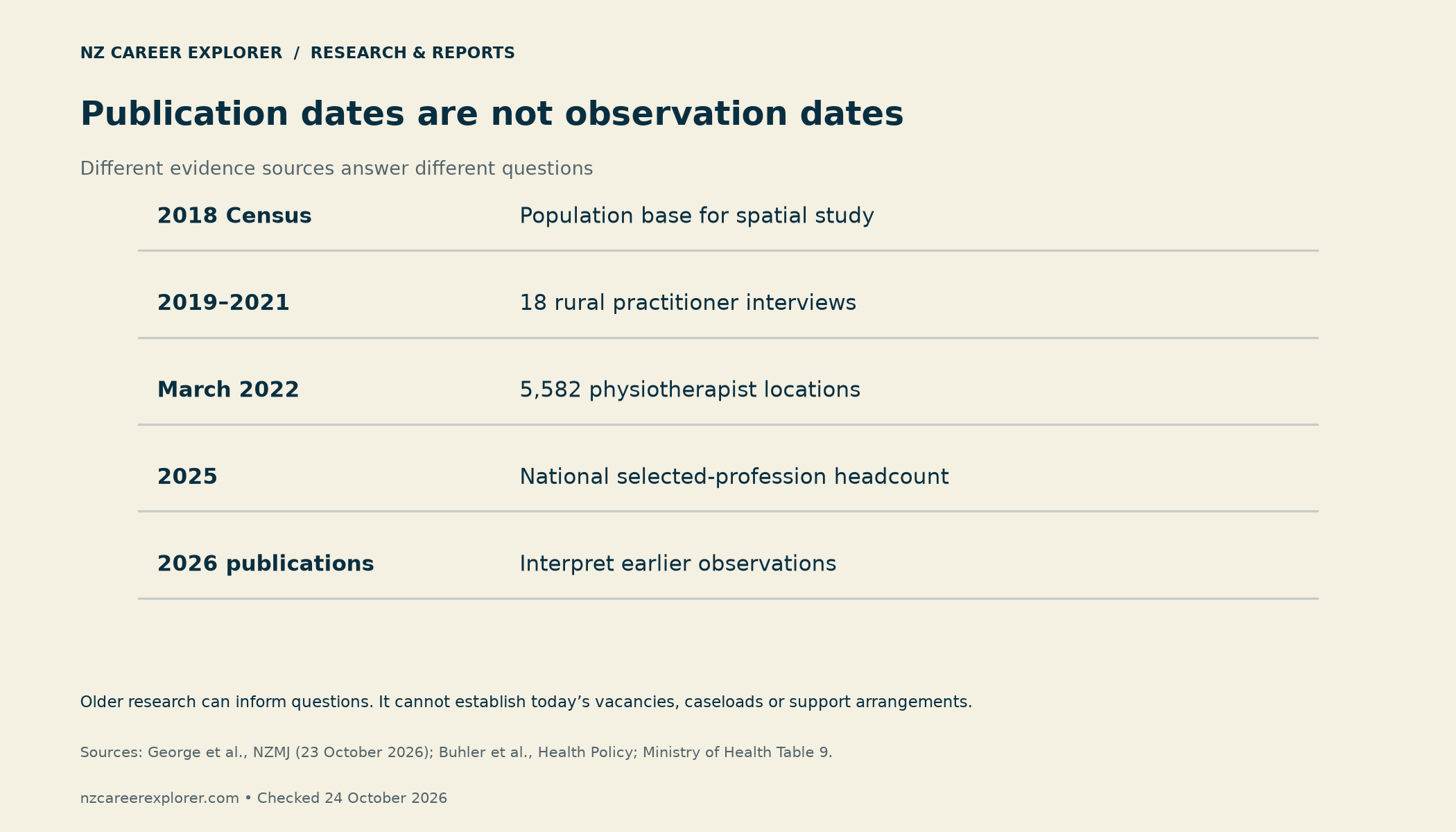
A 23 October 2026 New Zealand Medical Journal paper develops recommendations from interviews with 18 rural allied health practitioners. The interviews took place between July 2019 and December 2021. Its main themes concern belonging, supported practice and attractive job design, connected by the idea of fit.
Treat that evidence as a source of useful questions. It is not a national satisfaction survey or a comparison of today’s employers. All interviewees were women, professions were unevenly represented and the recommendations had not been externally tested. The authors also used a targeted literature review rather than a systematic review.
For an applicant, the practical response is to request concrete examples. A promise of support becomes more useful when the employer can name the supervisor, explain the meeting schedule and describe backup cover. Keep any unresolved point on your follow-up list.
Why geography matters without proving a job shortage
The University of Otago record of the physiotherapy spatial study describes analysis of 5,582 practitioner locations. That covered 92% of registered physiotherapists in March 2022 and used 2018 Census population data. The researchers found lower spatial accessibility associated with more rural locations and higher Māori population proportions.
The 92% figure measures coverage of the practitioner register. It is not the share of residents who can obtain treatment. Likewise, a geographical access measure does not show that an employer has funding, approval or a vacancy today. Use it to understand context, then investigate the actual role.
Check supervision and escalation before comparing perks
Start with the people you can contact during a difficult working day. Ask whether your supervisor works in the same profession and how regular meetings fit into the roster. Also establish what happens when that person is absent. A named backup makes the arrangement easier to understand.
Next, ask how the team handles work outside your competence or agreed scope. Request the escalation process and the person responsible for responding. These are employment questions about support arrangements, not instructions for treating patients or assessing clinical risk.
Finally, separate general team contact from professional supervision. A friendly group meeting may be valuable, but it does not automatically answer questions about your profession-specific development. Record what each meeting is for and whether time for it is protected.
Find out where travel fits in the working week
Two contracts can state the same weekly hours while leaving very different amounts of time for other duties. Therefore, ask the employer to outline a realistic week. Include outreach, travel, documentation, meetings, supervision and development alongside direct work.
Personalized Career Consulting
Unlock your potential with expert career advice tailored to your goals. Get personalized guidance and actionable steps toward your dream career in New Zealand.
Get Started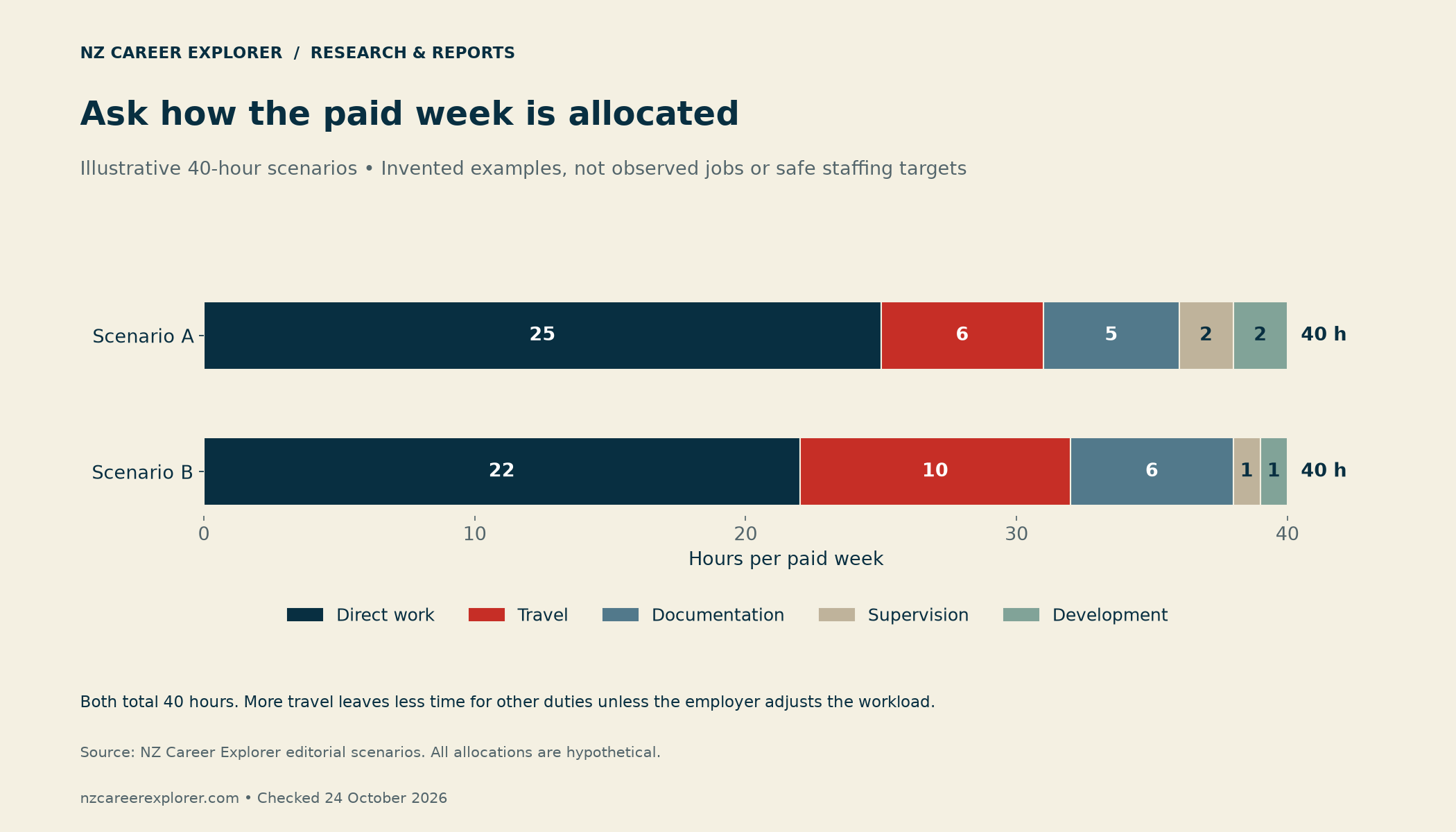
In our invented examples, both weeks total 40 hours. Scenario A allocates six hours to travel; B allocates ten. The difference is four hours, but the wider allocation also changes. Neither scenario represents a real employer, and the chart cannot determine whether a workload is safe or appropriate.
Instead, use the exercise to expose assumptions. Does the quoted workload allow time for travel and records? Who changes priorities when journeys take longer? If the answer is unclear, request a written explanation before treating the advertised hours as a complete picture.

Compare rural allied health jobs NZ offers in writing
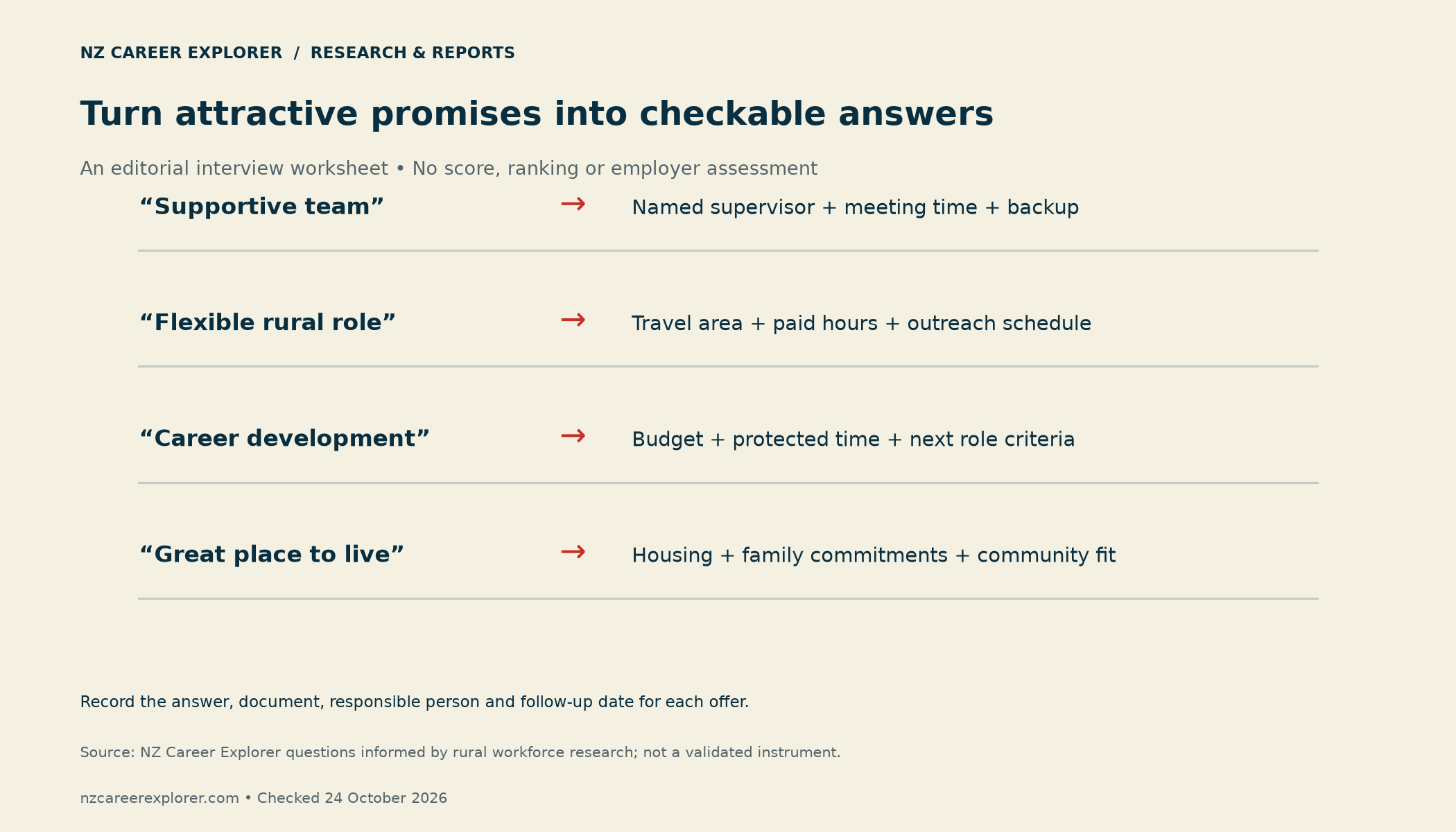
Keep two columns for two offers, then add a source column for each answer. An emailed clarification or the relevant contract clause is easier to revisit than a remembered conversation. Mark unanswered questions as unknown. Do not award a benefit simply because the advertisement uses positive language.
| Area | Question to resolve | Useful record |
|---|---|---|
| Supervision | Who meets with me, how often, and who is the backup? | Named contact and agreed schedule |
| Work pattern | How do travel, records and meetings fit into paid hours? | Typical roster and travel arrangements |
| Leave cover | Who handles work during planned and unexpected absences? | Cover process and responsible person |
| Development | What paid time, budget and progression criteria apply? | Written development agreement |
| Personal fit | Will housing, family and transport arrangements work? | Your own costs and practical checks |
Then compare pay on the same basis. Ask for the salary step, contracted hours, allowances and any relocation conditions in writing. Our NZ pay rise calculator can help compare gross pay and hours. It does not replace a full household budget or explain the terms of an individual contract.
A current vacancy shows why details need checking
The Health NZ Canterbury advertisement, PC4440877 seeks an occupational therapist or social worker for its rural adult community mental health team. It describes a permanent, part-time role of 0.6 FTE, or 24 hours weekly, with day travel between Kaikōura and the Rakaia River.
The employer requires New Zealand professional registration and a current practising certificate. It prefers at least two years of mental health experience. Its page does not state a numeric salary, supervision frequency or protected development hours. Those remain questions, not assumed benefits.
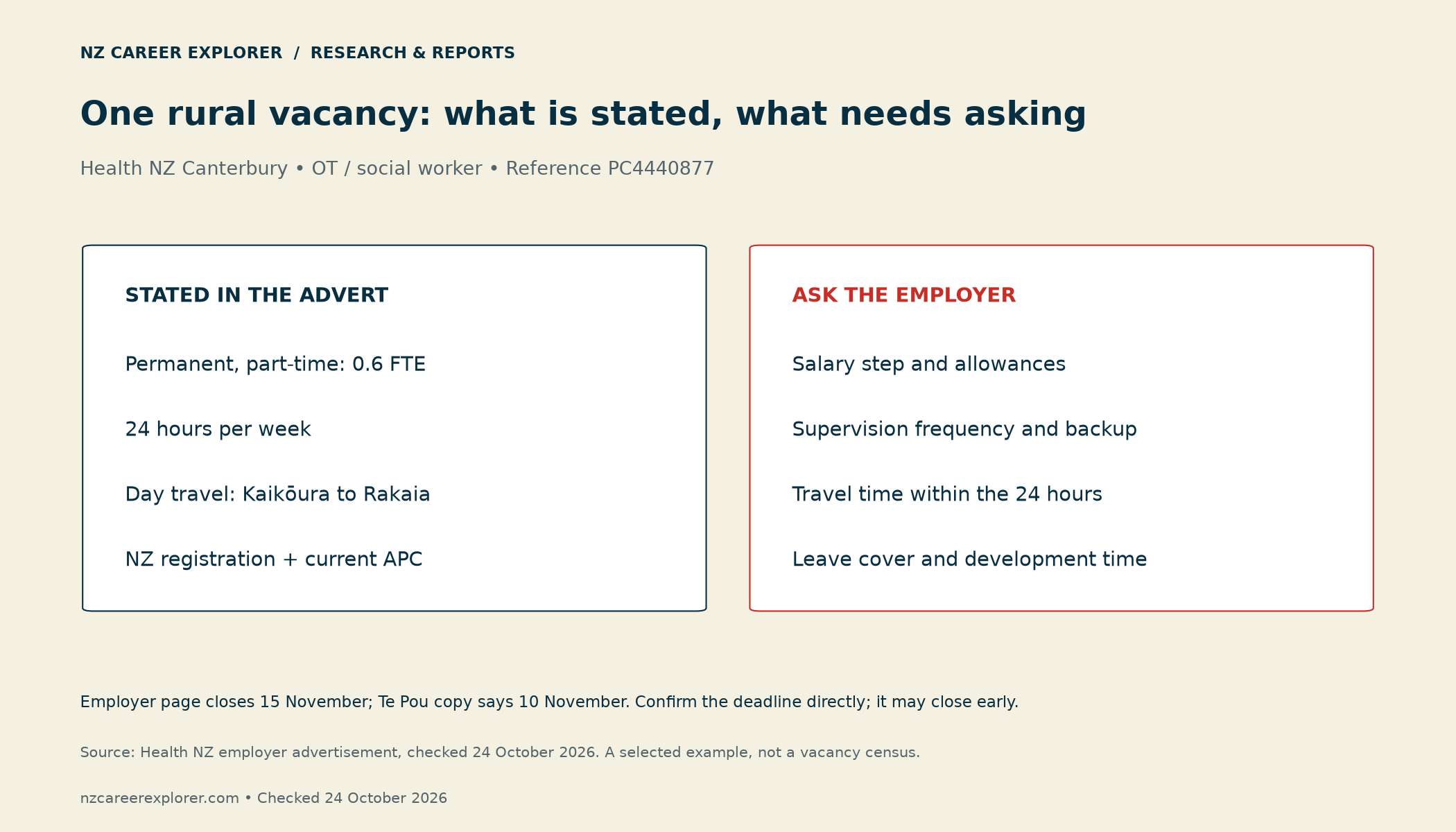
There is a deadline discrepancy. The employer page lists 15 November 2026, while the Te Pou copy lists 10 November. Confirm the date directly and act early: the employer says it may proceed before closing. The employer also notes priority for affected employees during organisational change.
This is one example selected for its clear rural responsibilities. It is not a national vacancy sample or evidence of a salary premium. We have not filled the missing pay figure with an estimate from an unrelated occupation or location.
If you qualified overseas, check the exact profession
The Ministry’s allied health overview distinguishes professions regulated under different systems. Start with the body relevant to your own profession. Confirm qualification recognition, registration and any practising certificate requirements before assuming that an overseas title transfers directly.
Also check employer requirements and the right to work separately. A job advertisement is not an immigration decision, and interest from a recruiter does not itself confer registration. The Health NZ allied health careers pages can help you identify the relevant role family and official next steps.
Method, limitations and downloadable worksheet
We checked primary research, government reporting and employer information on 24 October 2026. Earlier workforce totals come from subtracting published absolute changes from the 2025 total. We display selected years rather than inventing annual observations between them. The five-year and one-year percentage changes round to the published figures.
The national count, spatial analysis and small interview study cover different populations and periods. We do not combine them into a shortage estimate. We also omit unverified area counts from the supplied brief. The workweek examples and offer questions are original editorial tools, clearly separated from observed evidence.
Download the chart data and scenario inputs (CSV), or download the blank two-offer worksheet (CSV). Open the worksheet in a spreadsheet and add answers, evidence and follow-up dates. Suggested citation: NZ Career Explorer, “Rural Allied Health Jobs NZ: What to Check Before Accepting an Offer”, 24 October 2026.


