





Learning support jobs NZ employers advertise have different entry routes. An experienced registered teacher may fit a coordinator role. An early childhood professional may need specialist study. A speech-language therapist follows a different professional route. Start with your current qualifications: the same service expansion does not make those jobs interchangeable.
Our research compares three pathways, the latest rollout figures and three advertised roles. The useful first question is simple: which requirements do you already meet, and which need confirmation? Use the route matrix before paying for study or preparing an application.
Checked 24 October 2026. Vacancy details can change or close early. The examples below are a small, selected sample, not a national vacancy count. Future targets remain plans, while government progress figures describe reported delivery.
Learning support jobs NZ: read the rollout correctly
The Government’s 22 October update reports 190 additional specialist positions filled since December. It also says 474 more schools gained coordinator access, taking coverage among primary and intermediate schools from 41% to 62%. The announced targets are 80% in 2027 and full coverage by 2028.
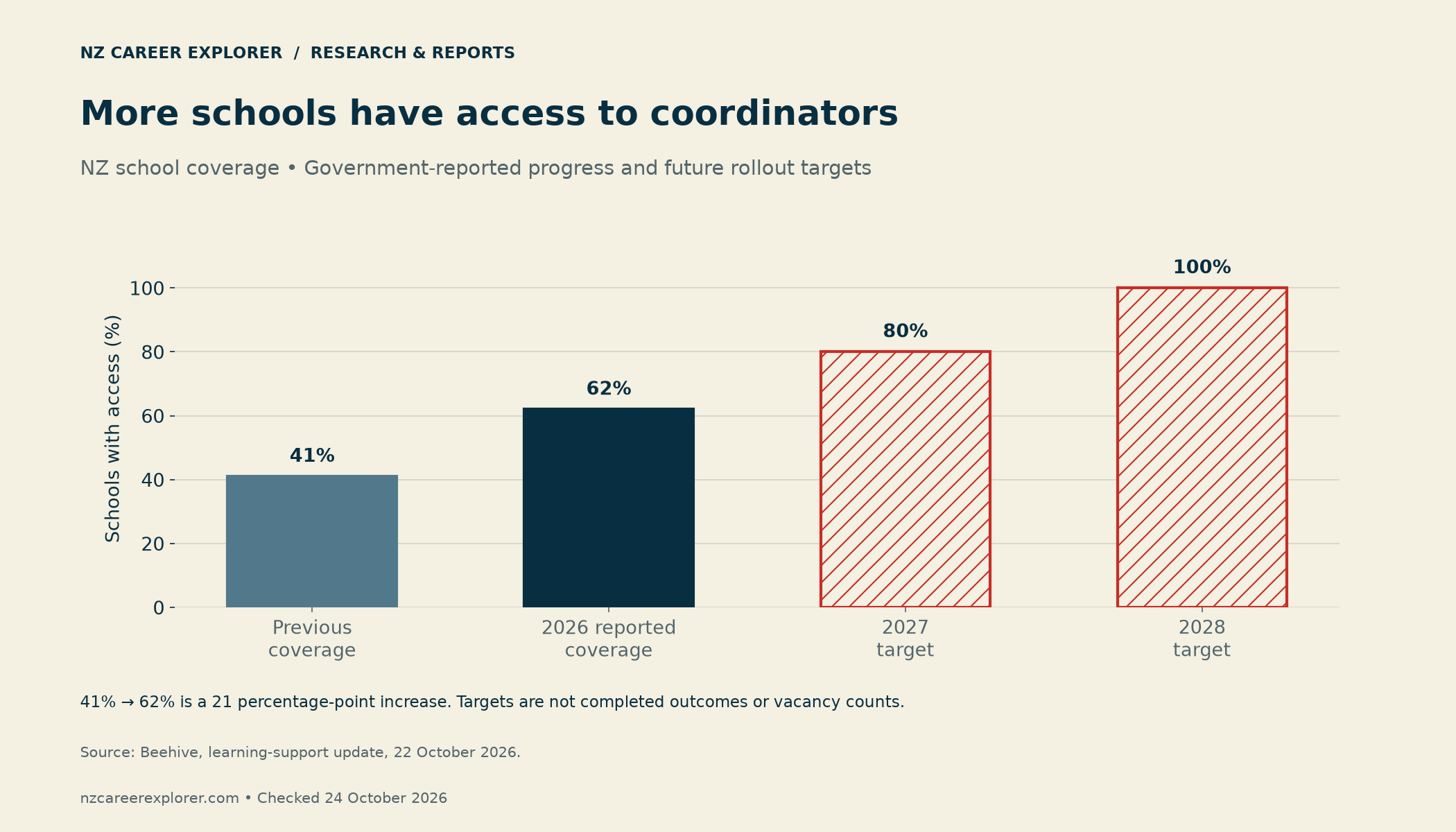
The increase from 41% to 62% is 21 percentage points. Reaching 80% would add another 18 points. Neither change measures the number of vacancies. Likewise, a position already filled is not an opening you can apply for. These distinctions prevent a service announcement from becoming an inflated hiring claim.
The 20 October School Leaders Bulletin encourages schools receiving a 2027 allocation to plan recruitment. It says those positions receive funding from Term 1, 2027. Therefore, check the advertised start date as well as the closing date. A role advertised now may begin next year.
What the funding tells you—and what it does not
The Budget 2025 learning-support factsheet describes a NZ$266 million early-intervention package. Its components cover service expansion, demand, teacher-aide time and provider or workforce development. These are earlier programme commitments, rather than new October vacancies.
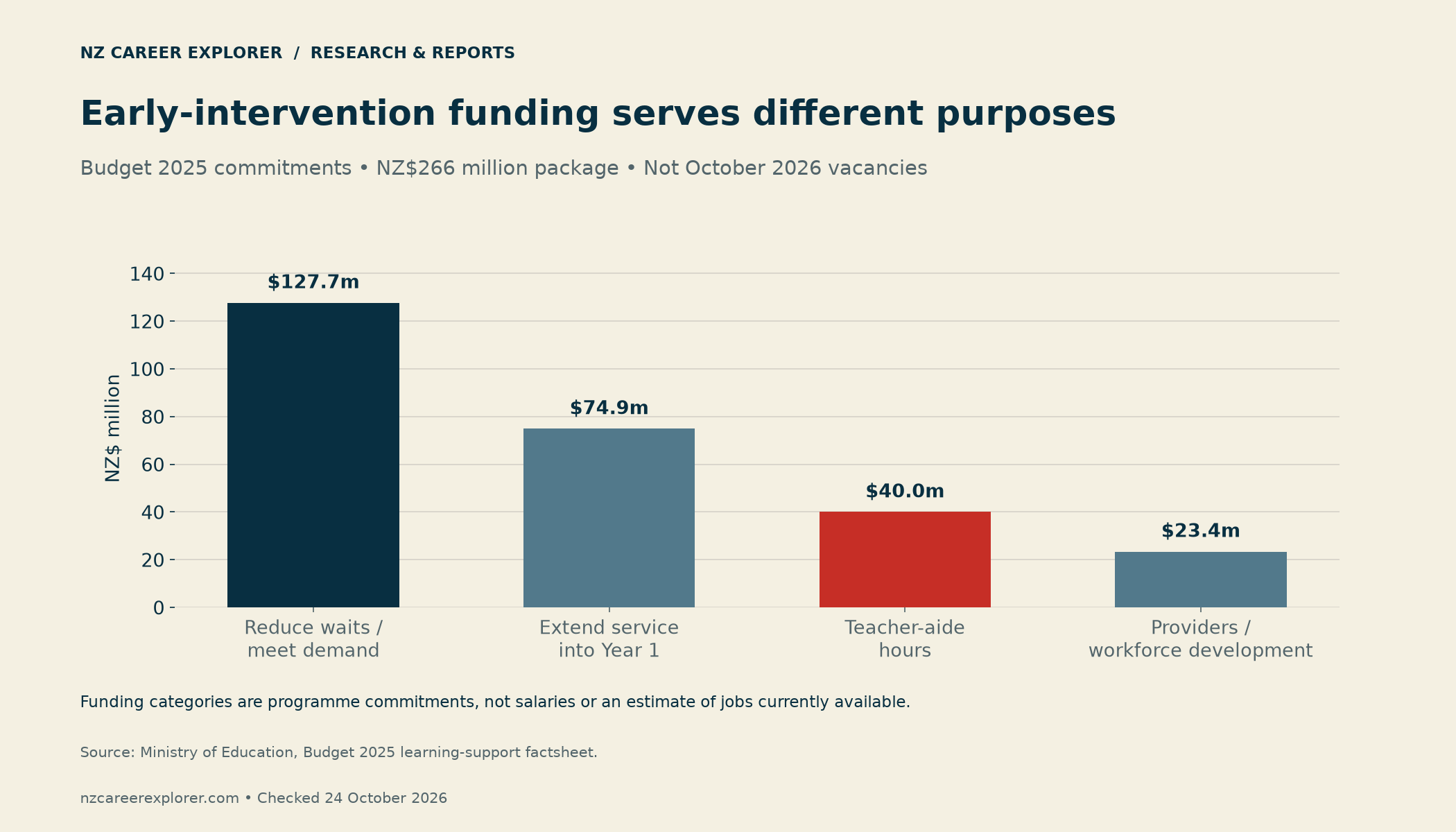
Separately, the Ministry’s funding breakdown allocates NZ$192.5 million to coordinator access, including about 650 additional full-time teacher equivalents over three years. A teacher equivalent measures staffing capacity; it is not necessarily one person or one full-time vacancy. Do not divide the 190 filled specialist positions by the early-intervention staffing commitment: the populations have not been matched.
Choose the route that matches your credentials
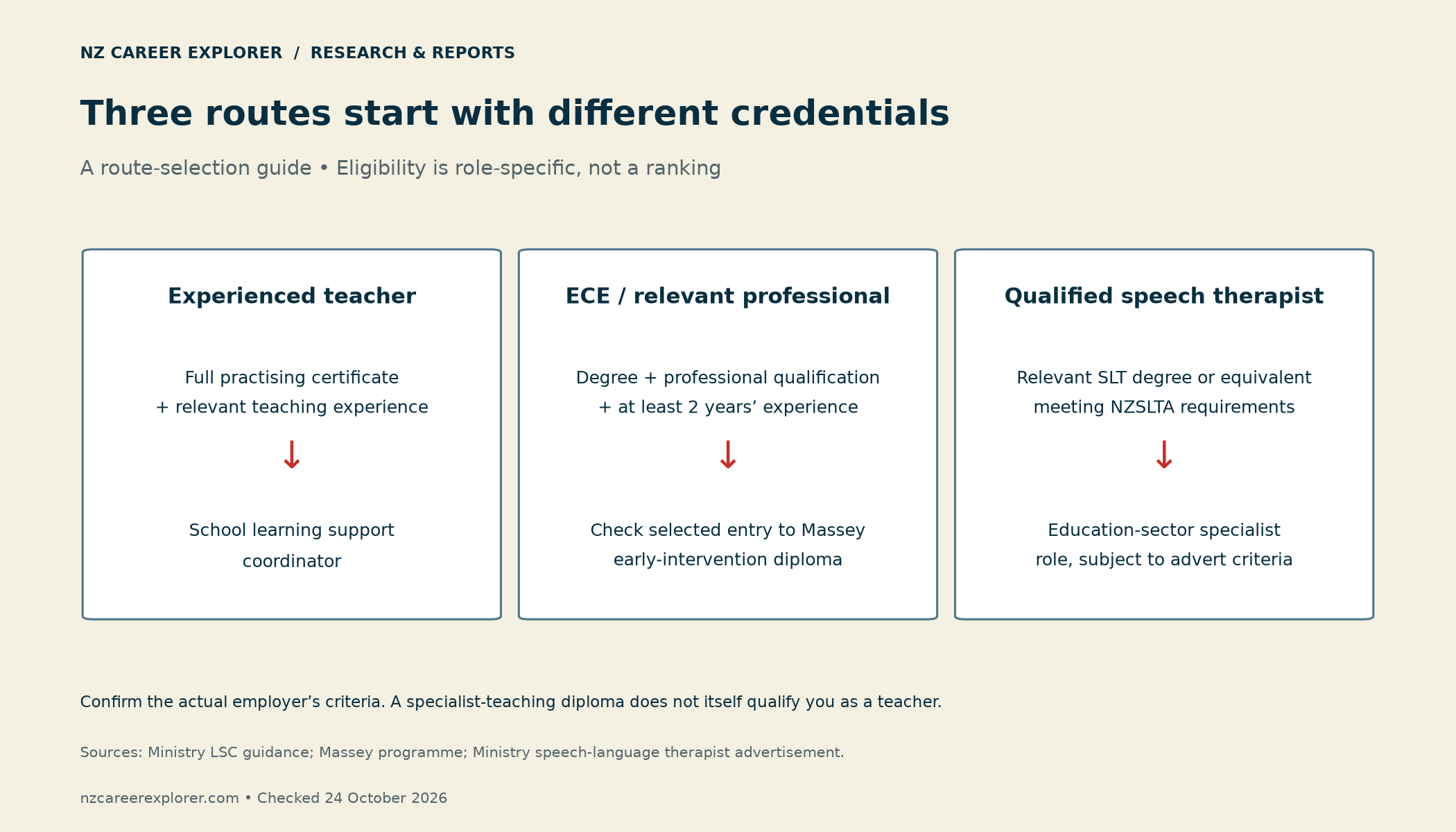
| Starting point | Route to investigate | Check before applying |
|---|---|---|
| Experienced teacher | School learning support coordinator | Full practising certificate, relevant experience, school role description |
| ECE or relevant qualified professional | Early-intervention specialist teaching | Programme entry, employer criteria, study time and award eligibility |
| Qualified speech-language therapist | Education-sector specialist position | Relevant degree or equivalent, professional requirements and specific contract |
First, list your qualification titles, practising status and relevant experience. Then compare them against the actual role description. Ask the employer about any uncertain requirement before assuming that a similar job title means you qualify. Our guide to education careers beyond classroom teaching provides broader context for that choice.
Route one: experienced teacher to coordinator
The Ministry’s coordinator guidance identifies experienced registered teachers with a current full practising certificate as the starting group. Coordinators help learners access support and work with teachers and families. They do not replace every specialist profession within the wider support system.
For example, Glen Eden Intermediate’s advertisement seeks a full-time permanent coordinator in Titirangi, Auckland. It lists a 30 October 2026, 3 pm deadline and a 3 February 2027 start. The school asks for teacher registration, a current practising certificate and experience in learning support or inclusive education.
That advertisement also values work with adolescent learners and culturally responsive relationships. In your application, explain one relevant example: the need you identified, the people you worked with, your action and the evidence of progress. Avoid a list of unsupported claims about being passionate or collaborative.
Finally, ask how much of the role is coordination, direct teaching and staff support. Establish who sets priorities when several learners need help at once. A clear allocation of time is more useful than an attractive title with unclear duties.
Route two: early childhood experience to early intervention
Massey’s early-intervention postgraduate diploma requires a degree or equivalent, a relevant professional qualification and at least two years of relevant professional experience. It is a selected-entry programme, designed for part-time study with compulsory contact workshops. Crucially, it does not itself qualify you to become a teacher.
The published structure spreads four courses across two years. Check course admission and work arrangements separately: acceptance into a programme does not guarantee a job, study leave or an award. Likewise, employer interest does not waive university entry requirements.
Personalized Career Consulting
Unlock your potential with expert career advice tailored to your goals. Get personalized guidance and actionable steps toward your dream career in New Zealand.
Get Started
The Ministry’s early-intervention teacher example covers Upper Hutt, Wairarapa and Tararua. It is full-time and permanent, with applications closing at midnight on 26 October 2026. The advertisement specifies an early childhood teaching degree and an early-intervention diploma, or the ability to obtain that diploma within four years.
It also requires relevant teaching experience, Te Reo Māori knowledge and a full driver licence because travel is part of the role. These specific requirements matter. A generic early-intervention course description cannot replace the employer’s expectations for kaupapa Māori service delivery.
Check study funding before making a commitment
The Early Intervention Study Award page says applications are currently closed. It lists an annual application window of 1 August to 12 September. Recheck the next round rather than assuming a late application will be accepted.
For eligible recipients, support includes domestic tuition and employer funding for up to 50 study-leave days each year. Part-time leave support is proportional. The page also requires employer backing, relevant qualifications and permanent rights to live and work in New Zealand. Its full employment and exclusion rules still apply.
Meanwhile, Massey lists a 10 December programme application deadline. The university and award deadlines are different. Being able to apply for study does not mean award funding remains available. Confirm the year, course intake, fees and employer contribution directly before committing.
If you trained overseas, start with the relevant qualification-recognition and practising requirements. Do not assume an overseas credential satisfies the school, university or professional body automatically. Keep study admission, professional eligibility and the right to work as three separate checks.
Route three: qualified specialist to education services
The Ministry’s speech-language therapist advertisement asks for a relevant bachelor’s or master’s degree, or an equivalent that meets NZSLTA requirements. It describes a full-time parental-leave position based in Lower Hutt, working in Upper Hutt, from 12 January to 9 July 2027. Applications close at midnight on 1 November 2026.
This example shows why contract type belongs beside qualifications. A specialist may meet the professional requirements yet prefer a permanent role. Conversely, a fixed term may fit a defined career plan. Ask about supervision, travel, handover and what happens when the covered employee returns.
Compare advertised pay without inventing an average
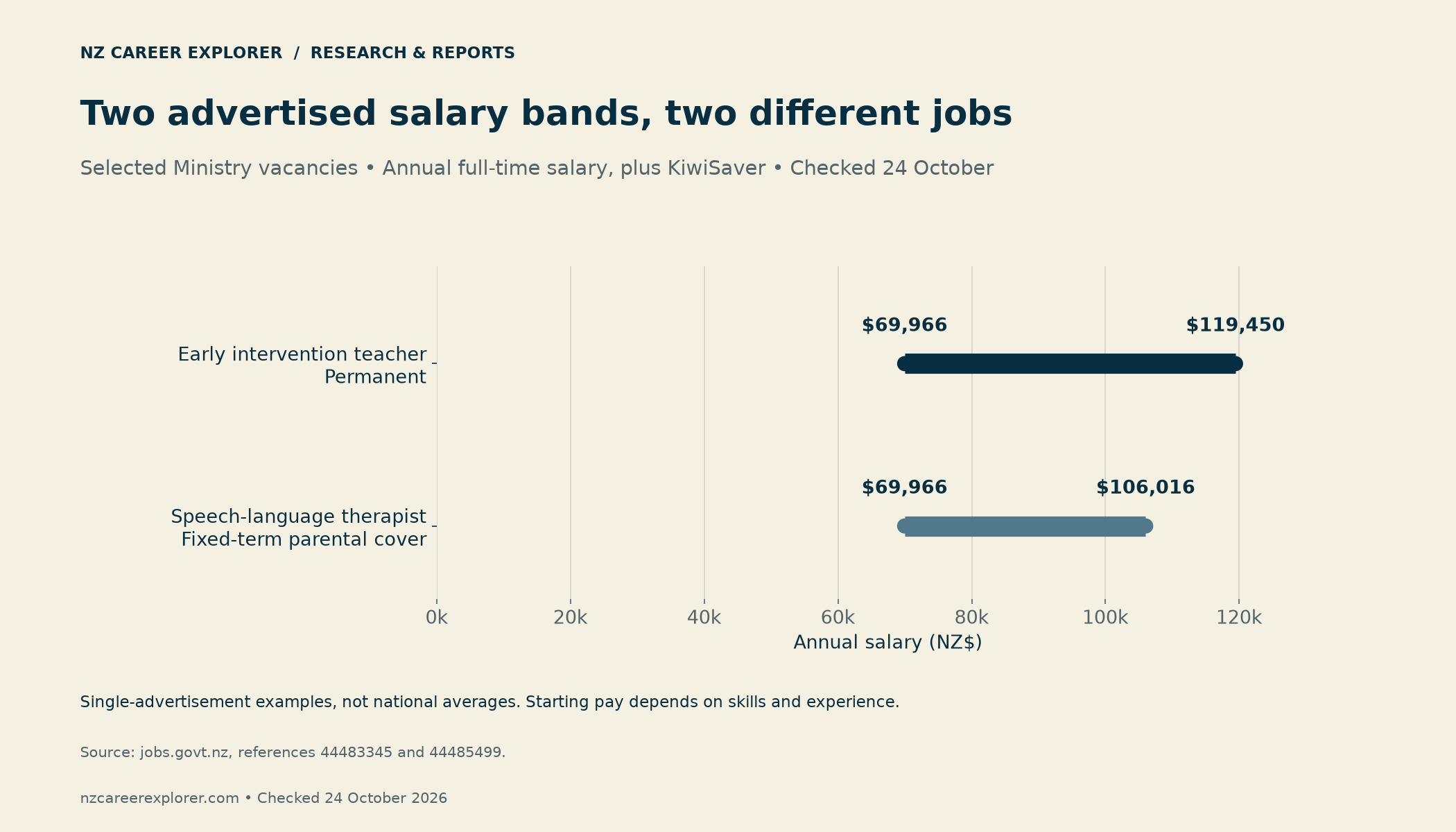
The early-intervention example advertises NZ$69,966–119,450 annually plus KiwiSaver. The speech-language therapist example advertises NZ$69,966–106,016 plus KiwiSaver. Both say the appointment reflects skills and experience. The higher endpoint is not a promise to a new applicant.
We did not find a numeric salary band on the school’s public vacancy page, so we have not invented one. Ask the school which agreement, scale and any allowances apply. For a broader offer comparison, use our NZ pay rise calculator to examine gross pay and hours together.
A dated vacancy sample, not a hiring forecast
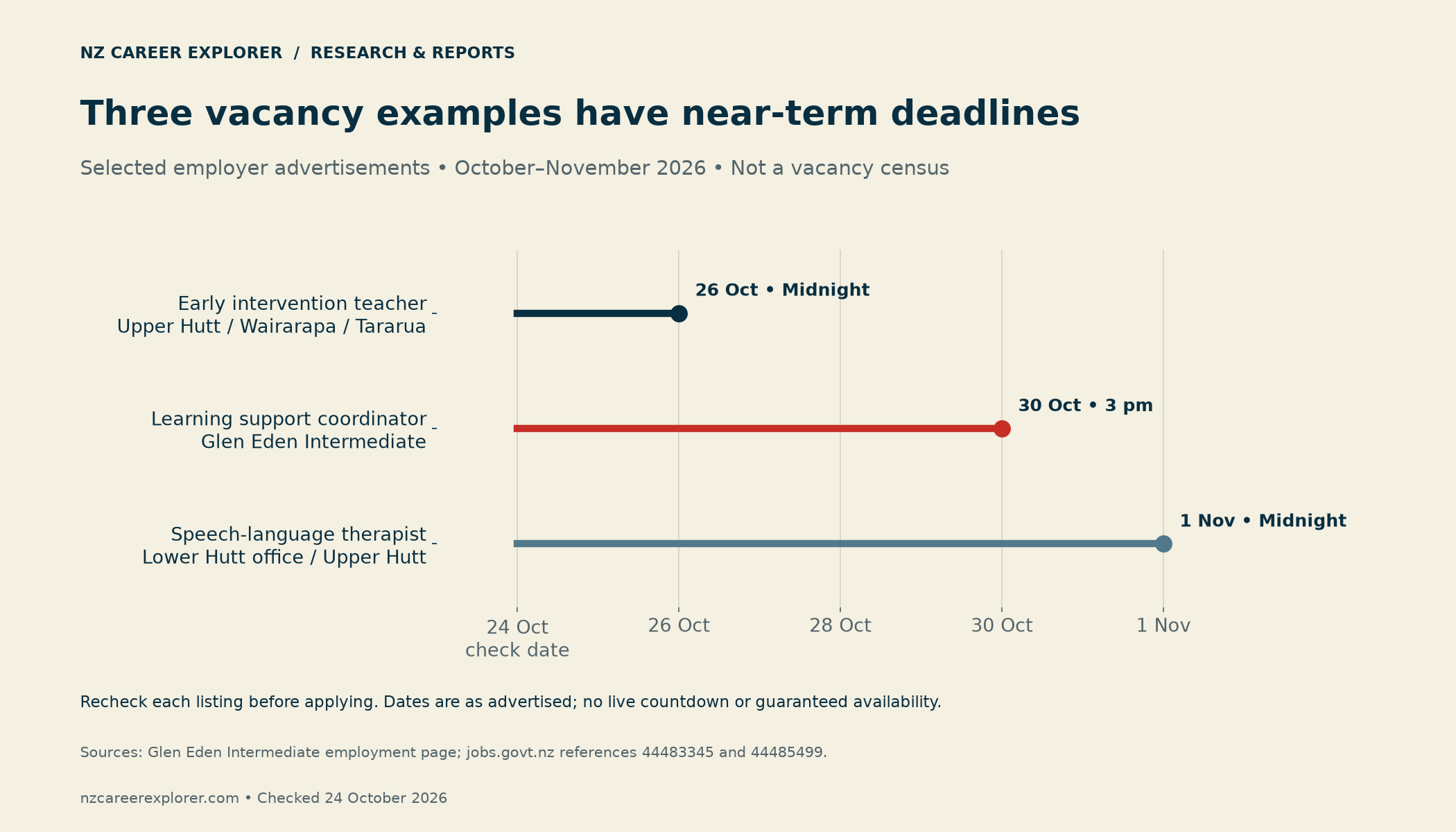
| Role / employer | Contract and location | Advertised closing date |
|---|---|---|
| Early intervention teacher / Ministry | Permanent, full-time; Upper Hutt, Wairarapa and Tararua | 26 October 2026, midnight |
| Coordinator / Glen Eden Intermediate | Permanent, full-time; Titirangi, Auckland | 30 October 2026, 3 pm |
| Speech-language therapist / Ministry | Fixed-term, full-time; Lower Hutt office, Upper Hutt work | 1 November 2026, midnight |
These three examples illustrate different routes and contract terms. They do not establish the number of learning support jobs NZ employers have available. We selected them for relevance and accessible employer information, not through a representative survey.
Questions to ask before accepting a role
- Who provides supervision, and how often will we meet?
- What caseload and travel area will I cover?
- How are travel, documentation and meetings included in working time?
- What study leave or professional development is agreed in writing?
- Which responsibilities are mine, and when do I refer to another specialist?
- What happens at the end of a fixed term or when funding allocations change?
Take these questions into an interview and record the answers alongside the pay and contract. Then compare the offer with your qualification route and personal commitments. A service expansion can create options, but it cannot tell you which specific job will fit your skills or circumstances.
Method, sources and reusable data
We checked primary government, university and employer pages on 24 October 2026. Our analysis subtracts reported coverage percentages to calculate percentage-point changes and sums the four published funding components. We keep reported outcomes, earlier funding commitments, future targets and live advertisement examples separate.
The source material has important limits. The Government’s update is reported progress, not an independent impact evaluation. Advertisements can change, and the three-role sample does not measure demand or typical pay. The route guide is our synthesis of published requirements, not a professional eligibility decision or a validated assessment tool.
Transform Your Career with a Professional CV and Cover Letter
Stand out to employers with an ATS-optimized resume and tailored cover letter designed to match your dream role. Let us craft your job application materials for success!
Get StartedDownload the chart data (CSV). The fields identify the measure, period or scope, value, units, status and source. Suggested citation: NZ Career Explorer, “Learning Support Jobs NZ: Which Route Fits Your Qualifications?”, 24 October 2026. Link back to this report and the primary source when reusing a figure.


