





NZ dairy export careers offer several off-farm routes, but a stronger export headline does not prove employers are adding jobs. Processing, warehouse and planning roles require different evidence. Compare the actual work, entry conditions and contract before choosing a course or leaving your current role.
This report combines official trade figures, a historical workforce baseline and three employer-advertisement examples. Our five visuals and reusable worksheet help you turn that evidence into better questions. The examples are a small, selected sample, not a national vacancy or salary survey.
Research checked 24 October 2026. Trade figures compare September 2026 with September 2025. Workforce data cover the year ended March 2024. Some employer pages contain stale or conflicting information, which we flag below. Always confirm current availability directly.
NZ dairy export careers: read the trade signal carefully
Stats NZ’s 19 October merchandise-trade release reports NZ$1.472 billion for the milk powder, butter and cheese grouping. That was NZ$129 million, or 9.6%, above September 2025. Within the grouping, physical shipments and unit prices moved in opposite directions.
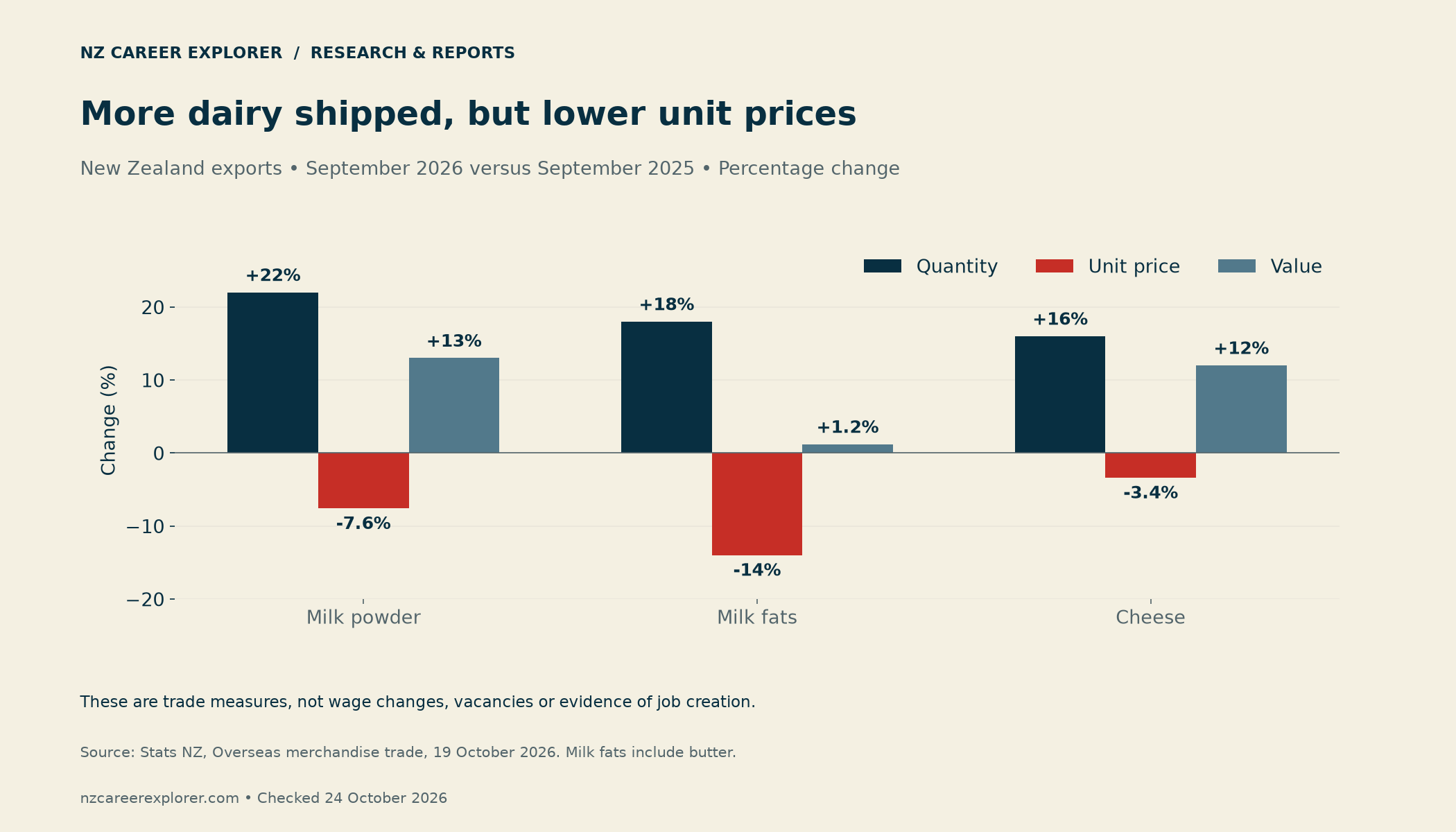
For a job seeker, higher volume is a reason to investigate operations. It is not enough to predict new hiring. A business might use spare capacity, change inventory timing or adjust existing shifts. These are possible explanations, not findings about any employer in our sample.
Likewise, export value is not a wage measure. Lower unit prices do not establish that staff pay has fallen. Nor can a national monthly total tell you whether a particular factory has a secure order book. Ask the employer what drives the role and how long the work is expected to last.
A reproducible volume-and-price calculation
Start with a milk-powder export value index of 100. Increase quantity by 22% while holding unit price constant: the index becomes 122. Then apply the 7.6% lower unit price. The result is 100 × 1.22 × 0.924 = 112.728, or growth of about 12.7%.
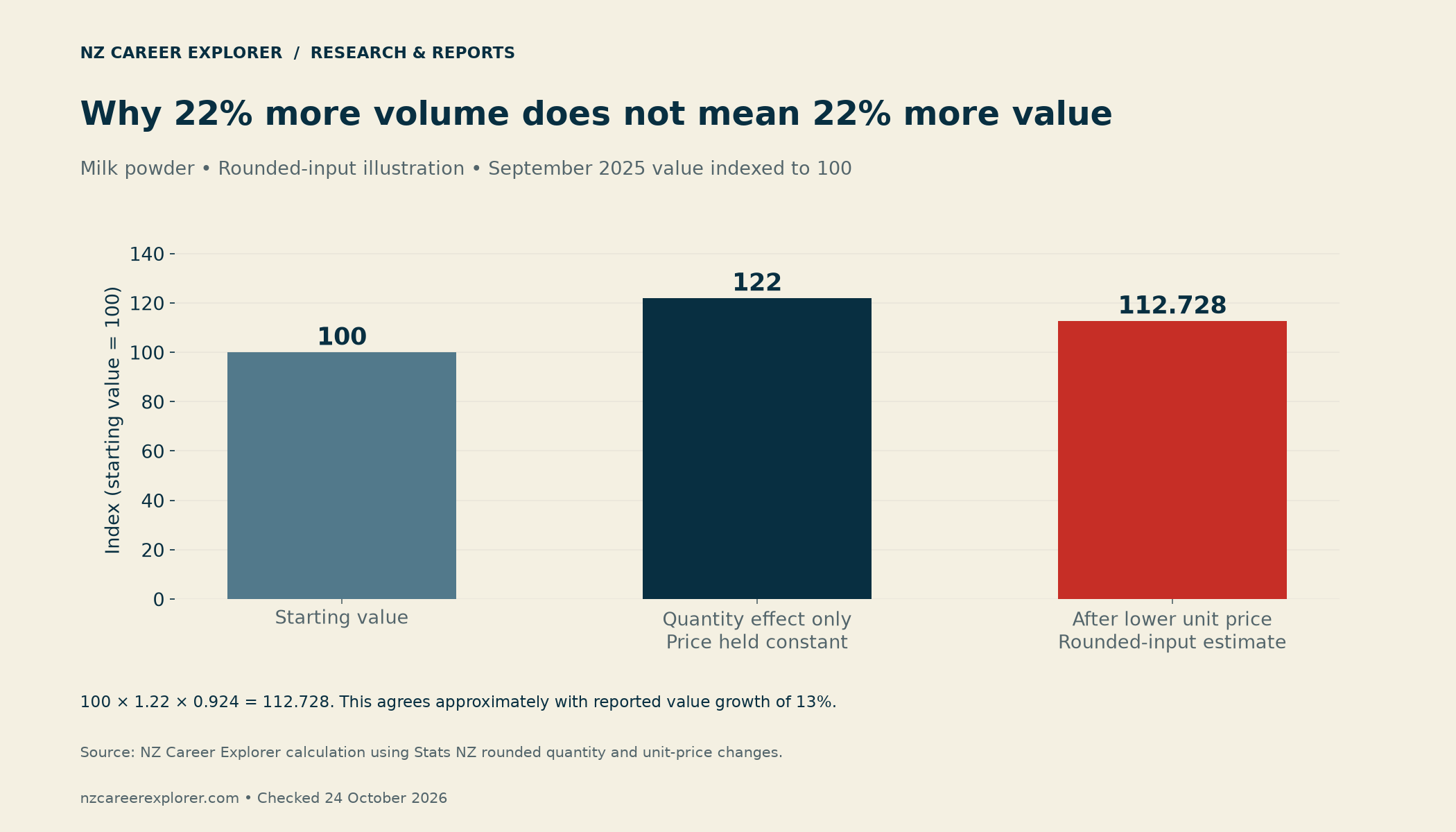
This broadly agrees with the published 13% value increase. Small differences are expected when inputs and outputs are rounded separately. Adding 22% and minus 7.6% would miss the interaction between quantity and price. Keep that distinction when reading other export stories.
The release omits quantity and unit-price changes for the total grouping because its products use different measurement units. Therefore, we do not create an overall volume index by adding the component percentages. Our reusable table retains the published commodity definitions.
Where off-farm work fits in the older workforce baseline
MPI’s dairy workforce profile reports an average workforce of 53,392 for the year ended 31 March 2024. Core processing and manufacturing accounted for 15,050, while core production recorded 37,525. These are historical people counts, not current vacancies.
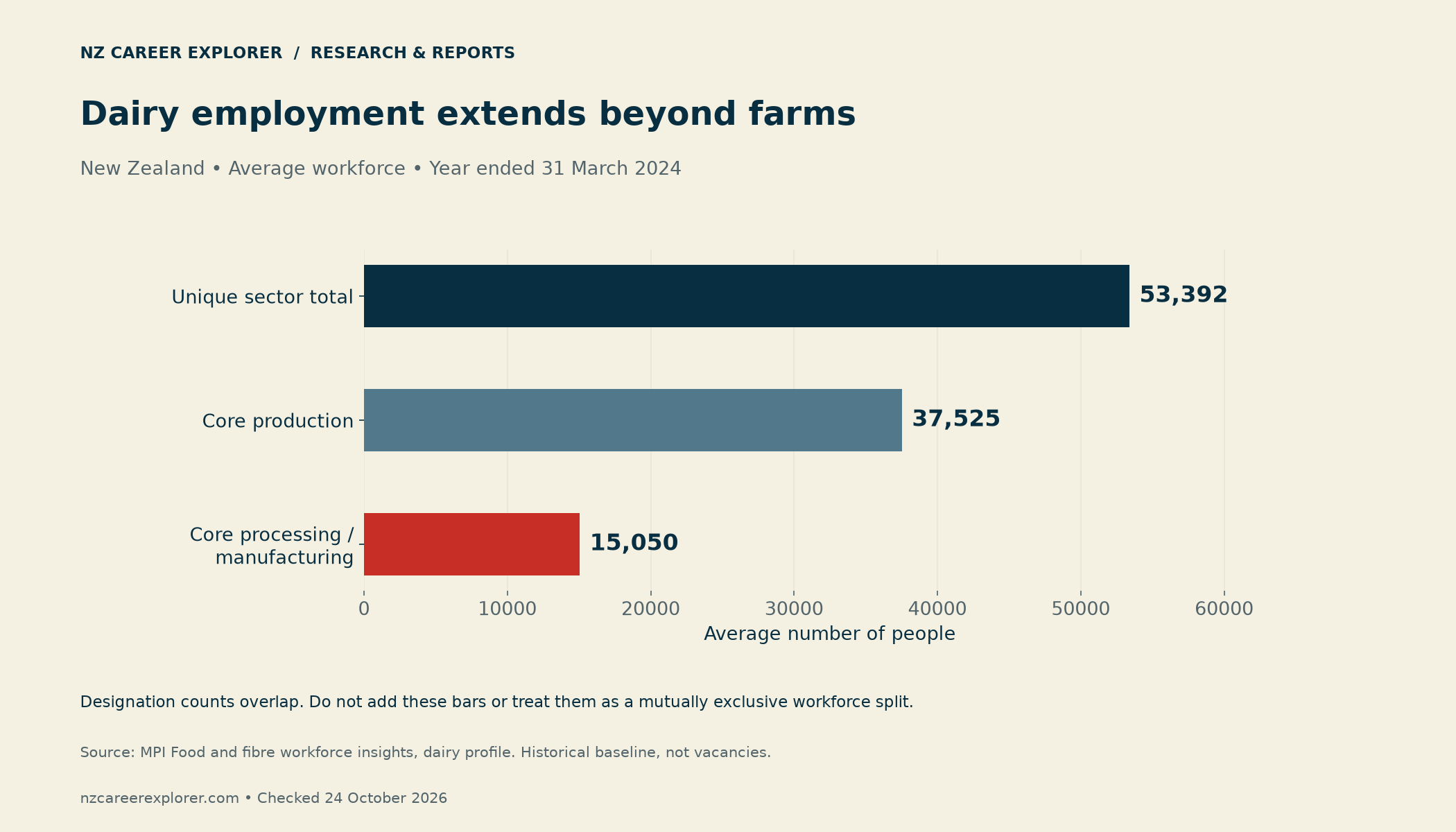
This baseline shows why a dairy-career search need not stop at farm roles. However, it does not identify how many jobs a newcomer can enter today. It also cannot rank regions by hiring prospects or establish a pay premium for processing work.
Use our logistics career overview for broad descriptions of transport, warehousing and coordination. Use current employer evidence for a specific application. The older overview is background reading, not the source of this report’s statistics.
Compare three routes using employer evidence
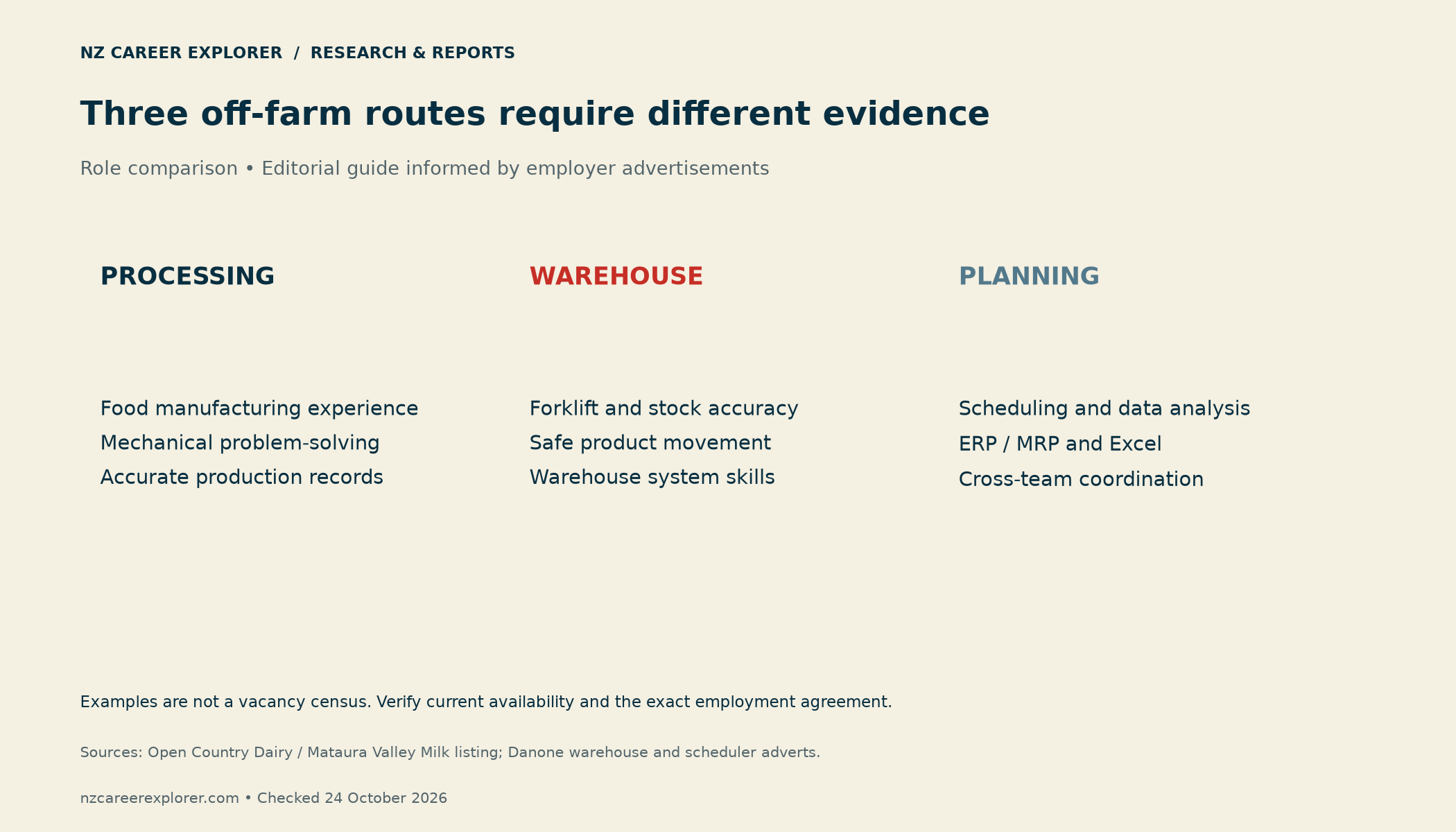
The Open Country Dairy listing for Mataura Valley Milk’s Gore Process Operator describes a 12-month fixed term starting in early November 2026. It covers milk-powder processing and seeks food-manufacturing experience, ideally dairy, plus mechanical aptitude and accurate records. The public listing was accessible with an Apply control when checked.
However, the visible description did not specify salary, guaranteed weekly hours, the full roster or a closing date. We therefore leave those fields unanswered. A full-time label does not tell you which nights or weekends you would work. Confirm all four details before comparing it with a current job.
Danone’s Warehouse Operator advert, reference 27876, described an Auckland permanent full-time role. Its requirements included three years of warehouse and forklift experience, a valid forklift licence, NCEA Level 1 or equivalent, and warehouse-system skills. However, its original page returned a 404 during our live browser check. Treat this as a historical requirements example, not an open vacancy.
Personalized Career Consulting
Unlock your potential with expert career advice tailored to your goals. Get personalized guidance and actionable steps toward your dream career in New Zealand.
Get StartedDanone’s Production Scheduler advert, reference 27815, described an Auckland permanent role at 40 hours weekly, Monday to Friday. It listed a relevant diploma or degree, at least two years’ planning-related experience, ERP or MRP systems and Excel. However, its displayed posting date followed its stated deadline. It also mixed laboratory qualification text with planning requirements. Those conflicts need employer clarification; we cannot confirm this opening.
Check Danone’s current vacancies for a valid listing rather than relying on a search snippet. The practical lesson is to compare the duties and verify the version of the advert. An indexed page can remain visible after a recruitment round changes or ends.
Choose evidence that fits the work
For processing, prepare a truthful example of following a controlled process, spotting a deviation and escalating it appropriately. Explain what you personally did and how you checked the result. Avoid implying that general machine experience replaces site-specific safety and food-quality training.
For warehouse roles, consider an example involving stock accuracy or a dispatch discrepancy. Describe the record you checked, the communication required and the correction. If an advert requires a licence or certification, ask exactly which credential it accepts and whether renewal support is available.
For planning, choose a case where demand, capacity or material availability changed. Explain how you updated a schedule and communicated the consequences. A simple, accurate account of a trade-off is more useful than a long list of software names.

Across all routes, keep customer and employer information confidential. You can demonstrate a skill without sharing an internal spreadsheet or naming a client. Separate your own contribution from a team result, and state any limits to your experience plainly.
Training for NZ dairy export careers starts with the role
Primary ITO’s New Zealand Apprenticeship in Dairy Processing combines Levels 3 and 4 over a published 27–32 months. Learners must already work in the sector and train through their employer. The provider says employees can start at any time, subject to arranging a suitable programme.
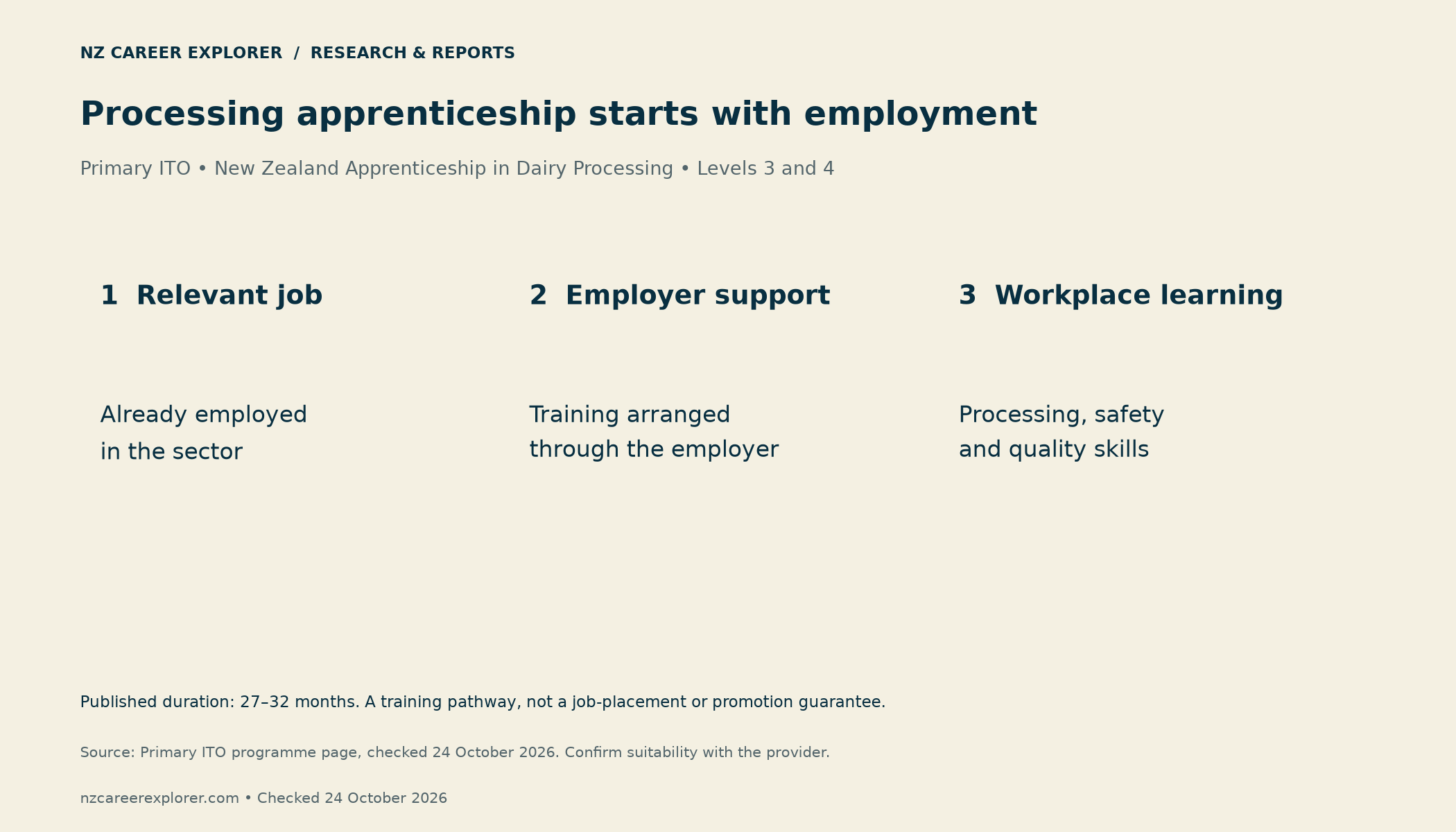
This is an employment-first pathway, not a promise of placement. It develops processing capability and does not automatically meet every warehouse or planning requirement. Ask which qualification aligns with the duties of the actual job before assuming that one programme opens all three routes.
Then resolve the practical support. Who provides assessment evidence? How much learning time is available during work? Who pays any fees? What happens if the contract ends before the programme? These are questions for the agreement, not benefits we have verified for the sample roles.
A reusable employer-comparison worksheet
| Field to confirm | Record the employer’s answer | Why it affects your choice |
|---|---|---|
| Role and location | Site, team and main tasks | A familiar title may hide different work |
| Availability | Current advert and closing date | Search results can be stale |
| Contract | Permanent, fixed term or seasonal; end date | Compare security and timing |
| Hours and roster | Guaranteed hours; nights; weekends | Plan travel, care and recovery time |
| Pay | Base rate; allowances; overtime terms | Compare the same pay components |
| Entry conditions | Required credentials and experience | Separate essentials from preferences |
| Training | Programme, fees, study time and support | Check whether learning is feasible |
Copy this table for each employer and leave unknown answers blank. Do not score an unknown as a benefit. If two options look similar, focus your next conversation on the unanswered detail that would change your decision most.
For an offer involving higher pay and longer hours, use our pay rise calculator to test the gross hourly comparison. Keep shift allowances and uncertain overtime separate from guaranteed base pay. The calculator does not replace a complete contract or household-budget review.
Newcomers should explain overseas manufacturing or logistics experience in terms of actual duties and results. Confirm how the employer assesses overseas credentials and current work eligibility. Our sample does not establish visa sponsorship, guaranteed recognition or an exemption from a stated licence condition.
Method, source table and limits
We compared primary trade data, MPI’s published workforce profile, the training provider’s programme and selected employer advertisements. The role sample was chosen to illustrate different functions. It is not exhaustive or representative. We have not inferred salary ranges, vacancy totals or a causal link from exports to hiring.
| September 2026 vs September 2025 | Quantity change | Unit-price change | Value change |
|---|---|---|---|
| Milk powder | +22% | −7.6% | +13% |
| Milk fats, including butter | +18% | −14% | +1.2% |
| Cheese | +16% | −3.4% | +12% |
The calculation uses rounded reported changes, so it is an approximate cross-check. Workforce designation counts overlap and use a different reference period. Our charts, route comparison and worksheet are editorial analysis; they are not official selection criteria or a prediction of career outcomes.
Transform Your Career with a Professional CV and Cover Letter
Stand out to employers with an ATS-optimized resume and tailored cover letter designed to match your dream role. Let us craft your job application materials for success!
Get StartedSuggested citation: NZ Career Explorer, “NZ Dairy Export Careers: Compare Processing, Warehouse and Supply-Chain Roles”, 24 October 2026, using Stats NZ and MPI data. Use the linked primary sources for definitions and later updates. Before acting on a vacancy, confirm its current terms with the employer.


