





NZ manufacturing interview preparation works best when you turn industry data into questions, then support your answers with real examples. A national survey can give you context. It cannot tell you why a particular factory is recruiting or whether its advertised hours will suit you.
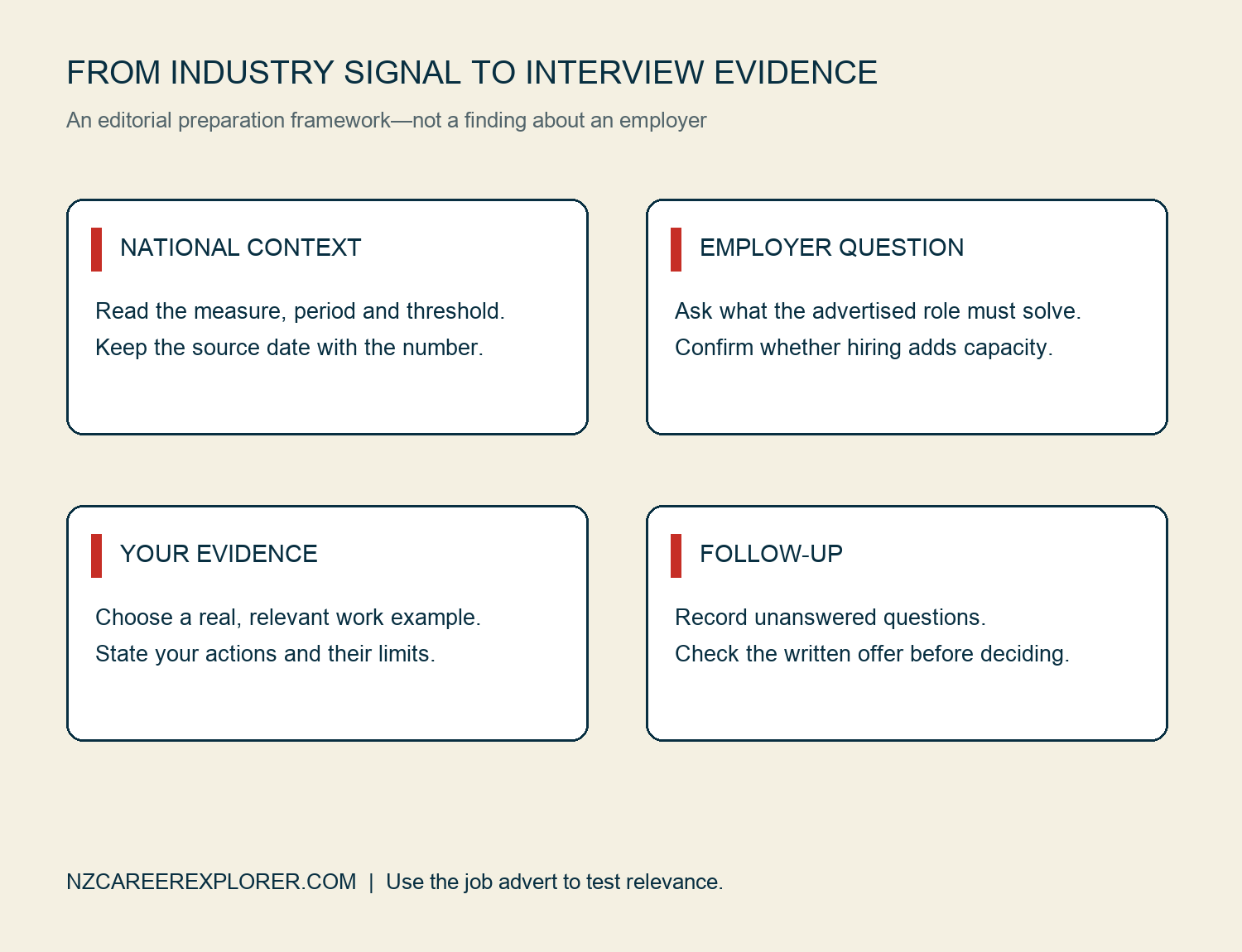
This guide uses the October 2026 manufacturing release to build an interview evidence planner. It separates three tasks: reading the industry signal, checking the actual vacancy and choosing evidence from your own work. The questions and worked example are our editorial framework, not findings about any named employer.
What the latest manufacturing data actually says
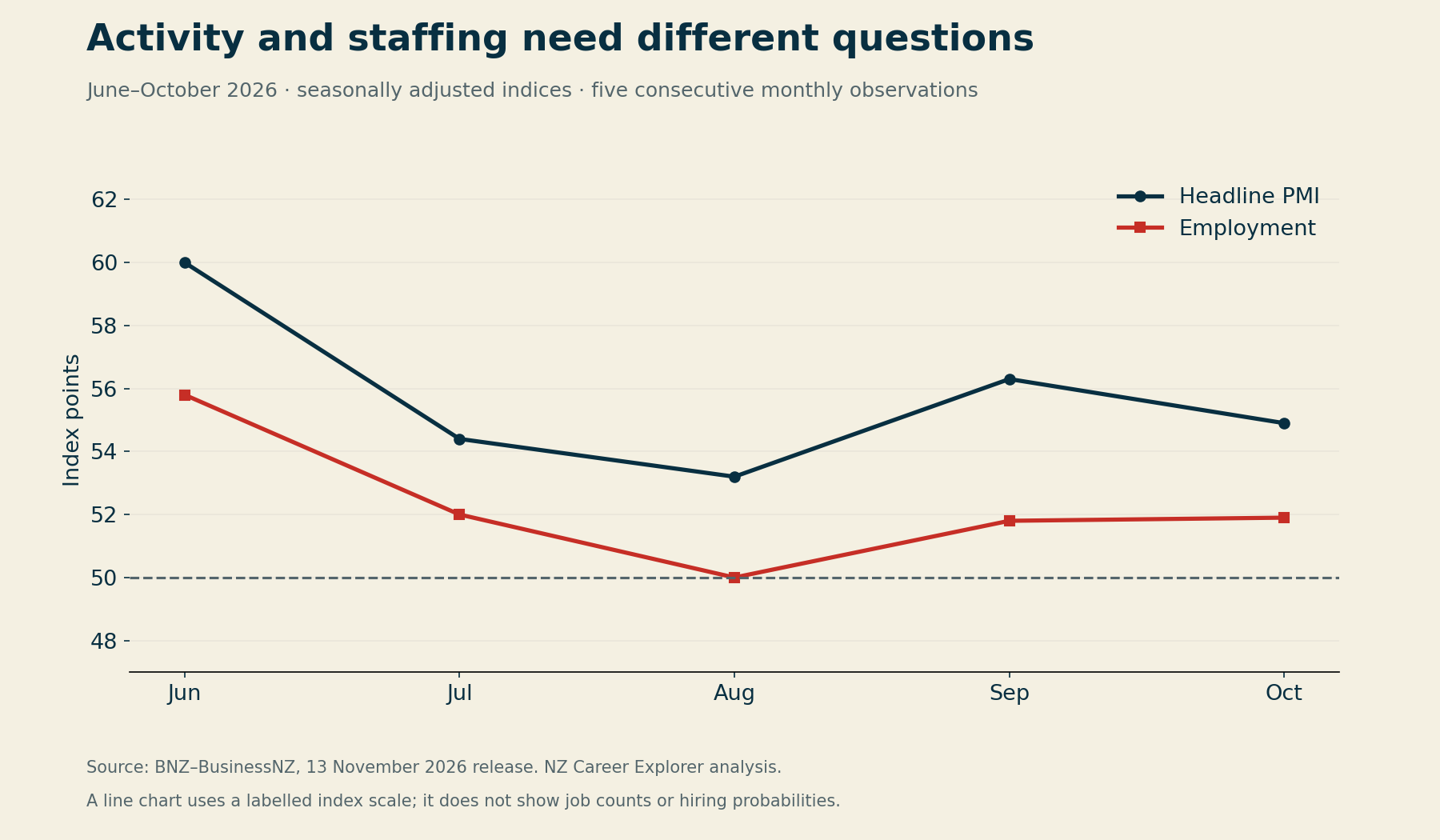
The BNZ–BusinessNZ release published on 13 November 2026 reports an October headline PMI of 54.9, compared with a revised September reading of 56.3. These seasonally adjusted index readings describe activity. They are not percentage growth rates.
A reading above 50 indicates expansion. However, an expanding national sector does not establish an individual employer’s vacancies, wages or recruitment plans. Read the survey alongside the job description, not as a substitute for it.
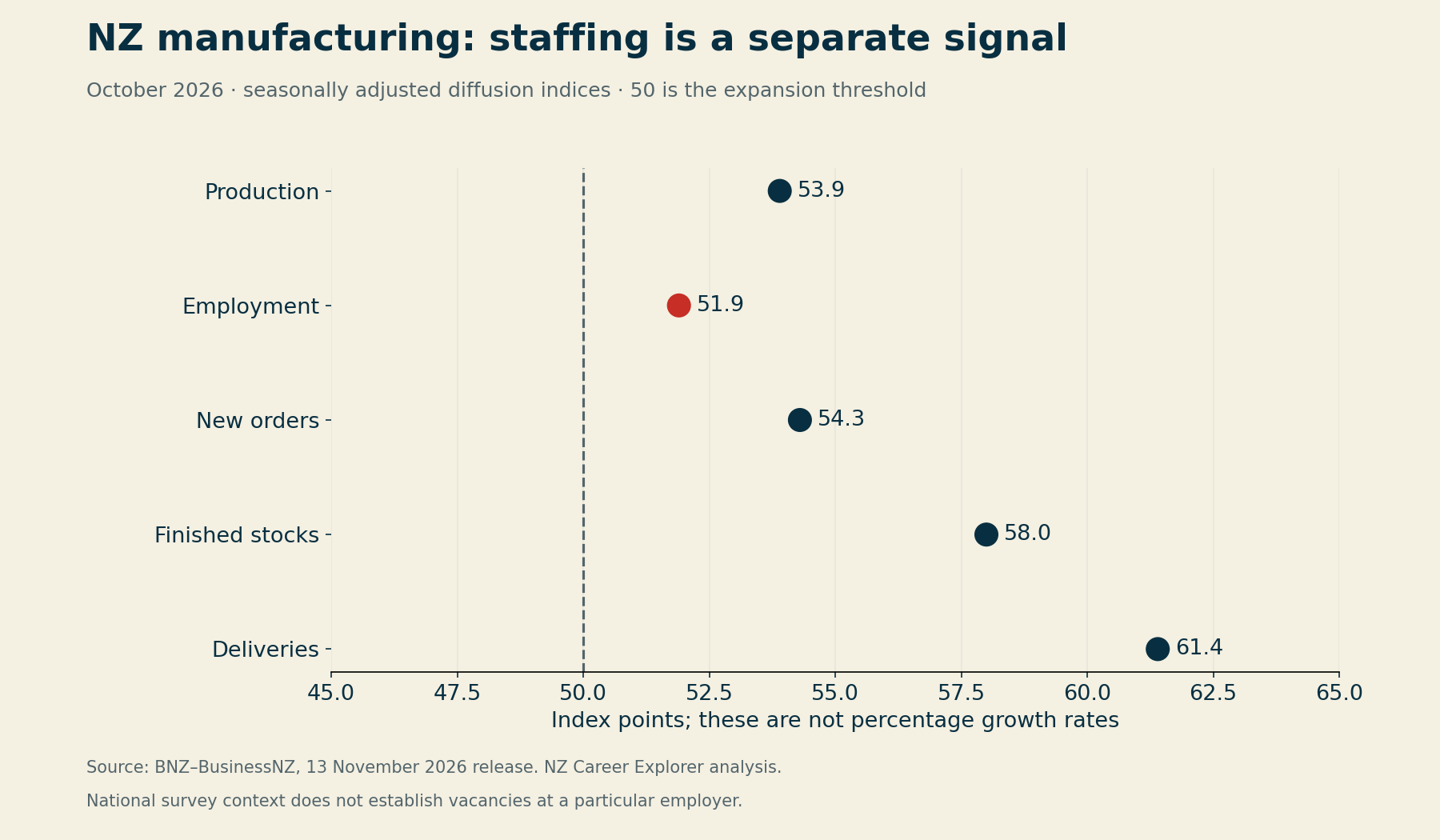
| October indicator | Index | Question to adapt |
|---|---|---|
| Employment | 51.9 | Is this an additional role or a replacement? |
| Production | 53.9 | Which output or quality problem will the role address? |
| New orders | 54.3 | How does the team plan for changing workloads? |
| Finished stocks | 58.0 | How are stock accuracy and handovers managed? |
| Deliveries | 61.4 | What happens when materials arrive late or out of sequence? |
The table links published indicators to suggested questions. It does not claim that any of these problems exists at the employer interviewing you. Use neutral wording and invite the interviewer to explain their situation.
NZ manufacturing interview preparation: direction versus change
For each indicator, we subtract September from October using the same release vintage. The headline fell 1.4 index points. Production fell 2.7, new orders fell 2.5 and finished stocks fell 1.0. Employment rose 0.1 and deliveries rose 2.3. A falling reading can still remain above the expansion threshold.
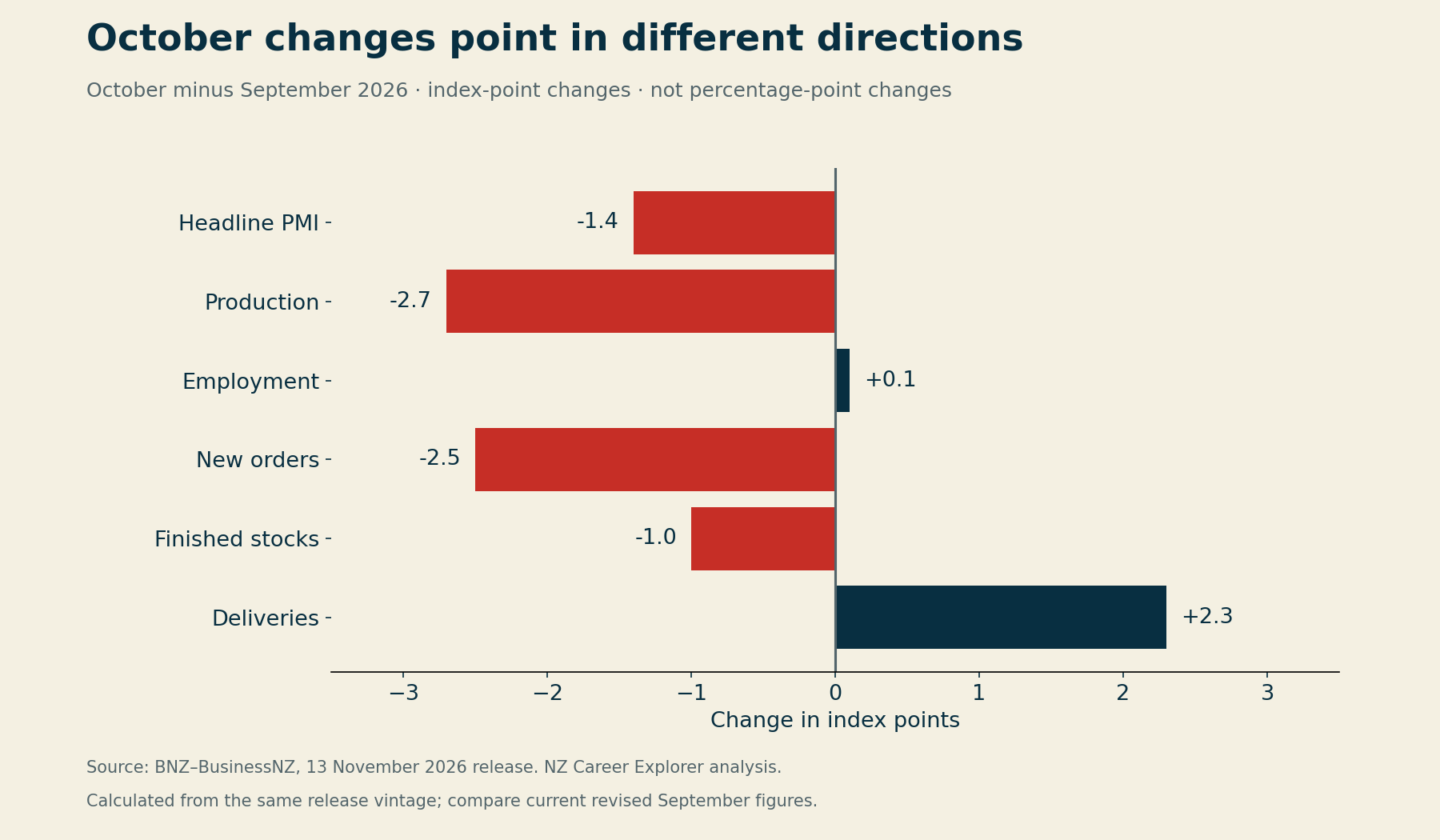
That distinction gives you a useful interview habit: ask about the work before making a claim about the business. For example, replace “your factory must be expanding” with “what has created the need for this position?” The second question leaves room for replacement hiring, a different shift pattern or a new skill requirement.
Similarly, avoid treating one positive indicator as proof of job security. A vacancy may involve a specialist task even when the wider industry is busy. The interviewer can explain the position; the national release cannot.
Use industry context without overclaiming
For NZ manufacturing interview preparation, choose one relevant signal rather than reciting the whole release. If the job advert stresses production planning, ask about scheduling and handovers. If it stresses inspection, ask how the team defines an acceptable result and records defects.
Our regional job-ad analysis helps with a different decision: where to focus a search. This article helps you prepare for a specific conversation after finding a vacancy. Neither resource replaces checking that the role is still open.
Five questions to adapt to the actual vacancy
1. What should the person achieve first?
Ask the interviewer to describe a useful early result. It could concern a reliable handover, a safe setup routine or learning a product specification. Then connect your answer to a real example that fits the task.
For a junior role, you might discuss how you followed a procedure and asked for a check. For an experienced role, you might explain how you identified a recurring problem and documented the response. Be clear about what you did personally.
2. Is the vacancy replacement hiring or added capacity?
This question helps you understand the role without assuming growth. Follow up on the team structure, reporting line and reason for the vacancy. Ask how success will be assessed, rather than promising to transform a process you have not seen.
Listen for concrete details. A clear description of responsibilities is more useful than a broad statement that the business is busy. Write down unanswered points for a later discussion.
3. How will training fit around production?
Ask who provides instruction, which tasks require supervision and how the team checks competence. Avoid claiming that a short course qualifies you for every machine or process. Explain the limits of your experience honestly.
Personalized Career Consulting
Unlock your potential with expert career advice tailored to your goals. Get personalized guidance and actionable steps toward your dream career in New Zealand.
Get StartedIf you are new to New Zealand, describe overseas experience in terms the employer can assess. Explain the equipment, task and checking process. Ask which local requirements apply to the advertised role; do not assume that similar job titles have identical duties.
4. How does the team manage changing workload?
Use this to explore communication, scheduling and priorities. You could ask how the supervisor handles urgent work while protecting quality. Keep the question open; the national survey does not establish a bottleneck at this site.
Prepare an example of a change you actually handled. State the constraint, your action and the result you can support. If you cannot verify a numerical improvement, describe the observable outcome without inventing a percentage.
5. Which hours and responsibilities will appear in writing?
Ask about the advertised schedule, location and expected duties. If the interviewer mentions a possible variation, clarify whether it is part of the role or only a future possibility. Keep notes so you can compare the written offer with the conversation.
Our casual and fixed-term comparison provides a separate framework for evaluating an offer. Use appropriate official guidance or qualified advice when your particular employment terms need interpretation.
A fictional NZ manufacturing interview preparation example
Imagine an advert asking for safe machine setup and careful record keeping. The candidate has completed supervised setup checks in a previous role. That is a relevant starting point, even if they have never worked on this employer’s equipment.
A grounded answer would describe the procedure followed, the check requested and the record retained. The candidate could then ask: “How does your team train someone on this equipment, and who signs off competence?” This connects real experience to an unanswered employer question.
An unsupported answer would claim that the candidate will increase output because the national industry is expanding. There is no evidence for that promise. This example is fictional and contains no measured candidate or employer results.
Download the data and interview planner
Use the blank planner privately. Keep confidential employer documents and personal identifiers out of any version you share. A concise note about your own work is usually enough to prepare a question.
- June–October 2026 manufacturing index data (CSV)
- Blank manufacturing interview evidence planner (CSV)
- Fictional worked interview-planner row (CSV)
The data file records the indicator, monthly readings, units, adjustment and primary-source URL. The blank planner links each signal to an employer question, advert evidence and your own example. The separate worked row shows the method with fictional details; it is not research data.
Method, limits and suggested citation
We transcribed the release’s June–October table and checked each plotted value against it. Monthly changes use October minus September from that same table. The time-series chart connects consecutive months only. We did not estimate vacancies, wages, interview success or employer-level growth.
The three charts serve different purposes: comparing October indicators, showing monthly direction and separating activity from staffing over time. The interview framework is editorial analysis. It has not been tested as an intervention and offers no guarantee of selection.
Suggested citation: NZ Career Explorer, NZ Manufacturing Interview Preparation: Turn PMI into Better Questions, 14 November 2026. Data: BNZ–BusinessNZ October 2026 PMI release, published 13 November 2026. Recheck the source before reusing figures because subsequent releases may revise earlier readings.
Before an interview, confirm the vacancy, read the role requirements again and choose two questions that matter to your decision. Use the evidence planner to make the conversation specific. Keep national context, employer facts and your own experience distinct.
Transform Your Career with a Professional CV and Cover Letter
Stand out to employers with an ATS-optimized resume and tailored cover letter designed to match your dream role. Let us craft your job application materials for success!
Get Started


