





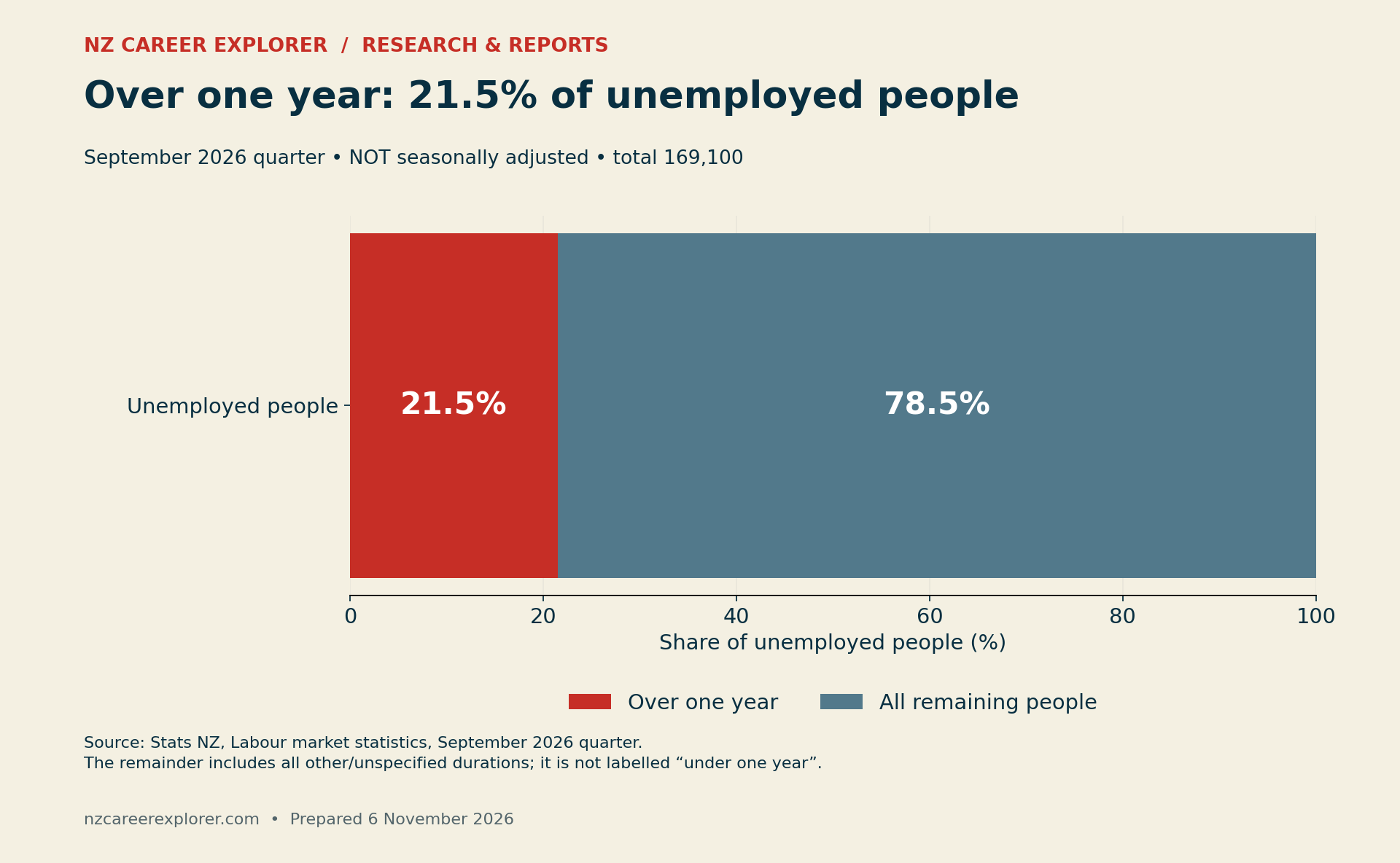
Long-term unemployment NZ figures show why a prolonged job search deserves context as well as a practical review. In the September 2026 quarter, 21.5% of unemployed people in the unadjusted survey estimate had been unemployed for over a year. That is roughly one in five. It does not tell an individual applicant why an employer has not replied.
This guide separates the population statistics from your own application record. It also provides a blank worksheet, a clearly fictional worked example and a decision-tree infographic. Use them to choose a useful next check without treating every unresolved application as a rejection.
What the new long-term unemployment NZ figures measure
Stats NZ published the latest labour-market release on 4 November 2026. Its duration measure uses 169,100 unemployed people, not seasonally adjusted. Multiplying that rounded estimate by 21.5% gives 36,356.5, or approximately 36,400 people. This is our calculation from rounded inputs, rather than a separately published exact count.
The remaining 78.5% includes all other people in that population. We have not labelled it “under one year”: the source duration chart excludes people with unspecified duration or who had not looked for work. Read the official September-quarter release alongside that qualification.
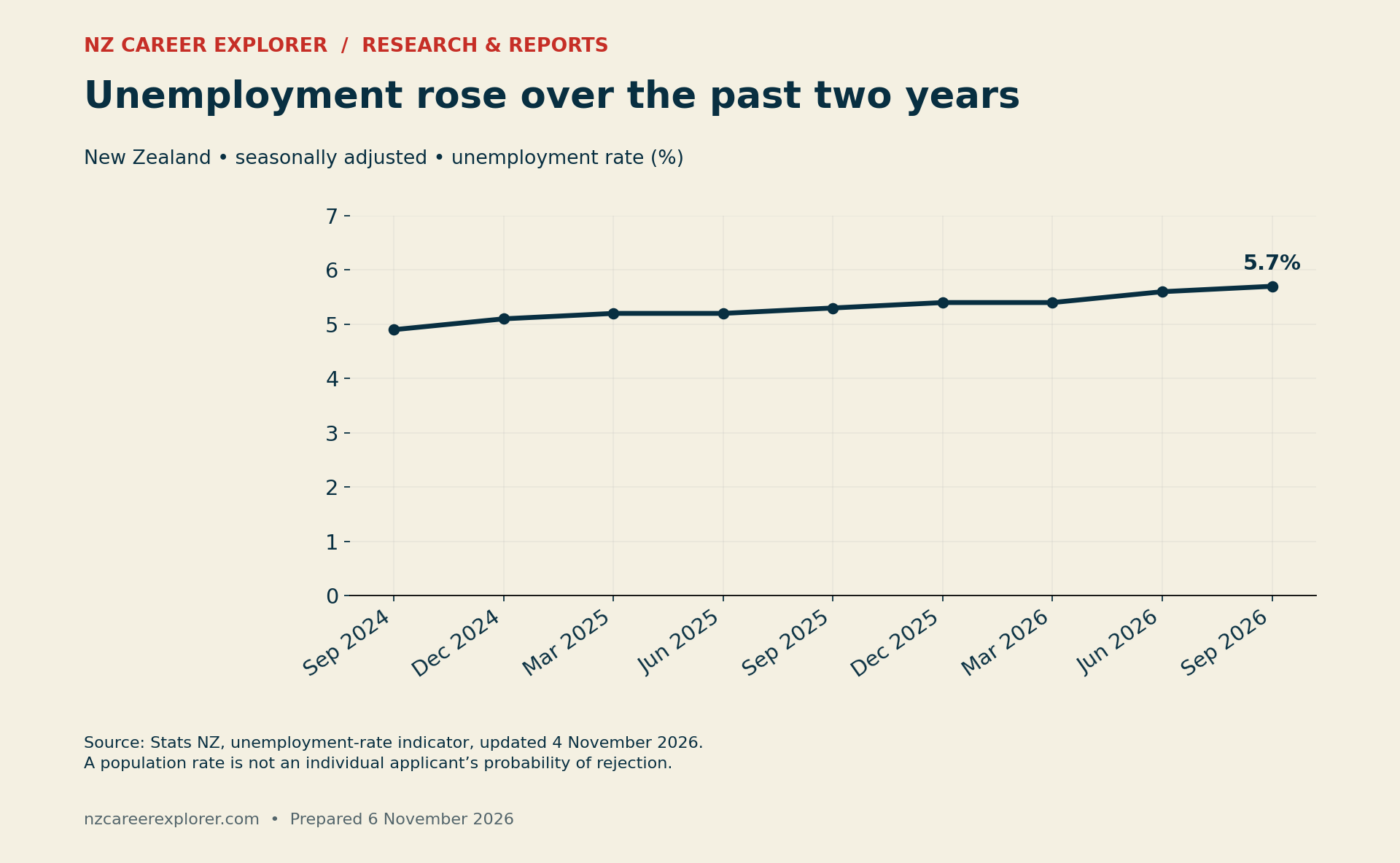
By contrast, the headline unemployment rate was 5.7%, seasonally adjusted, up from 5.6% in June. The corresponding adjusted unemployment estimate was 174,000. Do not multiply the 21.5% duration share by that different total. The unemployment-rate indicator supplies the time series shown below.
A wider view of unmet demand for work
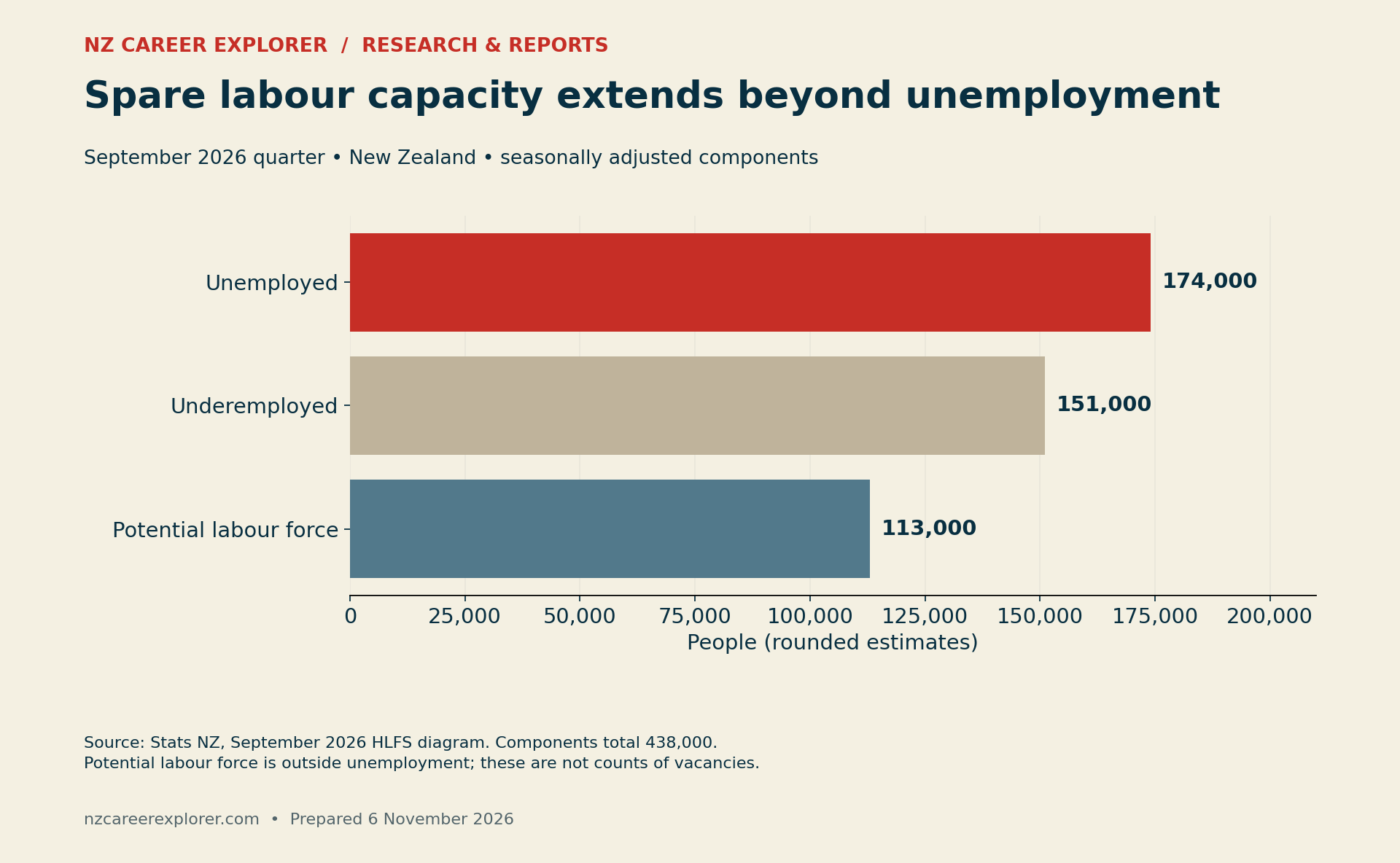
The release also reports 438,000 underutilised people: 174,000 unemployed, 151,000 underemployed and 113,000 in the potential labour force. These rounded, seasonally adjusted components describe different situations. They should not be read as a vacancy count or added to the unemployment total a second time.
For a separate measure of employer activity, see our September filled-jobs analysis. Filled jobs and unemployed people answer different questions. Neither national total replaces a search for suitable roles in your occupation and location.
Review your applications without blaming yourself
Start with a manageable group of comparable applications. For example, review roles in a similar occupation and location over a period you can document. Keep the closing date and review date. A newly submitted application and one with a confirmed outcome are different observations.
First, record evidence against the essential criteria. Separate requirements you meet, requirements you cannot verify and requirements you do not meet. This is your assessment of the advertisement, not proof of the employer’s judgement. If the role requires registration, work rights or a particular licence, check the relevant official rules before assuming eligibility.
Next, record substantive responses, interviewed applications and offers. An automatic acknowledgement is not the same as a human reply. Choose a definition and use it consistently. Count an application that reaches three interview rounds once in the “interviewed applications” field; keep the rounds in a separate note if useful.
Finally, record a current outcome: pending, closed without an offer, offer received or withdrawn. Preserve the evidence and date. Do not interpret silence as a confirmed rejection merely because it feels discouraging. You can still choose to stop actively following up while leaving the formal outcome unknown.
A fictional example: pending is not rejected
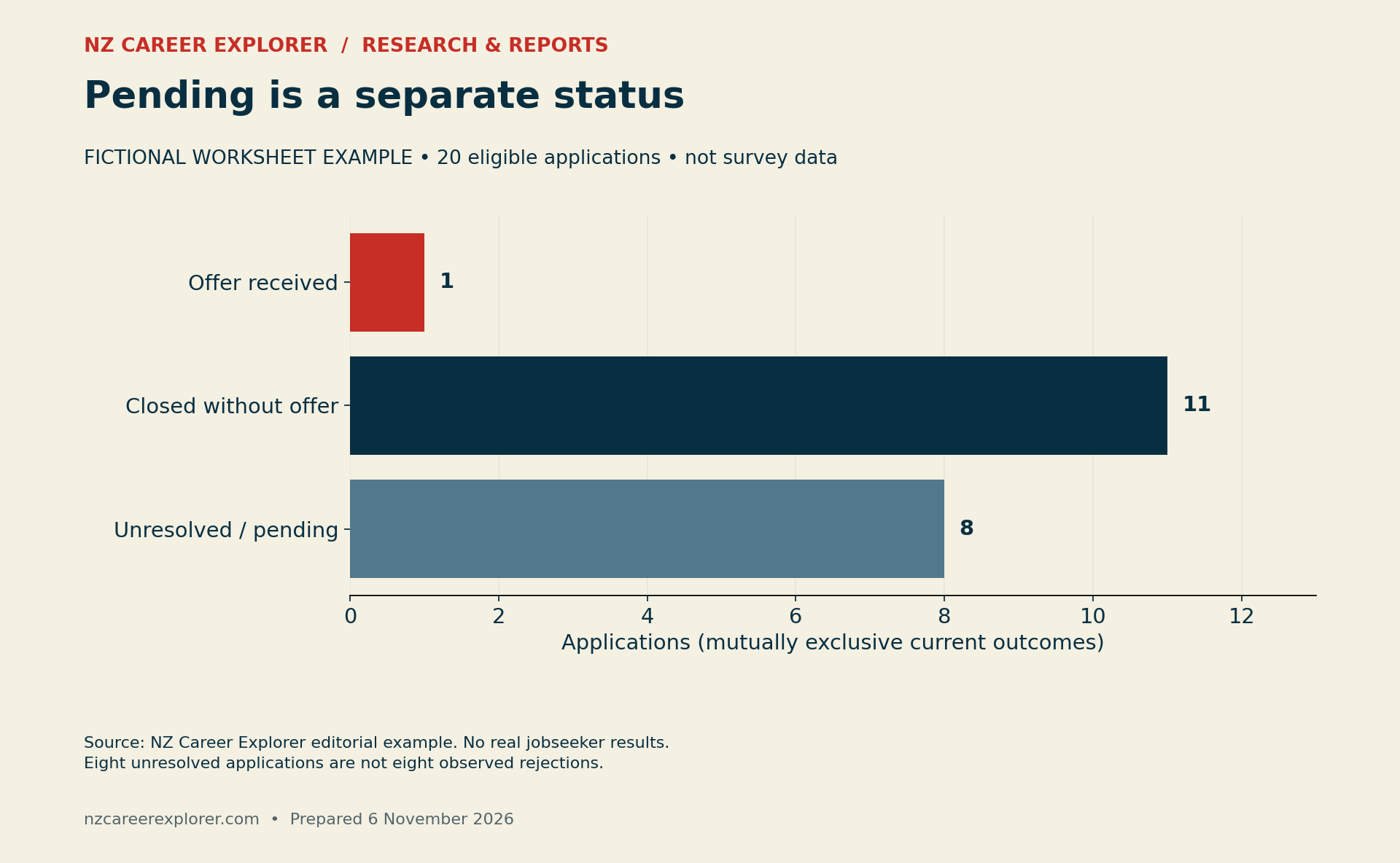
Imagine a private worksheet with 20 eligible applications. At its review date, eight remain unresolved, eleven have closed without an offer and one has produced an offer. Those three current outcomes add to twenty. The example is invented to show the record structure; it is not a sample of New Zealand jobseekers.
The same example records six substantive replies, three interviewed applications and one offer. These stage counts overlap: an offer can also belong to the reply and interview counts. Therefore, adding six, three and one would not give ten separate applications.
| Question | Fictional calculation | What it describes |
|---|---|---|
| How many eligible applications received a substantive reply? | 6 ÷ 20 = 30% | Replies at this review date |
| How many replies progressed to an interview? | 3 ÷ 6 = 50% | Progression among recorded replies |
| How many interviewed applications produced an offer? | 1 ÷ 3 = 33.3% | Offers among interviewed applications |
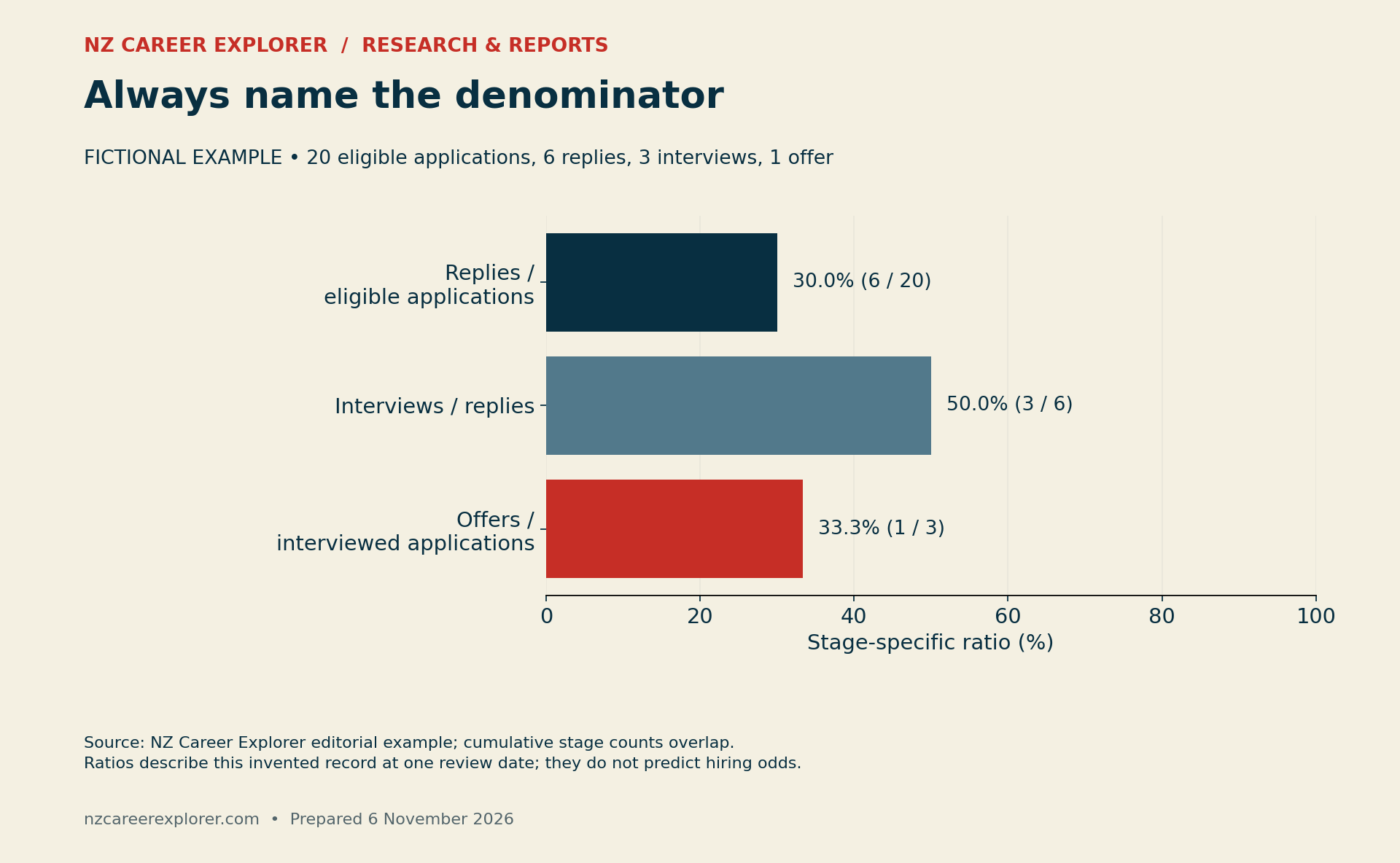
A ratio can change when an employer replies tomorrow. It can also change because you applied for a different mix of roles. Consequently, avoid comparing two small groups as if they were a controlled test. Record an adjustment you want to try, but do not claim that adjustment caused a later result.
Choose the next check from the evidence
If few suitable roles exist locally, review the search area, hours and occupation boundaries you can realistically accept. Include transport, caring responsibilities, accessibility and income constraints. A wider search may be impractical; recognising that constraint is more useful than prescribing endless applications.
Personalized Career Consulting
Unlock your potential with expert career advice tailored to your goals. Get personalized guidance and actionable steps toward your dream career in New Zealand.
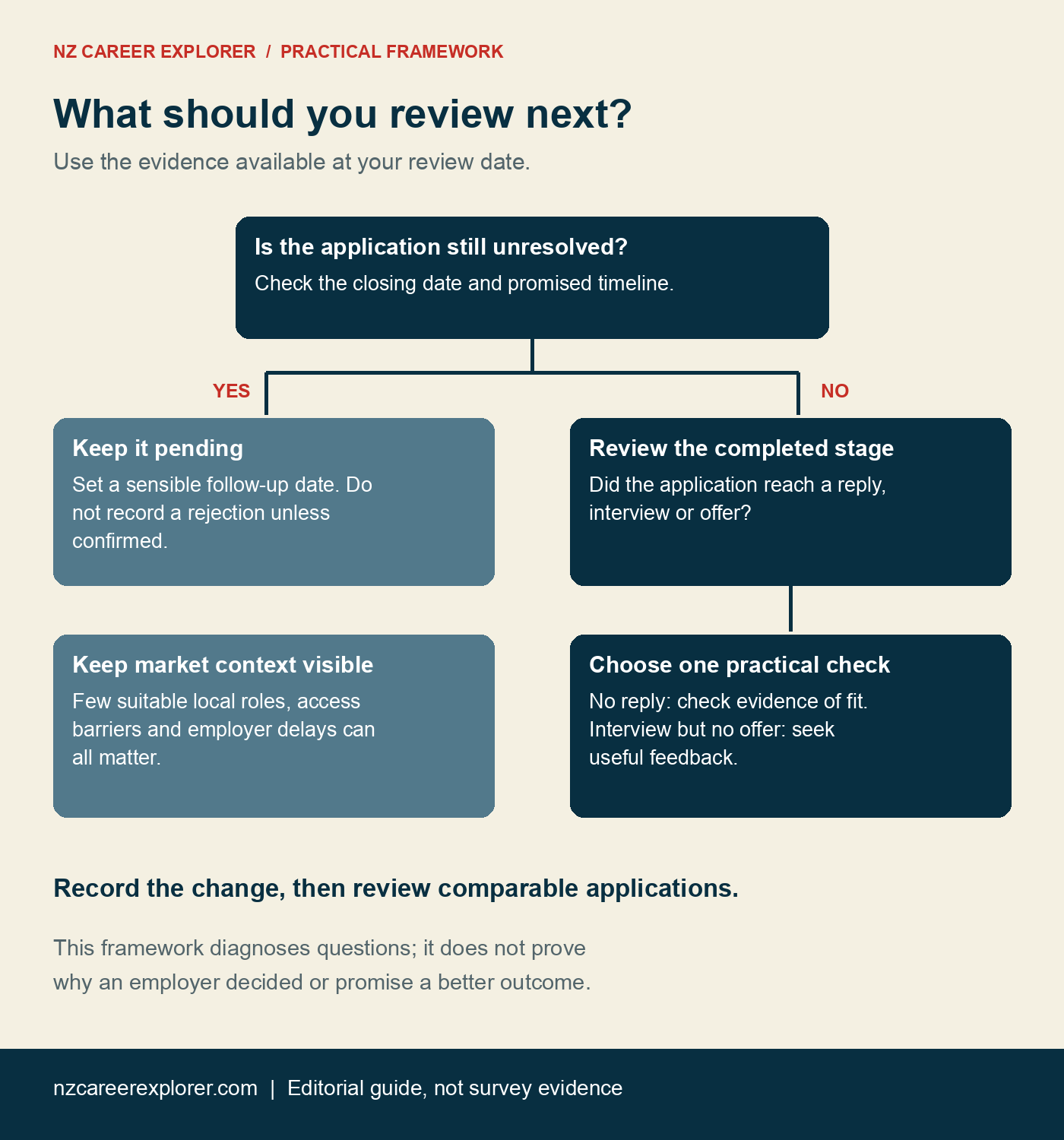
Get StartedIf suitable applications receive few substantive replies, ask a trusted adviser to compare one application with its advertisement. Check whether the evidence is easy to find and specific to the essential criteria. Also consider employer delays and competition. A missing reply alone cannot diagnose a weak CV.
If applications reach interviews without offers, prepare a small set of clear examples and ask for actionable feedback where appropriate. Record the feedback as one employer’s response. You do not need to turn a subjective comment into a universal rule about your abilities.
For pending cases, use any timeline the employer supplied. If none exists, choose a reasonable follow-up point and a limit on the time you spend chasing it. Continue other suitable applications while preserving the unresolved status. Do not repeatedly contact an employer after a clear request to stop.
Official help and relevant newcomer checks
Work and Income’s Find jobs service explains MyMSD job search, matching and applications. Its public guidance is available to read; access to particular services or financial assistance has its own conditions. Ask the agency which support fits your circumstances instead of assuming every programme is universally available.
For newcomers, Immigration New Zealand’s guide to finding work covers search routes, qualifications and occupational registration. Check your own visa conditions through the official service. A national unemployment statistic cannot determine your work rights or an employer’s sponsorship decision.
Our MSD work-broker role analysis explains one part of the employment-support system. It is background reading rather than a promise that a particular vacancy or support appointment is currently available.
Download the data and application-review tools
The source-data file separates percentages, people, adjustment status and source URLs. The blank worksheet has twenty application IDs and no personal data. Store your completed version privately; there is no need to publish CVs, names of referees or confidential employer messages.
Download the source figures and derived calculation (CSV)
Get the blank application-review worksheet (CSV)
Open the fictional worked example (CSV)
Read the field definitions and cautions (CSV)
Choose one review date and one practical change to investigate. Keep original outcomes intact as new information arrives. The purpose is a clearer record and a better question for your next conversation, not a score that judges your worth.
Methodology, limitations and citation
We checked Stats NZ’s 4 November release and current indicator on 6 November 2026. The charts reproduce selected official estimates, calculate the duration-share complement and illustrate the worksheet with fictional data. The source estimates are rounded and subject to survey variability and revision. We do not test statistical significance or establish causes of changes.
This is a cross-sectional market snapshot, not a study of applicants followed over time. It cannot identify why someone is unemployed, how long their search will take or which intervention works. The worksheet is an editorial planning tool and has not been validated as a hiring predictor.
Transform Your Career with a Professional CV and Cover Letter
Stand out to employers with an ATS-optimized resume and tailored cover letter designed to match your dream role. Let us craft your job application materials for success!
Get StartedSuggested citation: NZ Career Explorer, “Long-Term Unemployment NZ: What the New Data Means for Your Job Search,” prepared 6 November 2026, using Stats NZ, Labour market statistics: September 2026 quarter. Cite Stats NZ for the survey results and this article for the worksheet design and derived approximation.


