





Looking for research jobs at Mātai in Gisborne? The 29 October expansion announcement is worth following, but it is not a list of roles open today. Separate the funding decision, building timeline, projected opportunities and the employer’s actual recruitment material before planning an application.
The government announced a NZ$20 million loan supporting a NZ$28.4 million innovation-centre project. Its construction, operational-role and annual-placement figures concern different stages and units. They should not be added into a headline count of vacancies available now.
This report provides five figures and four downloadable research tools. The original framework is an opportunity evidence ladder: funding, delivery, employer role, requirements and written offer. Each step needs its own evidence. No complete future recruitment calendar or salary survey was established.
Checked 31 October 2026. Mātai’s official summer-internship page says the 2026–27 round is closed. Its radiologist careers description needs a separate current-availability check.
What the Gisborne funding announcement establishes
The dated government release describes a three-storey Mātai Innovation Centre beside the institute’s existing imaging-research building. The project covers construction and fit-out. The Regional Infrastructure Fund support is a loan, rather than a grant or a payment to applicants.
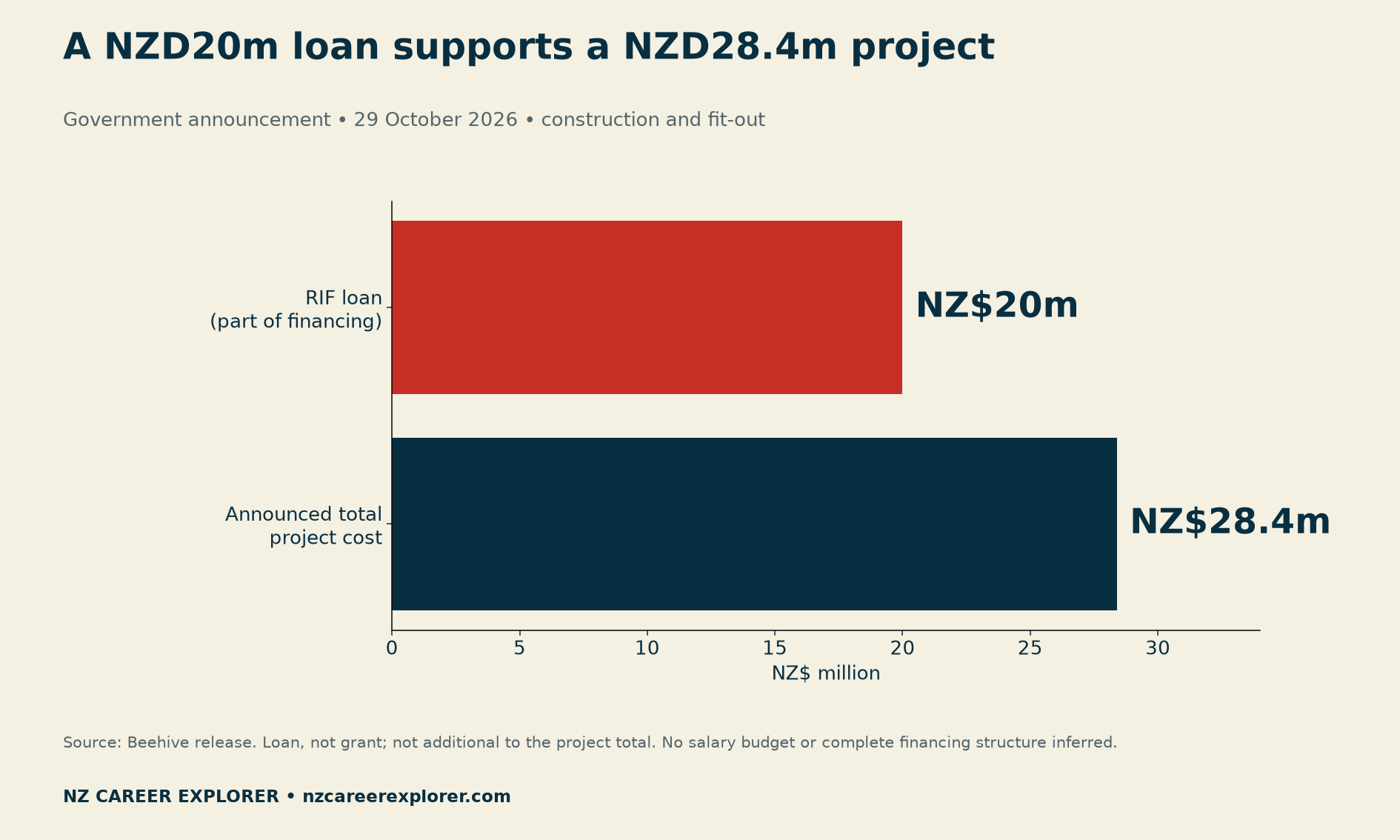
A building investment can help identify an organisation to monitor. It does not establish which occupation will be recruited next, who will employ the person or what qualifications a future advertisement will require. Facilities and job specifications answer different questions.
Read the conditional timeline for Mātai research jobs in Gisborne
Completion is expected by April 2029, dependent on design milestones and consents. That is a conditional project milestone. It is not a confirmed start date for an individual role. The announcement’s longer-term education and research-placement target runs to 2035.
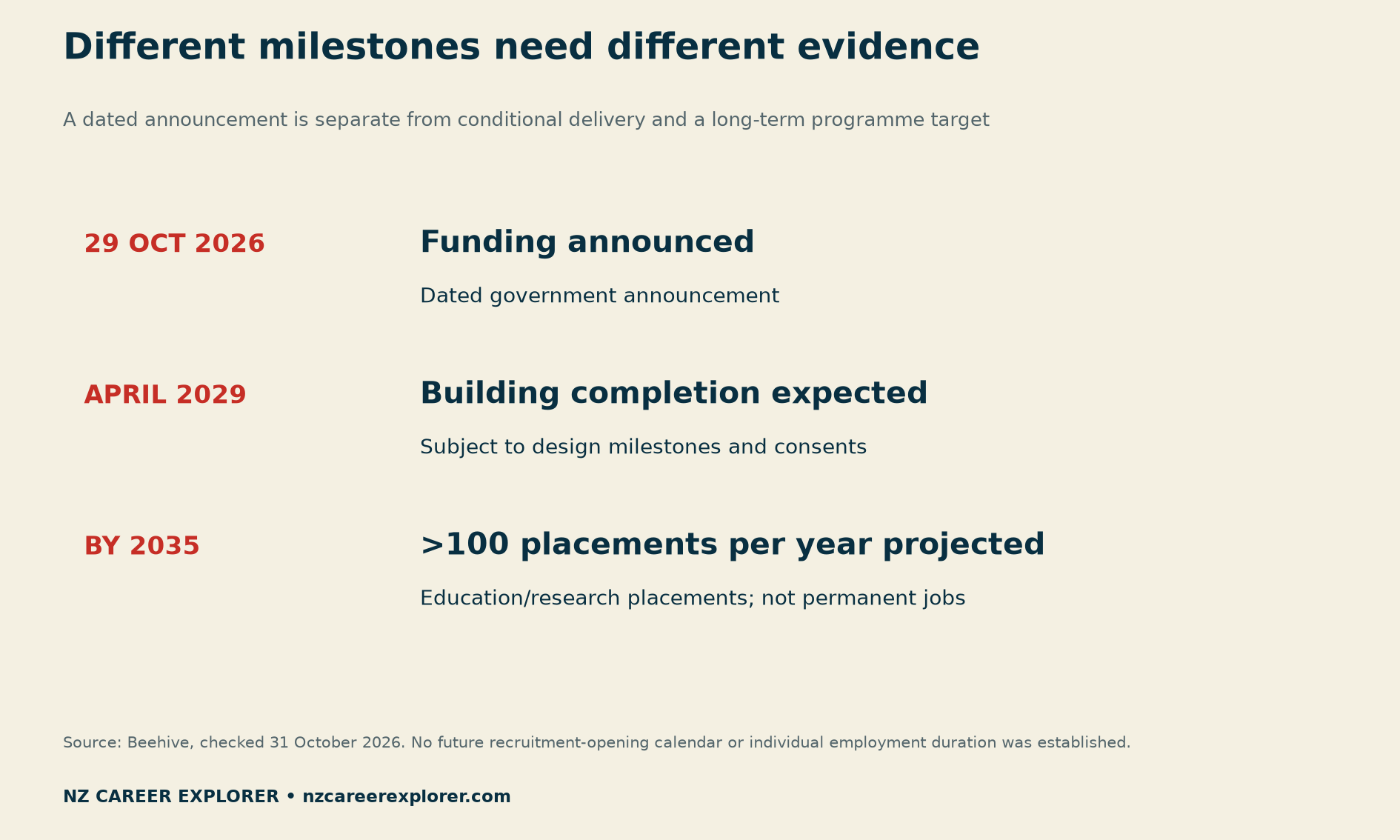
Keep a milestone register with the source, publication date, status and next check. When a later announcement changes a date, retain the earlier version and explain the change. A silent replacement makes it harder for readers to tell whether the project progressed or the timetable moved.
Keep construction, operational roles and placements separate
The release forecasts approximately seventy construction jobs. Once operational, Mātai is expected to support more than 150 full- and part-time roles. Education and research placements are projected to double to more than one hundred a year by 2035. These are three different opportunity measures.
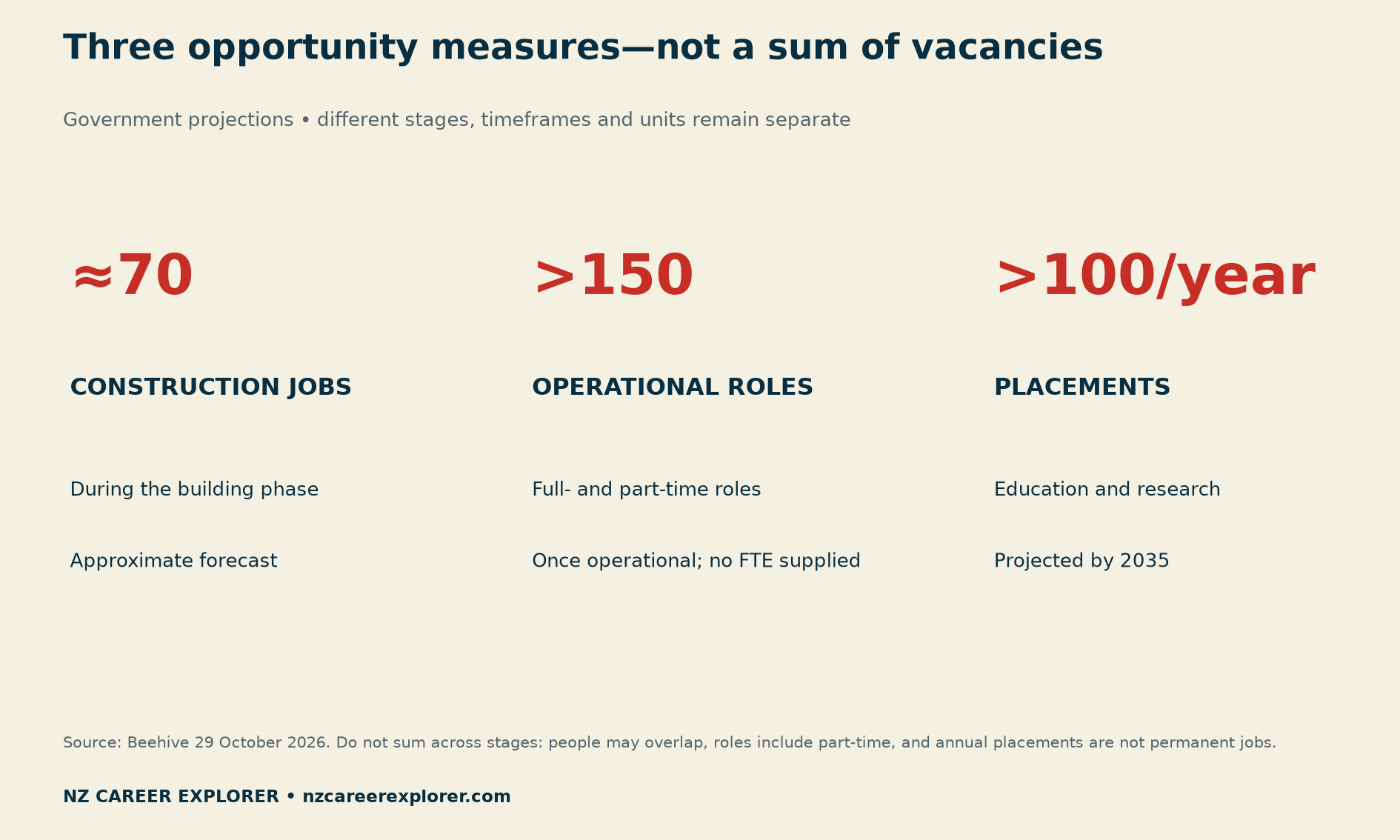
Do not turn the construction and operational figures into 220 jobs available today. The release does not establish that all operational roles would be additional new hires. It also does not provide a full-time-equivalent conversion. Annual placements are not permanent jobs and cannot simply be added to either role figure.
Likewise, “more than one hundred” and “projected to double” do not supply an exact baseline of fifty placements. Preserve the source’s lower-bound wording rather than converting it into an unjustified precise series.
Use an evidence ladder to follow Mātai Gisborne research jobs
The first rung is funding: retain the dated announcement and financing type. The second is delivery: check a confirmed milestone and its remaining conditions. Those rungs support research about the institution. They do not establish an available role for a reader.
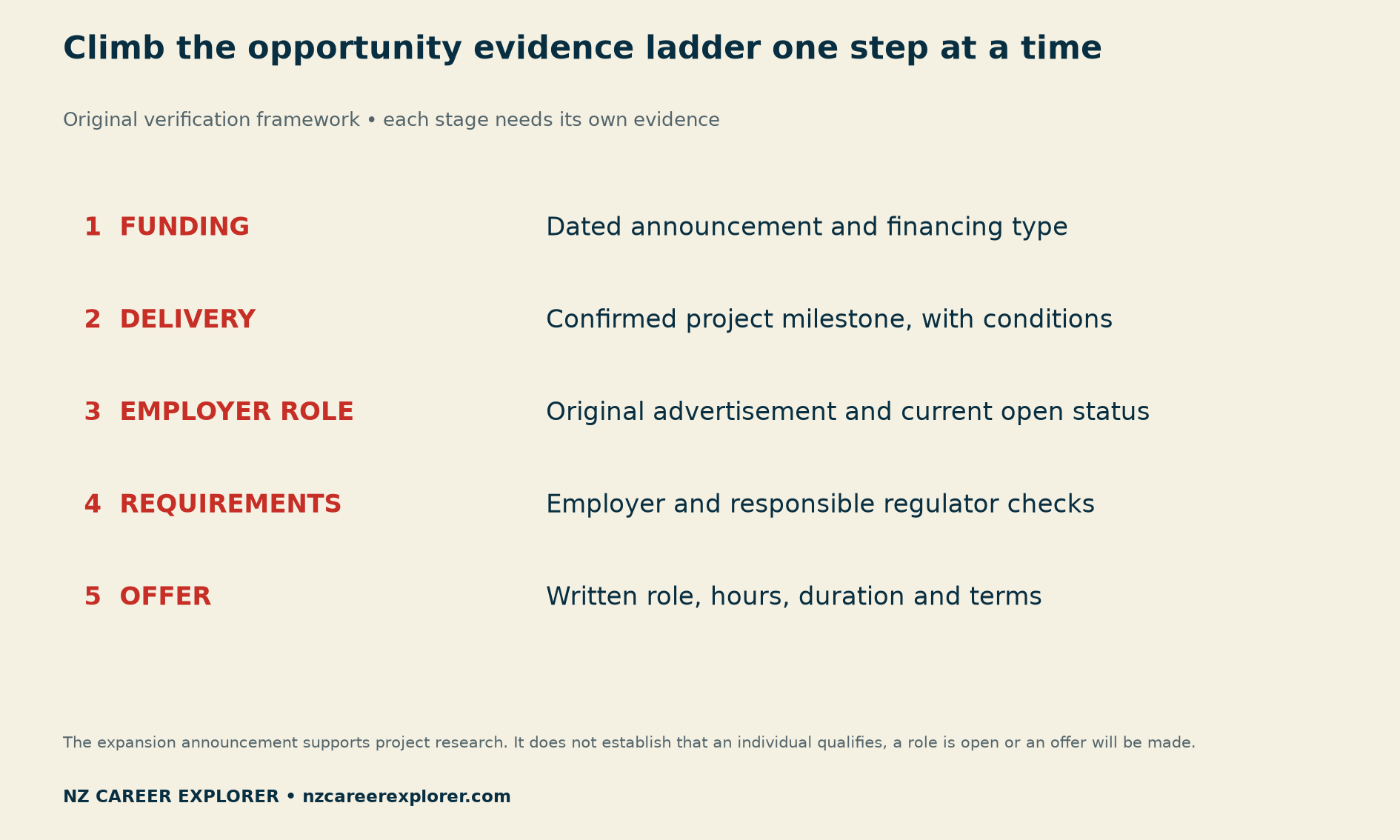
The third rung is the employer role. Find an original advertisement, record its reference and confirm it remains open. The fourth is requirements: compare the actual tasks, qualifications and responsible regulator’s conditions with your own evidence. This article does not decide anyone’s eligibility.
The fifth rung is a written offer with the actual role, hours, duration and terms. Only then can you compare a specific arrangement with alternatives. Our NZ pay-rise calculator guide addresses pay and working-time comparisons when those inputs are known.
What the current Mātai careers and internship pages say
The official summer-internship page says applications for 2026–27 are closed and under review. We did not verify a next-round opening date. The expansion announcement does not reopen that round. Older programme descriptions or past intern reports should not be treated as current application instructions.
Personalized Career Consulting
Unlock your potential with expert career advice tailored to your goals. Get personalized guidance and actionable steps toward your dream career in New Zealand.
Get Started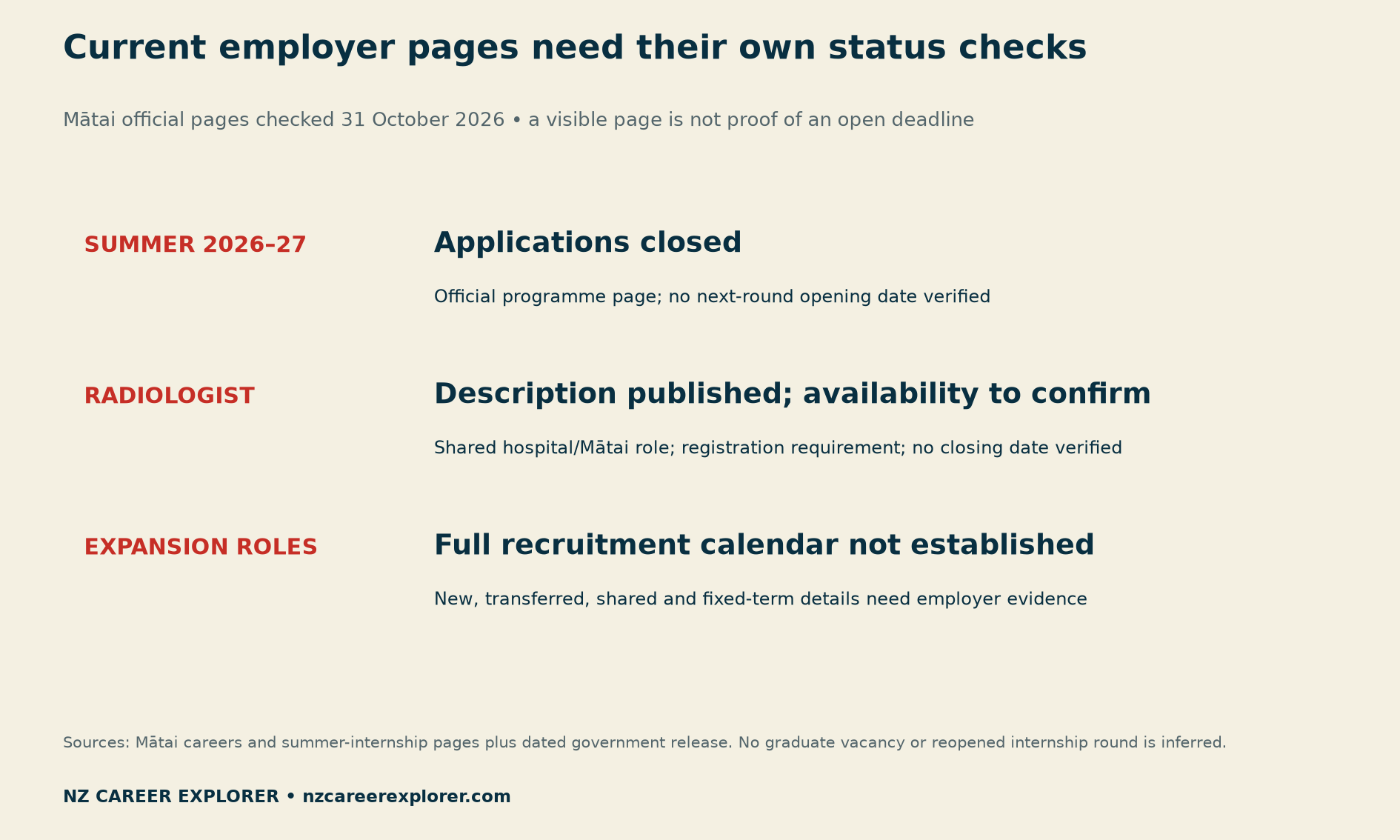
The careers page describes a radiologist role shared between Gisborne Hospital and Mātai. Its requirements state MCNZ vocational registration or eligibility for MCNZ registration. The page is not evidence of a newly announced graduate vacancy, and no closing date was verified there.
For research jobs at Mātai in Gisborne, use the actual employer material to distinguish specialist clinical work from other research opportunities. Applicants with overseas training should use the Medical Council’s registration information and the employer’s current process. We do not interpret registration pathways or assess a person’s clinical suitability.

Prepare evidence without inventing future requirements
The preparation inventory offers areas to reflect on: analysis, documentation, teamwork, ethics learning, technical work and community engagement where relevant. These are editorial prompts, not Mātai’s confirmed selection criteria for future roles. Link any requirement to a real advertisement when one appears.
For an analysis example, explain the question, data source, method and checks. State what you did yourself and what someone else contributed. A reproducible notebook or a clear account of a finding may be useful evidence where the actual role requests those skills.
For documentation, show how a reader can follow your work. For teamwork, describe your responsibility and how you communicated a problem. Keep confidential research, client material and personal information out of a public portfolio. Use material you have permission to share or an explicitly labelled synthetic example.
A preparation plan can remain useful while recruitment dates are unknown. Choose one evidence gap to work on and a date to check official sources again. Do not buy a course or relocate on the assumption that a projected role will become an offer.
Questions to resolve when a real role appears
Ask whether the position is new, transferred, shared or a replacement. Record the employer and funding duration, especially for a fixed-term research contract. Check hours, location and the work expected, then distinguish required credentials from preferred experience. Mark unanswered fields “not established” rather than filling them from the expansion headline.
Our September filled-jobs report applies the same distinction between sector evidence, a current advertisement and personal fit. The Warkworth–Te Hana preparation guide shows a separate project-stage approach to future opportunities. Neither report substitutes for an employer’s actual vacancy terms.
Download the announcement and opportunity tools
Announced measures and source register (CSV) preserves funding, scope and opportunity figures with their qualifiers and units.
Dated milestone register (CSV) separates the announcement, conditional completion, operational stage and placement target.
Opportunity status watch sheet (CSV) records the closed internship round, published radiologist description and unanswered expansion-recruitment questions. Update status from the original employer page before acting.
Blank research-preparation inventory (CSV) helps record your own examples, contribution, checks and permission to share. Its suggested areas are not a verified employer selection rubric.
Methodology and limits
We checked the 29 October government announcement and Mātai’s careers and summer-internship pages on 31 October 2026. The source register preserves the date, units and exact qualifier behind each figure. The diagrams keep unlike opportunity measures separate; no workforce total is calculated across stages.
The original contribution is the evidence ladder, dated opportunity comparison and preparation tools. No occupational breakdown, salary range, complete recruitment calendar or individual eligibility assessment is claimed. Future roles may have different employers, requirements and funding arrangements. Suggested citation: NZ Career Explorer, “Mātai’s Gisborne Expansion: Future Research Jobs and Current Roles,” 31 October 2026, with project projections attributed to the New Zealand Government and current programme status to Mātai.
Transform Your Career with a Professional CV and Cover Letter
Stand out to employers with an ATS-optimized resume and tailored cover letter designed to match your dream role. Let us craft your job application materials for success!
Get Started


