







NZ scaffolding technical assessor jobs call for more than a record of work on site. The useful question is whether you can show how you assessed evidence, supported another person and respected the limits of your authority. A new WorkSafe vacancy makes that distinction concrete.
This report maps the advert into a practical evidence matrix. It also preserves a salary discrepancy rather than choosing the higher figure. Use the chart, source-status register and blank worksheet to organise an honest application. They cannot decide whether you qualify for this particular role.
What the NZ scaffolding technical assessor jobs advert actually says
The Technical Specialist, Construction vacancy was listed on 26 November 2026. It describes a 12-month fixed-term role supporting WorkSafe’s scaffolder Certificate of Competence function. The stated closing date is 10 December at 11:59pm. Check the live listing before applying, because an advert can change.
The work combines technical scaffolding knowledge with competency-assessment support. For an applicant, that creates an evidence problem: years in a trade may establish experience, but they do not explain how you reviewed a difficult question. Choose examples that show your reasoning and your actual contribution.
The salary figures need an employer answer
The advert body gives an expected appointment base salary of NZ$120,551–139,440. Its job-details panel instead displays NZ$120,551–133,143. Those upper figures differ by NZ$6,297. We have retained both, with their locations, rather than treating either as a corrected or confirmed range.
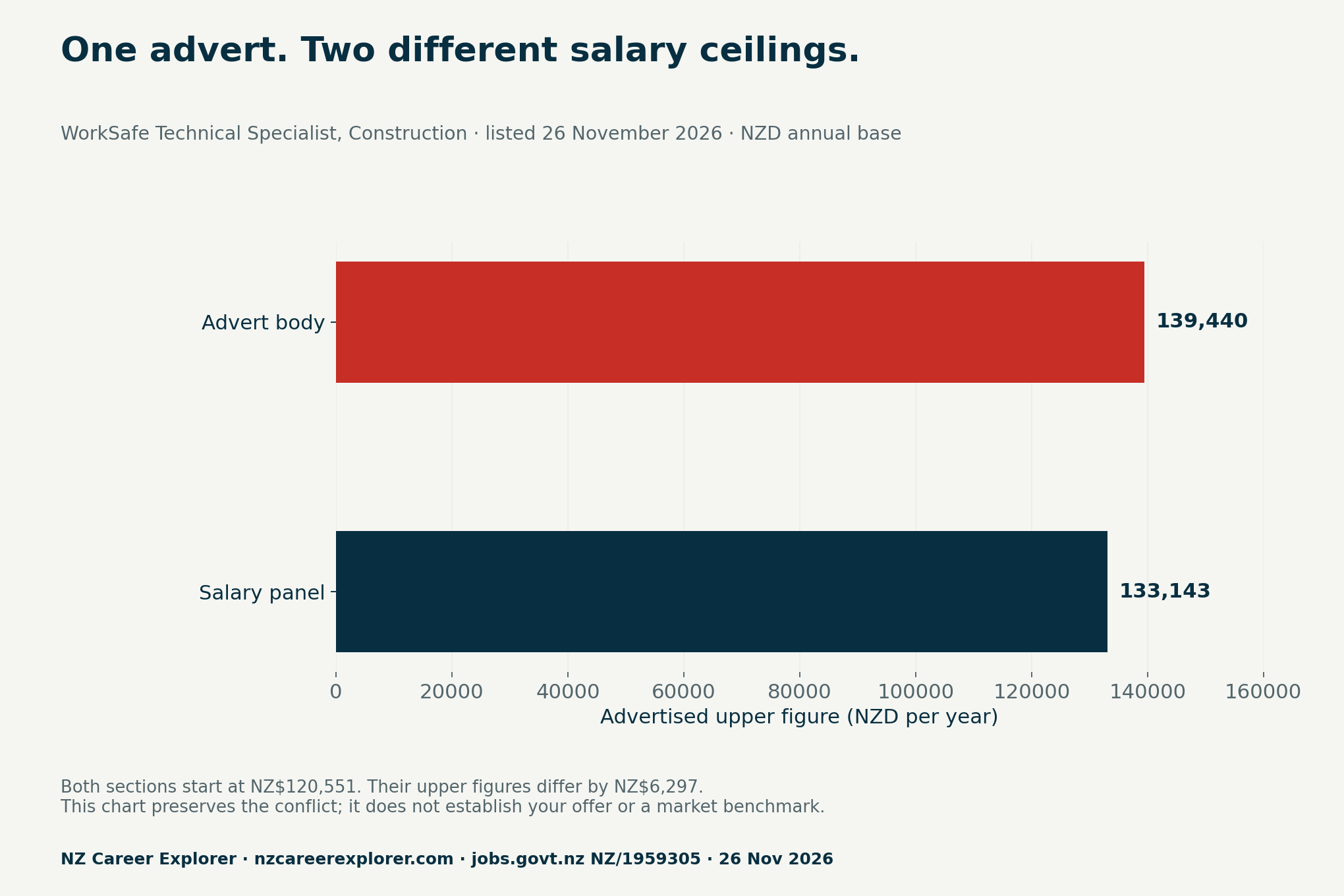
For example, a private comparison sheet could record the two figures and one question: “Which published range should applicants use, and what determines an appointment within it?” Keep the answer with its date. Do not base a resignation, relocation budget or salary expectation on the larger number alone.
This is one specialist vacancy. It is not a scaffolding salary survey, a count of labour shortages or a promise that a particular certificate leads to this pay. Likewise, a fixed term is a contract condition to investigate, rather than a reason to assume the role will become permanent.
Separate site practice, mentoring and assessment
Start with three columns. In the first, describe work you personally performed. In the second, show how you helped someone else understand a process. In the third, identify the decisions you were authorised to make. These may overlap in one project, but they establish different things.
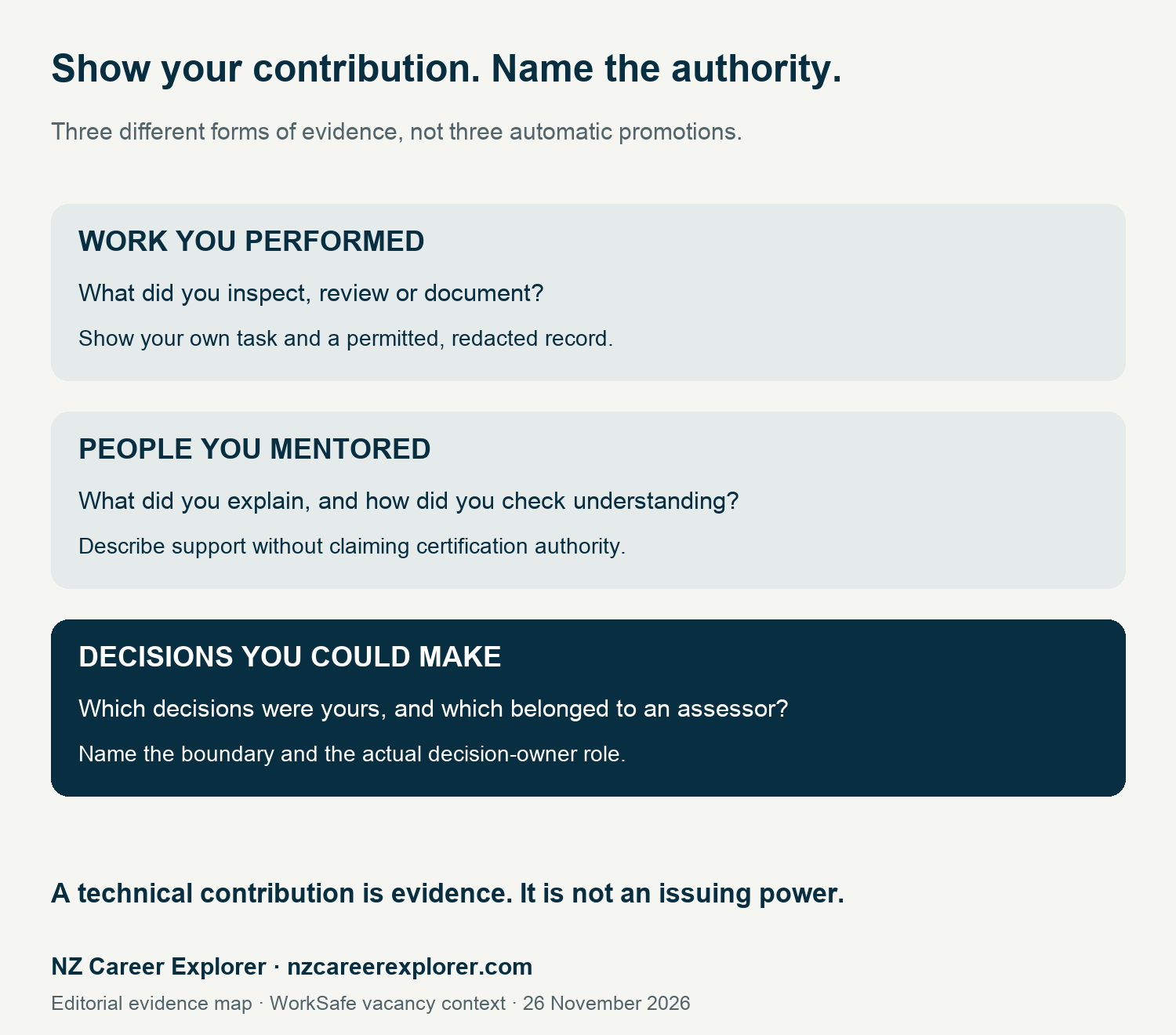
Next, connect each example to something you may lawfully share. A short, redacted summary may be enough to explain your reasoning without disclosing an employer’s technical file. Ask permission where needed. Do not upload confidential safety records, client details or another worker’s assessment material into an application tool or public portfolio.
| Evidence field | Useful question | Claim to avoid |
|---|---|---|
| Work performed | What did I personally review or document? | My team’s whole output was my own |
| People mentored | What did I explain and check? | Mentoring let me certify someone |
| Authority | Who owned the final decision? | I issued approval when I only advised |
| Evidence | What may I share with permission? | A confidential file is a portfolio sample |
A fictional example with an honest boundary
Consider an experienced worker who reviews an inspection record, identifies an unresolved item and prepares a clear summary for an authorised assessor. They also explain the documented escalation process to a new colleague. This fictional worker can describe their review and mentoring. They cannot say they issued a certificate if that decision belonged to someone else.
A useful sentence names the action and its limit: “I prepared the evidence summary and explained the escalation route; the authorised assessor owned the final decision.” Replace that sentence with your own truthful experience. Avoid copying a synthetic example into a CV as though the work happened.
Then add the outcome you can actually support. That might be a clearer handover, a documented question or a revised record. If you cannot prove a safety improvement or a percentage reduction, do not invent one. A precise account of a modest contribution is more useful than a dramatic claim with no evidence.
Check the transition without assuming the handover date
WorkSafe’s transition guidance says its new process is expected to go live in December 2026, with the exact date still to be confirmed. Meanwhile, the SARNZ application form’s privacy notice refers to transfer on 1 December 2026. The sources use different levels of certainty. Ask the responsible organisation for the current position before relying on a specific handover date.
WorkSafe also says existing SARNZ-issued certificates remain valid until they expire. The transfer alone does not mean a current holder must replace a card early. That statement concerns certificate validity. It does not establish that an applicant meets the requirements of this specialist vacancy.
Overseas-trained readers should check the current route separately. SARNZ’s October prior-learning update says its recognition-of-prior-learning pathway is no longer a recognised route to a New Zealand scaffolding certificate. It describes work on possible options, rather than an available approval. Do not treat overseas experience, an earlier webpage or a planned pathway as a current certificate decision.
Personalized Career Consulting
Unlock your potential with expert career advice tailored to your goals. Get personalized guidance and actionable steps toward your dream career in New Zealand.
Get StartedPrepare focused questions before applying
First, ask about the salary conflict. Next, clarify which assessment or authorisation experience the employer expects, and how it wants that evidence presented. Finally, check the fixed-term arrangements, office expectations and permitted ways to discuss prior work. Keep questions concise and tied to something you could not resolve from the current advert.
An evidence gap is useful information. If your experience is mainly site delivery, you may have strong technical examples but limited assessment exposure. Record that honestly. Ask whether the role needs prior formal assessment experience, instead of renaming routine site supervision to make it sound like regulatory authority.
Download the auditable source table and working tools
The pay audit preserves both sections of the listing. The status register keeps the timing and pathway qualifications beside their sources. A blank evidence matrix and a clearly fictional worked example help readers prepare their own private records. None contains applicant data or a scored eligibility test.
- Advert salary figures and discrepancy audit (CSV)
- Transition and advert source-status register (CSV)
- Blank personal evidence matrix, without identifying fields (CSV)
- Fictional evidence example and claim boundaries (CSV)
Method: we checked the linked vacancy and transition sources on 26 November 2026. The salary difference is 139,440 minus 133,143, or NZ$6,297. One chart is sufficient because the useful numerical comparison is the salary conflict. Extra plots would imply a dataset on workers, outcomes or demand that these sources do not provide.
For related career reporting, browse Research & Reports. Our metrology technician evidence guide offers another example of describing technical work carefully. Suggested citation: NZ Career Explorer, “NZ Scaffolding Careers: From Site Experience to Technical Assessment”, 26 November 2026.


