





A learning designer vs training coordinator NZ comparison becomes useful when both roles face the same task. Our fictional procedure change affects 18 staff across three shifts. The designer sample explains what people must learn; the coordinator sample shows how delivery will reach them and where gaps remain.
Two public-sector adverts listed on 19 November 2026 provide the context. The Ministry of Justice learning designer role emphasises accessible learning materials and a varied portfolio. The Customs coordinator role concerns delivery logistics, resources, records and evaluation support. These are two specific cases, not a survey of the profession.
Learning designer vs training coordinator NZ: check each advert separately
As checked on 22 November, Justice lists a 23 November close and says it reviews applications before closing. It accepts a relevant qualification or equivalent knowledge, skills and experience. Its fixed-term description also gives an end date of 30 June 2027. Ask the employer to clarify any term detail that affects your decision.
Customs lists a 26 November, 11pm close. Its title refers to January 2028 while the body describes 12-month parental-leave cover; confirm the exact dates rather than calculating a start date from those labels. This is a repost, not evidence of a newly created position.
Also read the Customs citizenship or permanent-residence, residence-history, drug-test and clearance conditions directly. They belong to that listing, not every training role. Newcomers should ask recruitment about their own circumstances instead of assuming that portfolio quality settles eligibility.
Use one small scenario rather than two unrelated portfolios
Our invented workplace changes how staff record an incomplete shift handover. Eighteen staff work across shifts A, B and C, six per shift. The learning objective is narrow: identify a missing handover field, ask the named owner for clarification and avoid marking the handover complete until the gap is resolved.
No actual employer procedure or staff record is used. Give the example a version number and a short fictional fact sheet. That keeps the design decisions and delivery decisions comparable without implying that the exercise has been trialled with real learners.
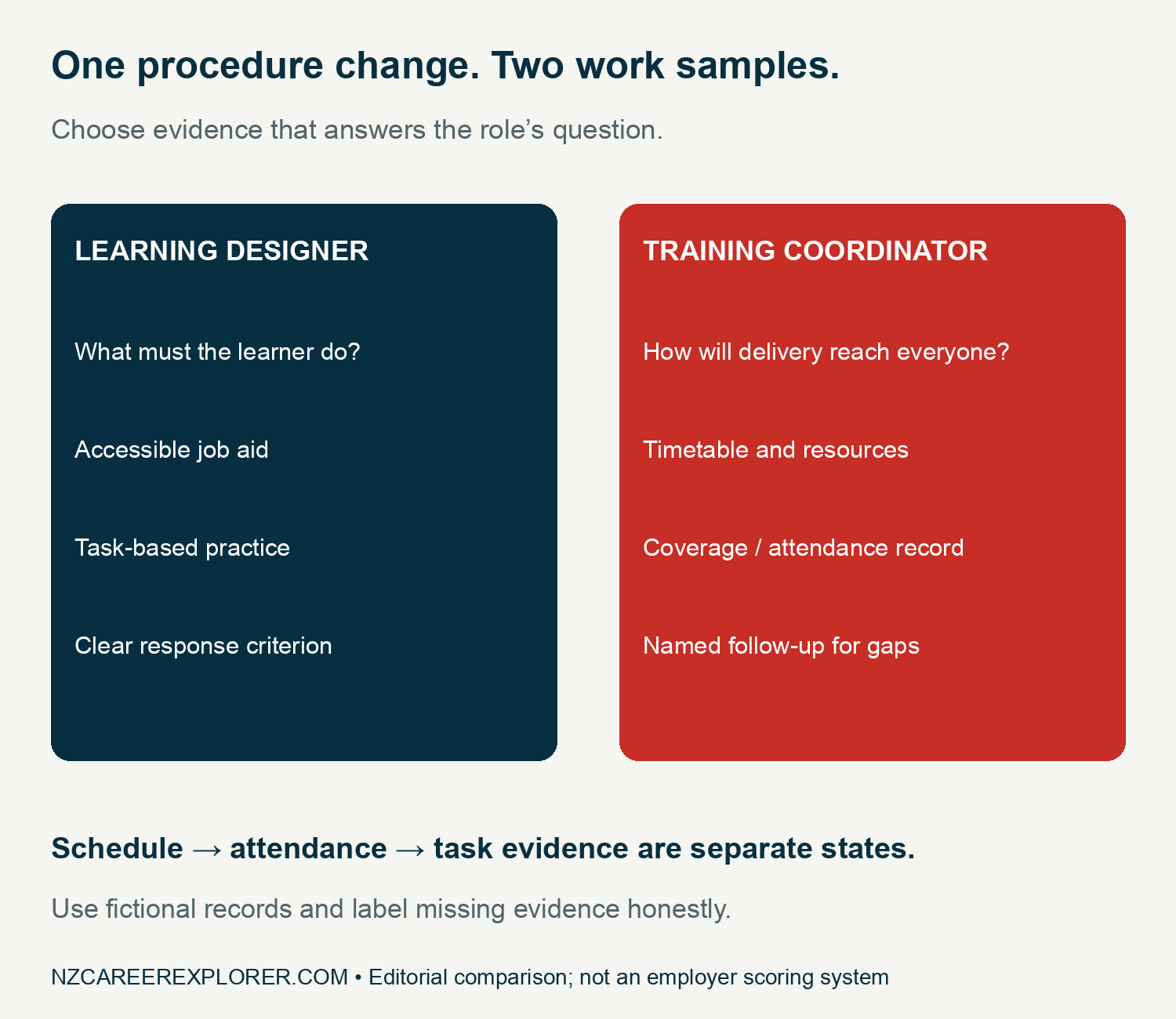
Designer route: make the correct action inspectable
Write a one-page aid with three clear labels: notice the missing field, ask the named owner and retain the unresolved status until confirmation arrives. Use readable type and meaningful headings. In this example, colour may reinforce a status but should not be the only way to identify it.
Then add one practice item: “The incoming handover has no owner for an unresolved task. What would you do before closing it?” The response criterion expects the learner to identify the gap, request the missing ownership information and leave closure pending. A polished slide alone would not show that criterion.
Finally, explain why you chose that format and what you have not tested. Accessibility and usefulness require appropriate checks with intended users; our sample does not claim those checks occurred. Keep evidence of the draft separate from evidence of learner performance.
Coordinator route: show the two people still outside the schedule
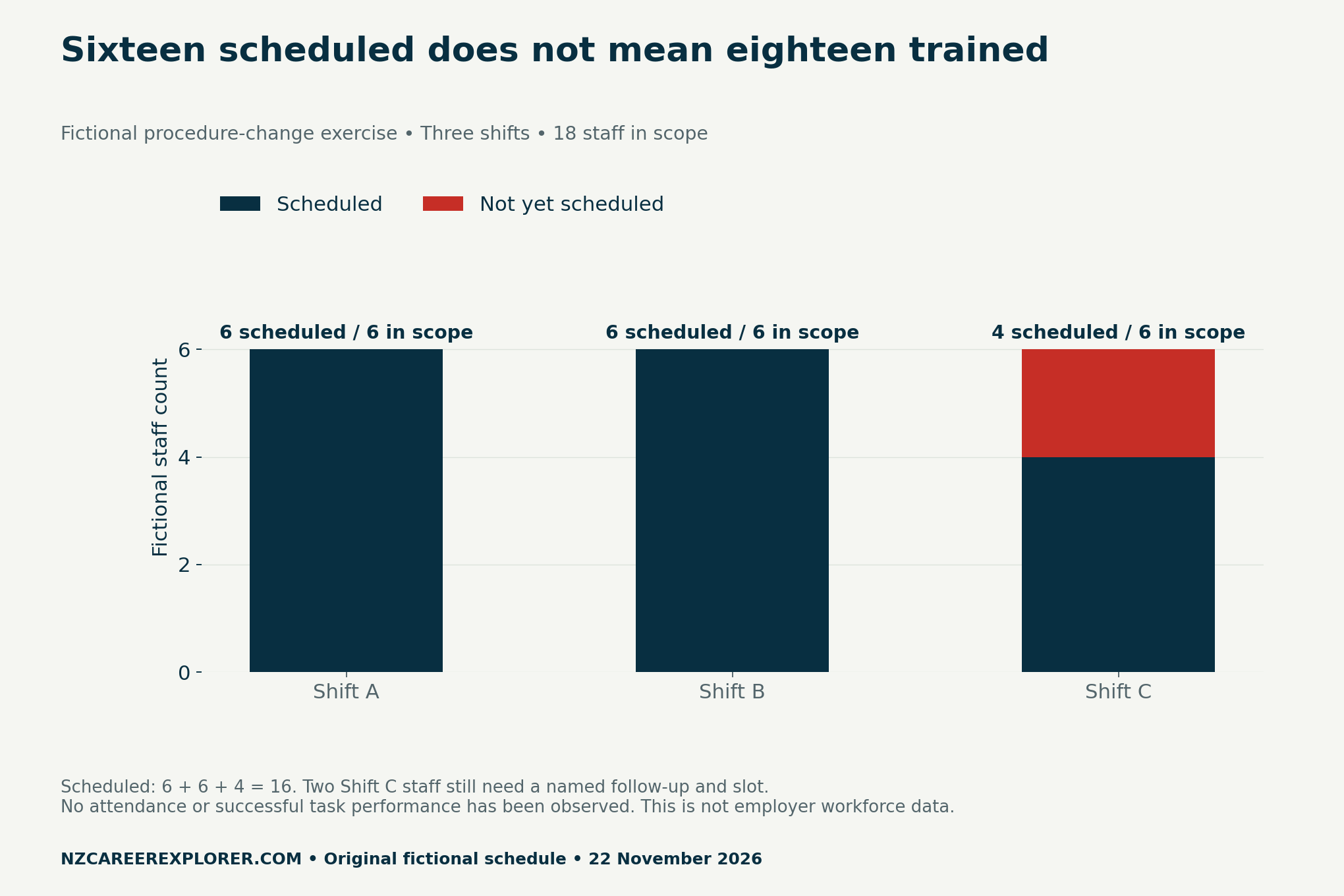
| Shift | In scope | Scheduled | Still needs a slot |
|---|---|---|---|
| Shift A | 6 | 6 | 0 |
| Shift B | 6 | 6 | 0 |
| Shift C | 6 | 4 | 2 |
The coverage arithmetic is 6 + 6 + 4 = 16 scheduled. Subtracting from 18 leaves two people without a slot. Keep those two visible, even if the timetable looks complete at a glance. Do not relabel the 16 as trained or the remaining two as having failed.
A useful follow-up row identifies the missing slot, a named fictional owner and the next confirmation needed. An attendance field remains blank until evidence exists. After attendance, a separate task check may still be needed; this exercise has no observation that could establish successful learning.
Apply a small evidence rubric without inventing employer scores
Our editorial rubric has three evidence fields per route. Mark a field 1 only when the stated artifact exists, and 0 when it is missing. The designer packet has an aid, practice item and response criterion. The coordinator packet has a timetable and coverage record, but its named follow-up is deliberately unfinished.
That gives artifact coverage of 3/3 and 2/3 within this invented packet. It is not an employer score, hiring probability, quality grade or ranking of the roles. The missing row tells you what to complete next; the fraction does not establish competence.
A post-launch question, such as whether staff actually use the new process, can be added as an optional next investigation. Do not claim it was an explicit requirement in either advert. Explain who would need to commission that work and what evidence would answer it.
Personalized Career Consulting
Unlock your potential with expert career advice tailored to your goals. Get personalized guidance and actionable steps toward your dream career in New Zealand.
Get StartedMethod, limitations and portfolio downloads
We compared the two official listings on 22 November 2026, then built one fictional scenario and a reproducible schedule. Counts reconcile to 18, and scheduled staff reconcile to 16. No pay comparison, workforce-demand estimate, learner trial or hiring result is inferred from two adverts.
For broader background, see our learning designer career overview. This report adds a same-task portfolio comparison. Choose which sample to lead with by reading the actual deliverables and conditions of the role you want.
- Fictional shift coverage and status boundaries (CSV)
- Three-field editorial evidence rubric (CSV)
- Blank two-route work-sample ledger (CSV)
- Dated advert and scope guide (CSV)
Sources: Justice learning designer advert and Customs training coordinator advert. Suggested citation: NZ Career Explorer, “Learning Designer or Training Coordinator? Show the Right Work”, 22 November 2026. All staff counts and work samples are fictional.


