





A larger salary does not always buy more, especially when the role also takes more time. This NZ pay rise calculator compares your old and new gross salary, working hours and price changes. Use it before a pay review or when weighing a revised job offer.
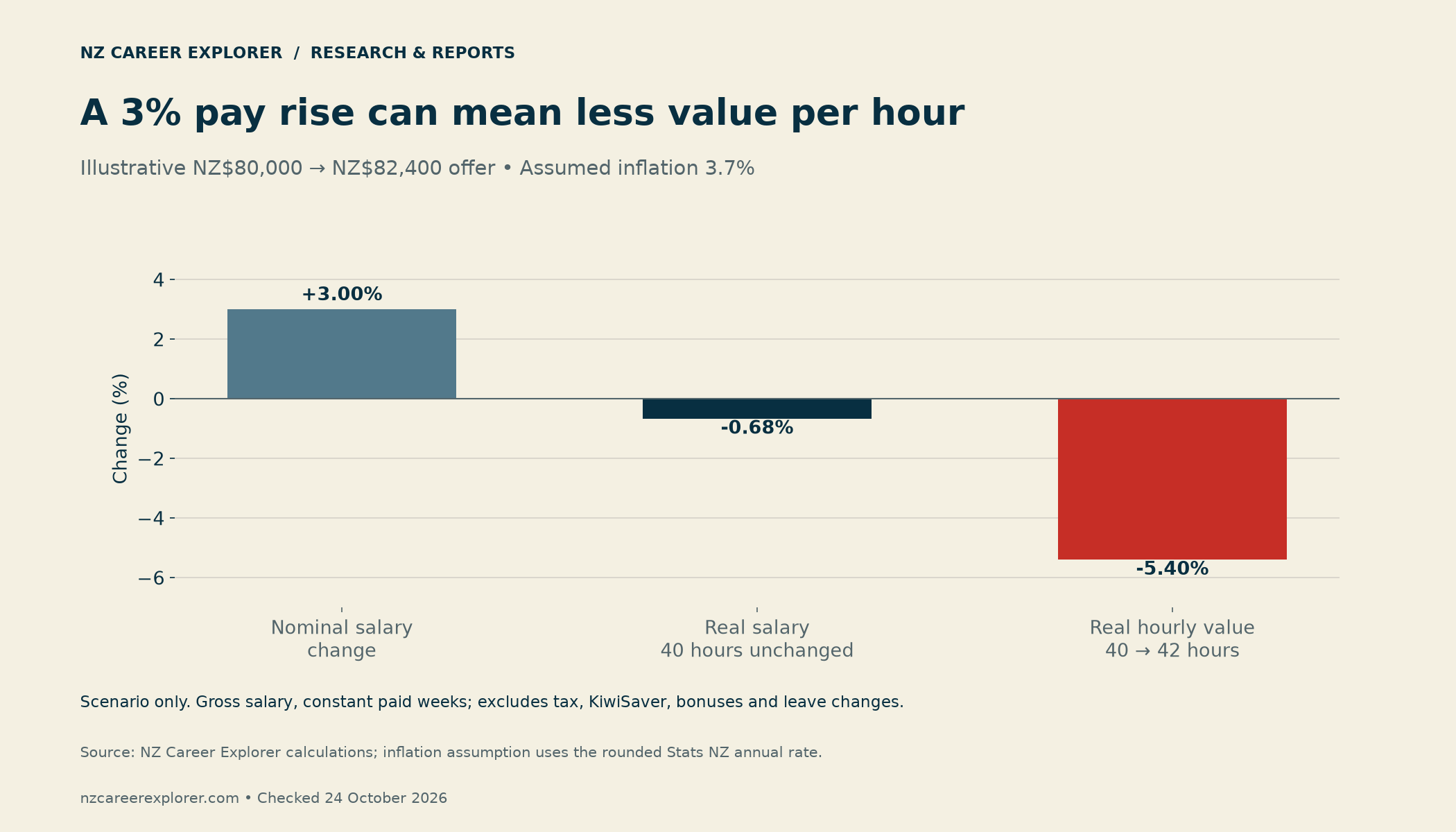
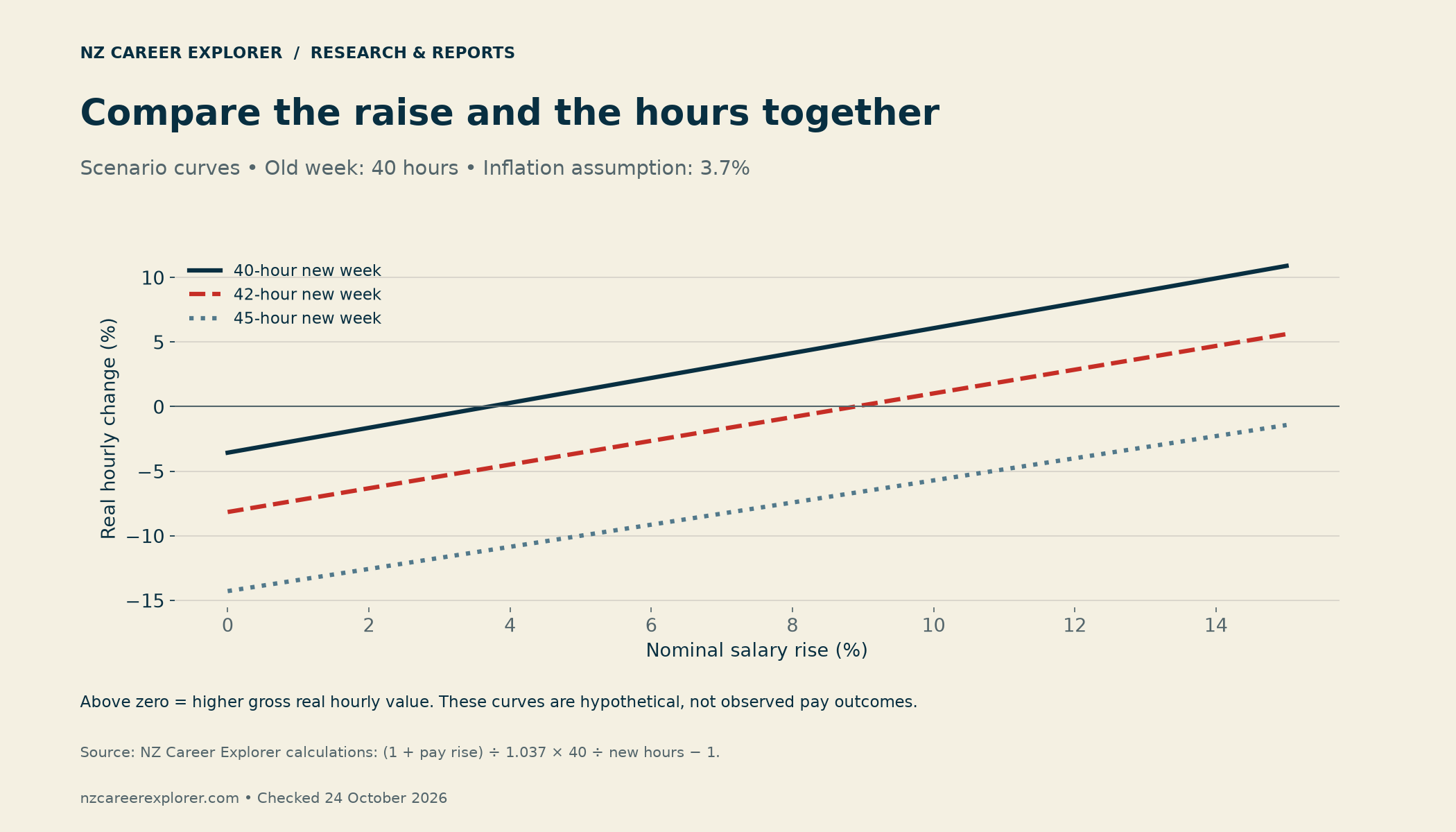
The worked example: a rise from NZ$80,000 to NZ$82,400 is 3%. With 3.7% inflation, its purchasing power falls about 0.68%. If weekly hours also increase from 40 to 42, gross real hourly value falls about 5.40%. These are transparent scenarios, not surveyed salaries or a prediction of your offer.
Stats NZ reported annual CPI inflation of 3.7% in the September 2026 quarter, with a 0.7% quarterly increase. The release date was 22 October 2026. Use a price-change period that matches your pay comparison; today’s annual headline is not suitable for every review.
Use the NZ pay rise calculator
Enter annual gross base salaries on the same basis. Use comparable weekly hours and the cumulative price change over your review period. The starting values reproduce our illustration. Results exclude tax, KiwiSaver, bonuses and leave differences. Calculations run in your browser; this tool does not submit your inputs.
Worked example: nominal salary +3.00%; real salary −0.68%; real hourly value −5.40%; break-even salary NZ$87,108.
Start with the right inflation period
The September CPI release and downloadable tables provide the primary price evidence. Annual inflation eased from 4.1% in June to 3.7% in September. However, prices were still higher than a year earlier. A slower increase is not a price cut.
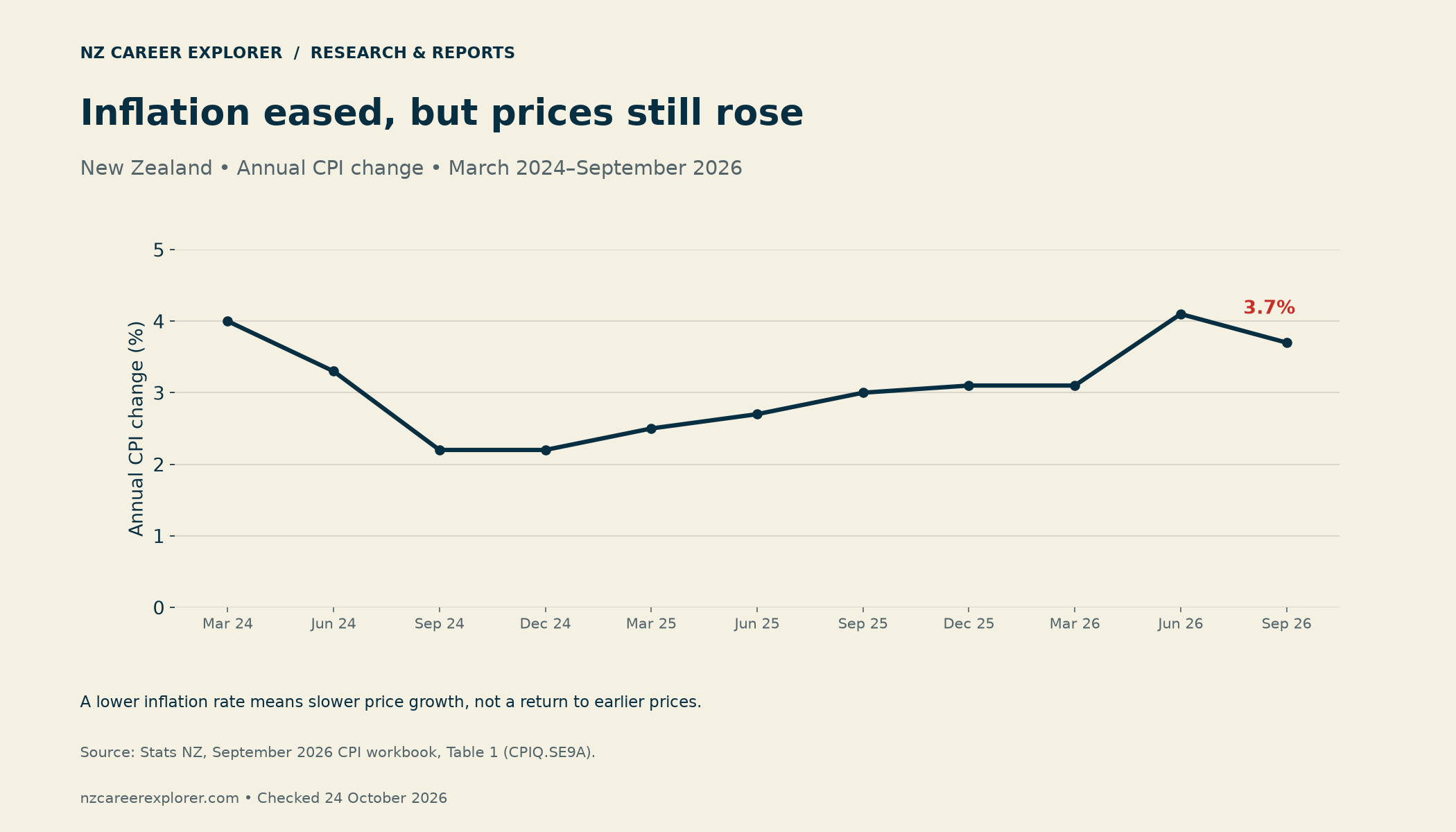
For a September 2025-to-September 2026 comparison, the all-groups indexes are 1,319 and 1,368. Their ratio gives about 3.715% inflation. The published annual rate rounds to 3.7%, which is the assumption used in our headline scenario. Small rounding differences explain why an index-based result can differ by a few hundredths of a percentage point.
For a two-year review from September 2024 to September 2026, use 1,280 and 1,368. That gives 6.875% cumulative inflation. Do not use 3.7% for the whole two years, and do not simply add two annual rates. Calculate (end index ÷ start index − 1) × 100, then enter that result above.
| Review interval | Start / end CPI indexes | Price change to enter |
|---|---|---|
| Sep 2025–Sep 2026 | 1,319 / 1,368 | About 3.715% |
| Sep 2024–Sep 2026 | 1,280 / 1,368 | 6.875% |
| Illustration in this report | Rounded annual-rate assumption | 3.7% |
These are quarterly benchmarks, not prices on an exact day. For an October review, September may be the latest available quarter. State that choice rather than implying there is an October CPI observation. Use the same all-groups series and base for both endpoints.
Headline CPI is not your household budget
Your spending mix can differ from the average CPI basket. Stats NZ reported annual price increases of 19.1% for petrol and 9.3% for electricity. New-house construction prices rose 3.2%. These selected changes explain why a national benchmark can feel different from your own bills; they are not the weights to use for a personal index.
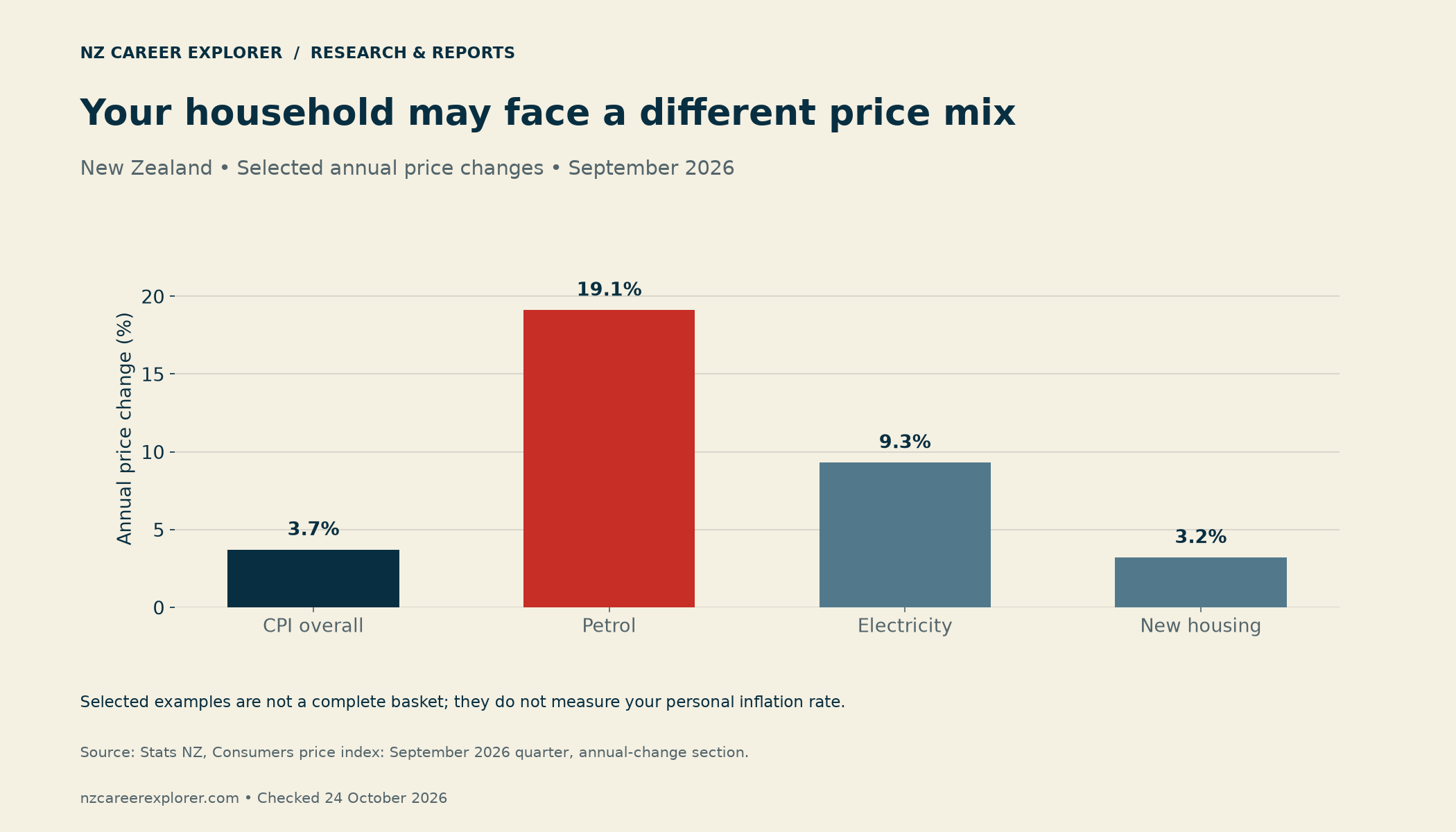
First, use the official benchmark consistently. Then list material changes in your own costs, such as commuting, childcare or housing. Keep that budget exercise separate from CPI. Otherwise, adding a commuting increase to an index that already includes transport can double-count costs.
Why extra hours change the pay-rise result
An annual salary compares money over a year. An hourly comparison also accounts for the time required to earn it. Therefore, a role with a bigger salary can offer less gross value for each hour. This matters when a promotion adds regular evening work or a revised agreement increases weekly hours.
| Measure | Calculation | Result |
|---|---|---|
| Nominal pay change | 82,400 ÷ 80,000 − 1 | +3.00% |
| Real salary change | 1.03 ÷ 1.037 − 1 | −0.68% |
| Real hourly change | 1.03 ÷ 1.037 × 40 ÷ 42 − 1 | −5.40% |
Multiply each ratio result by 100 to express it as a percentage. The hourly formula assumes the same number of paid weeks in each year. If one offer changes leave, unpaid breaks, paid weeks or overtime arrangements, compare those details separately before drawing a conclusion.
Calculate the salary that preserves real hourly value
Under the example’s assumptions, maintaining the former real hourly value requires NZ$87,108: 80,000 × 1.037 × 42 ÷ 40. That is an 8.885% nominal increase. It is a mathematical break-even point, not a claim about the market rate or what an employer legally owes.
Personalized Career Consulting
Unlock your potential with expert career advice tailored to your goals. Get personalized guidance and actionable steps toward your dream career in New Zealand.
Get Started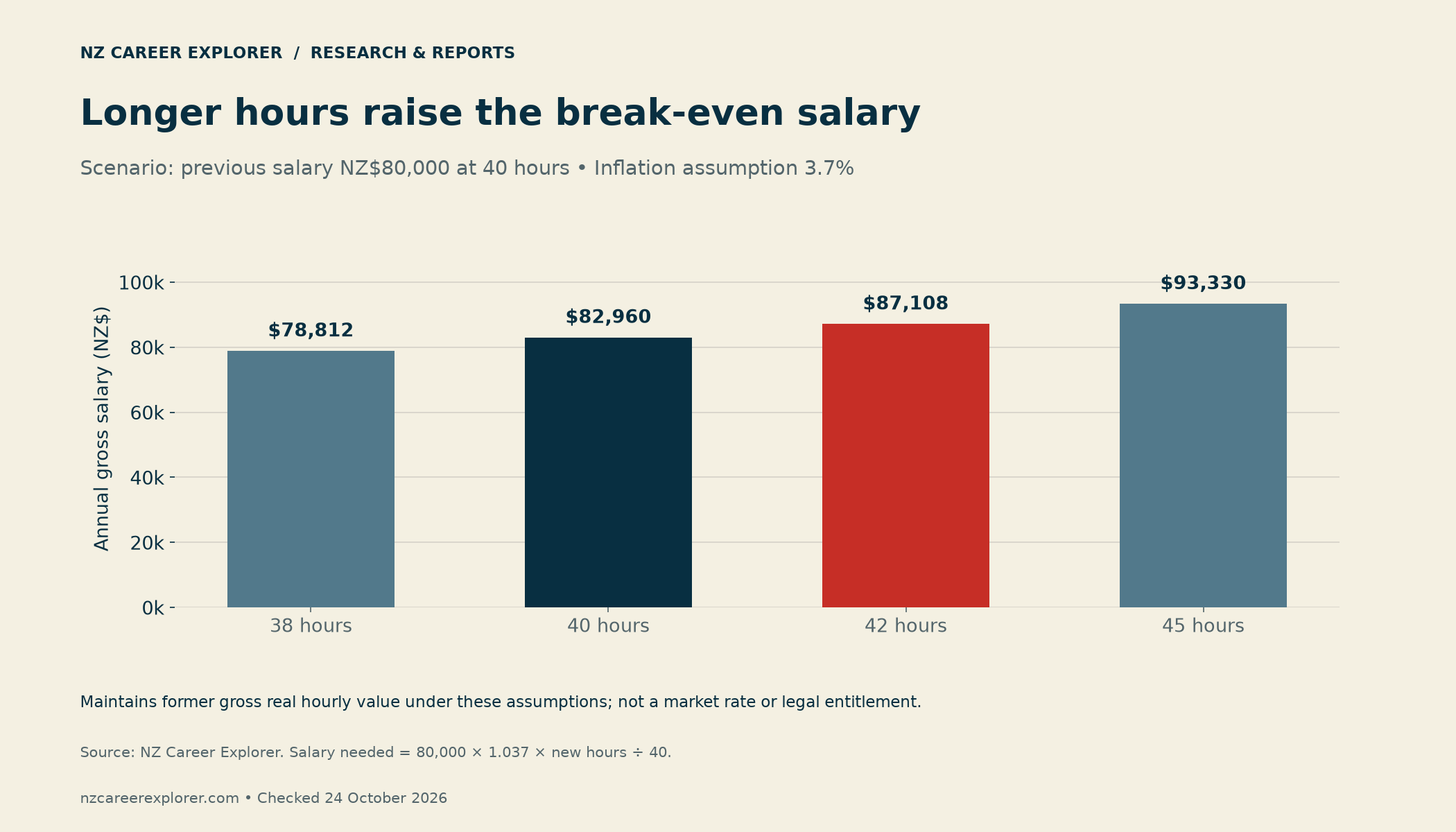
A shorter week can also matter. At 38 hours, the same formula gives NZ$78,812. That lower annual figure maintains hourly purchasing power in the model, but it still leaves fewer dollars for your annual budget. Both the annual and hourly results belong in the decision.
Test several offers before choosing
Use the calculator to compare a realistic range of salaries and hours. For example, keep the old offer fixed, then change only the new salary. Next, test the hours the employer expects during busy periods. This separates the effect of the raise from the effect of the workload.
Do not treat an uncertain bonus as guaranteed base pay. Likewise, distinguish contractual hours from the hours you realistically expect to work. Record both if they differ. You can then ask the employer to clarify scope, peak periods and how additional work is handled.

Questions to take into a pay review
Bring your calculation alongside evidence of the role’s responsibilities and your contribution. Employment New Zealand’s hours guidance says agreed hours belong in a written employment agreement. It also explains overtime and changes to hours. Check the guidance against your actual agreement rather than treating this calculator as legal advice.
- What are the agreed weekly hours, and what happens during peak workloads?
- Does the revised salary buy a larger role, extra hours, or both?
- Which payments are guaranteed, and which depend on performance or conditions?
- Will leave, flexibility, commuting or training support change?
- When will the next review happen, and what evidence will it consider?
For broader industry context, read our guide to economic trends and finance careers in New Zealand. It is a companion to the offer calculation, not evidence of today’s salary for a particular occupation. Our public and private sector career comparison can also help you frame the wider decision.
What national wage figures can and cannot tell you
The June 2026 labour-market release reported 2.0% annual growth in salary and wage rates in the Labour Cost Index. Average ordinary-time hourly earnings in the Quarterly Employment Survey rose 2.8% to NZ$44.62. These measures answer different questions and do not establish what an individual accountant, analyst or operations worker should earn.
In particular, do not compare June wage growth with September inflation and label the result observed September real-wage growth. The periods do not match. This NZ pay rise calculator instead uses your own salary inputs and a clearly stated price-change interval.
Method, data and limitations
We checked the official September CPI workbook, including Table 1’s CPIQ.SE9A series, on 24 October 2026. The charts distinguish published statistics from our hypothetical offer calculations. The salary example is illustrative; NZ$80,000 is not an occupational average. The calculator uses ratios rather than subtracting percentage changes, and rejects missing or invalid inputs.
The model compares gross base salary with constant paid weeks. It excludes income tax, KiwiSaver, student-loan repayments, bonuses, leave value and household-specific spending. It does not measure job security, progression, flexibility or wellbeing. Evaluate those factors alongside the numerical result. A higher calculated value alone does not establish that a job is the right choice.
Download the chart data and scenario assumptions (CSV). Fields identify observed versus scenario values, the measure, reference period or assumption, units and source. Suggested citation: NZ Career Explorer, “NZ Pay Rise Calculator: Check Inflation and Extra Hours Before Accepting,” 24 October 2026; calculations based on Stats NZ CPI data.


