







Treasury settlements NZ shift checks can change how you assess a finance operations job. A title and annual pay figure do not show when you will get home. The Reserve Bank’s current specialist vacancy publishes seasonal roster windows, giving applicants a concrete starting point for comparing work with existing commitments.
Our comparison separates time fit from experience fit. Two charts preserve the advertised roster and appointment range. A two-sheet infographic and four CSV tools help readers record travel, employer answers and genuine settlement experience. The guide does not turn an elapsed clock window into paid hours or assume that a familiar finance title establishes specialist competence.
Read the treasury settlements NZ shift and appointment terms
The RBNZ Settlements Operations Specialist advert, listed on 23 November, closes on 30 November 2026. It describes a fixed term or secondment ending in January 2028. Its body names Auckland or Wellington, while the summary panel says Wellington. Confirm the actual location for an offer.
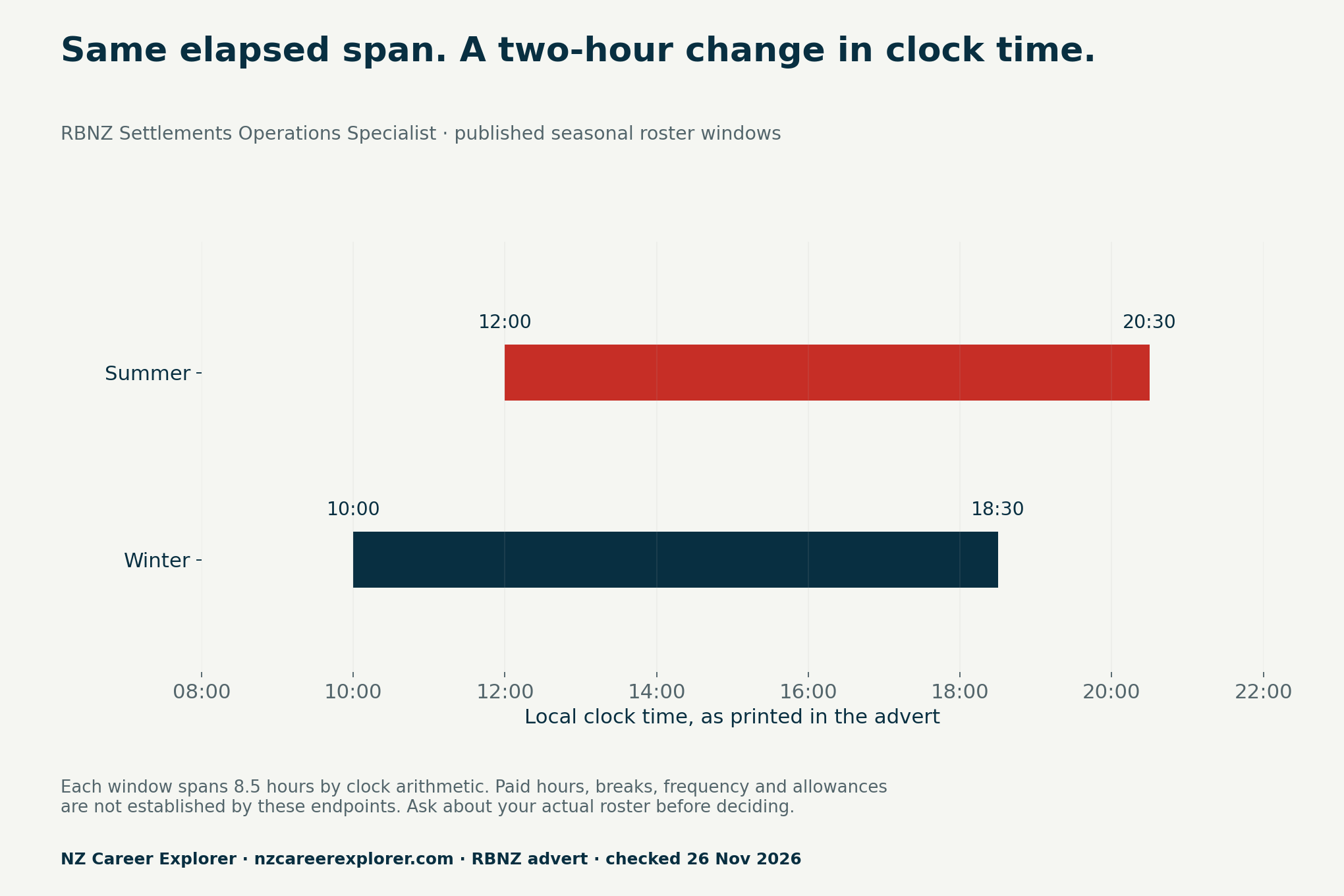
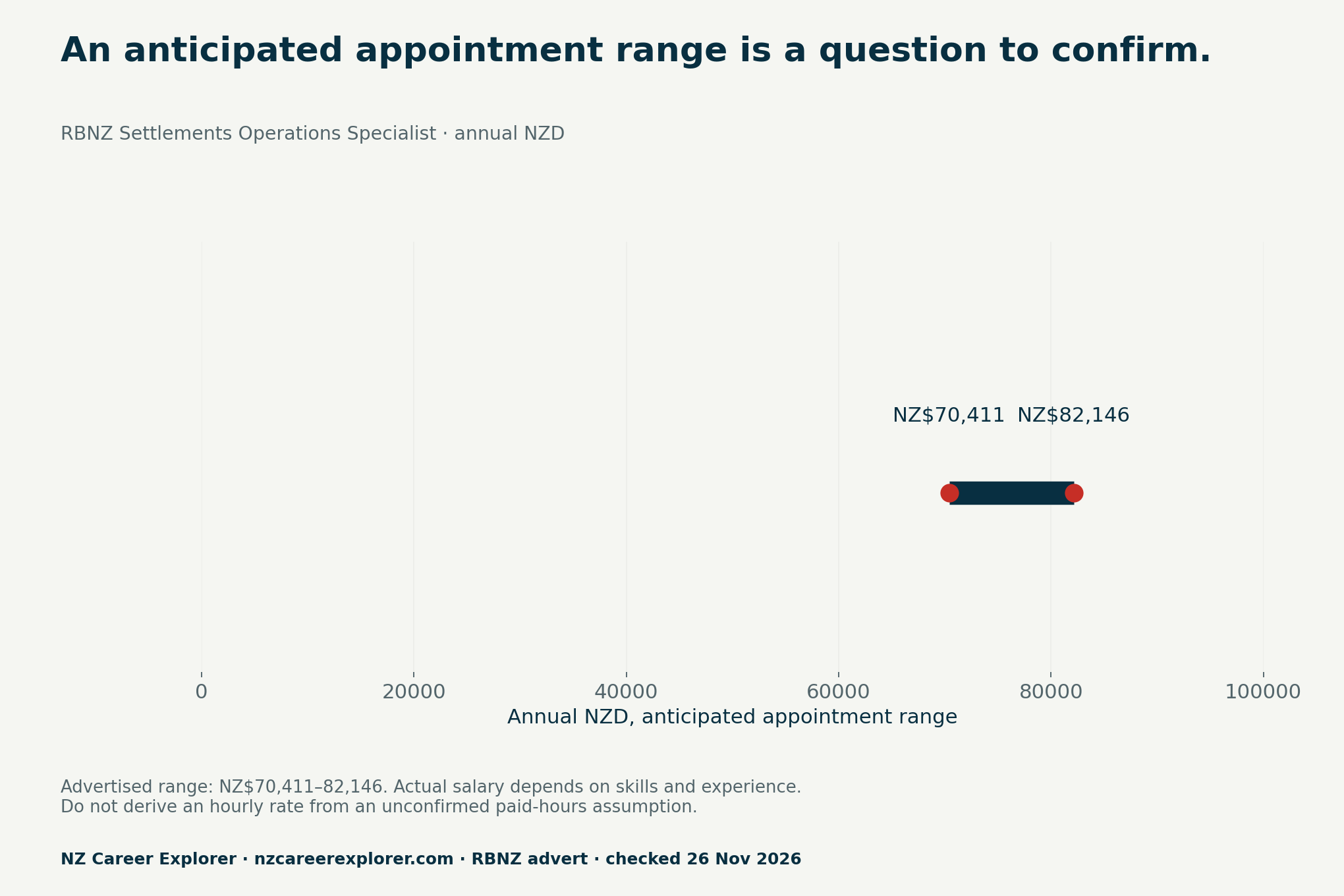
The anticipated annual appointment range is NZ$70,411–82,146, depending on skills and experience. Published roster windows are 12:00–20:30 in summer and 10:00–18:30 in winter. Duties cover settlement events, account reconciliation and exception investigation. The advert also asks for wholesale banking and specialist settlement-system knowledge.
These facts describe one recruitment notice. They do not measure market demand, typical pay or an applicant’s chance of selection. Keep the source wording alongside your own questions. Before changing jobs, replace assumptions about the offer with the employer’s dated answers.
The summer window ends two hours later
Subtracting the published endpoints gives an elapsed span of 8½ hours in either season. Summer starts two hours later and ends two hours later than winter. That shift in clock time can matter even when the span stays equal. It changes which part of the day you need to protect.
A weekly calendar should therefore have separate summer and winter views. Start with confirmed shift endpoints, then add your own realistic travel allowance. Finally, place existing commitments beside them. Use neutral labels such as evening class or pickup arrangement. You do not need to publish family details or your home address.
If a commitment conflicts, write down the precise question rather than assuming flexibility. For example, ask how often the seasonal window applies, how rosters are communicated and what changes are possible. Treat the response as information to assess, not a guarantee until it forms part of the relevant agreement.
Keep annual pay separate from paid-hours assumptions
Use the anticipated appointment range as a prompt for an offer discussion. Ask where an individual offer sits and which terms apply. Do not calculate an hourly rate by multiplying the published clock span across a guessed number of days. That would combine a known range with unconfirmed paid hours.
A household comparison can still be useful without an hourly estimate. Keep the written salary offer in one column and confirmed recurring costs in another. Record any uncertainty about travel or roster arrangements. Update the comparison when an answer arrives, so a provisional assumption does not quietly become a fact.
General reconciliation is only part of an evidence story
The Reserve Bank’s wholesale payments and settlement overview explains that banks and financial-market participants use its systems to process transactions. It distinguishes NZClear clearing and settlement services from ESAS wholesale payments. That context helps explain why a general accounts example and actual wholesale settlement exposure are different evidence fields.
Begin with a reconciliation example you can truthfully describe. Identify what you compared, how you investigated a difference and what happened next. Then separately record any direct work with settlement events, products or specialist systems. If that exposure is missing, name the gap. An adjacent task should not be relabelled as experience you do not have.
For an exception example, explain your own action and the decision owner. You might have found the mismatch, prepared the comparison or escalated an unresolved question. Use only permitted, redacted evidence. Avoid client identifiers, transaction values or screenshots that an employer has not authorised you to share.
Questions to resolve before you switch
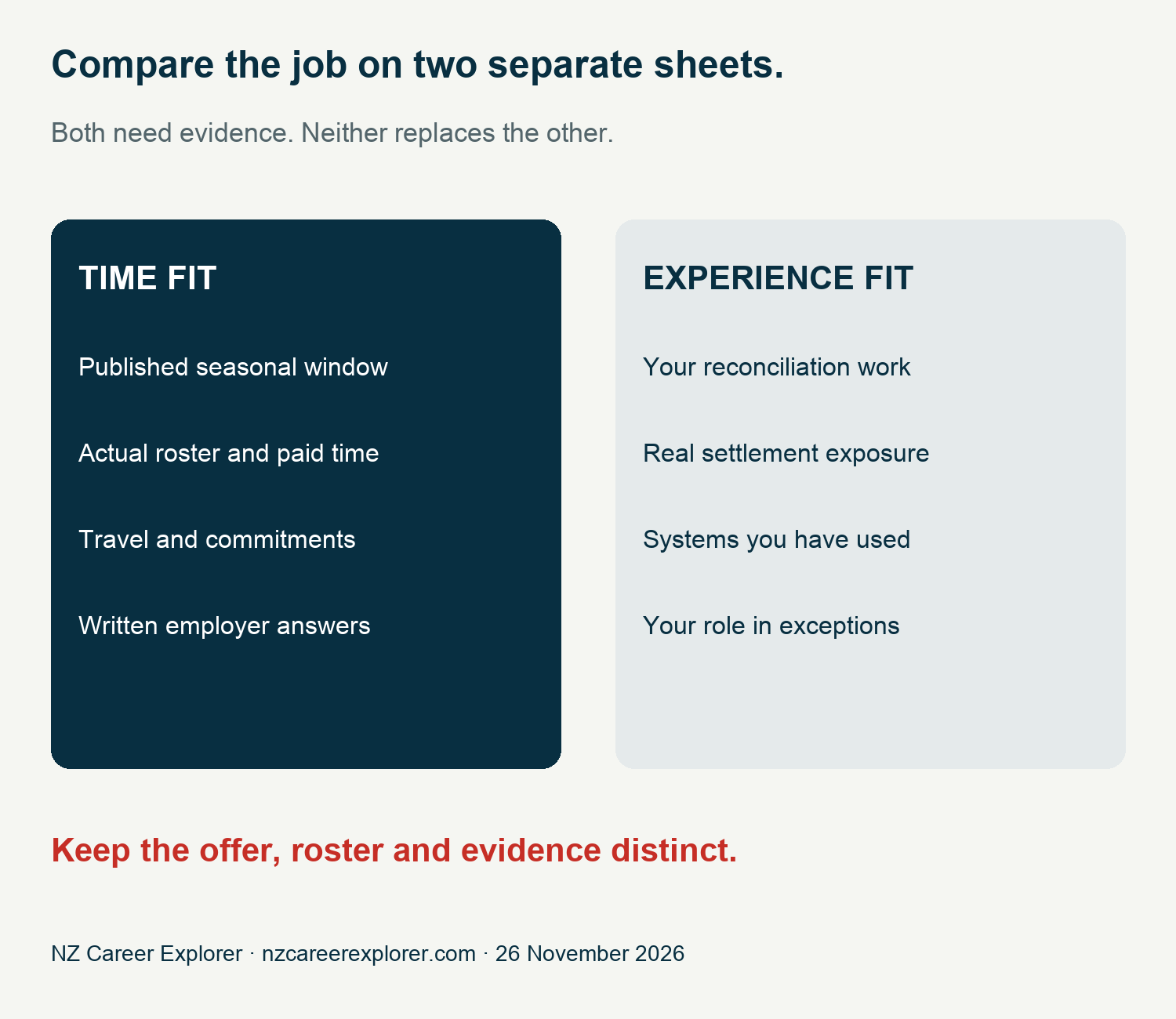
Use the weekly-fit sheet to ask about the actual roster, paid time, breaks and attendance location. Keep a separate entry for the contract end and any secondment conditions. Where a benefit or allowance matters to your decision, seek the applicable written terms. The worksheet does not assume that an allowance exists.
Next, use the experience sheet to identify one supportable example for each relevant task. A clear application explains what you did and where your knowledge stops. If you need clarification about a required system, ask about the expected level of use. Do not replace missing experience with a list of product names.
Personalized Career Consulting
Unlock your potential with expert career advice tailored to your goals. Get personalized guidance and actionable steps toward your dream career in New Zealand.
Get StartedDownload the source terms and comparison sheets
The terms register preserves the pay and location qualifications. The shift file shows the clock arithmetic. Two blank tools cover the weekly schedule and experience evidence. They are planning aids, not employer forms. Keep your completed versions private and use non-identifying references for examples.
- Advertised terms and interpretation boundaries (CSV)
- Published shifts and elapsed-time calculations (CSV)
- Blank weekly shift and commitment comparison (CSV)
- Blank settlement experience evidence sheet (CSV)
Method and limits: checked on 26 November 2026. Clock arithmetic uses 20.5 minus 12 and 18.5 minus 10. The resulting spans do not establish paid hours. Two substantive charts are appropriate: one roster comparison and one appointment interval. There is no dataset here on worker outcomes, job counts or sector pay.
For another source-led example of distinguishing technical knowledge from authority, see our aeronautical specialist application guide. Browse more Research & Reports. Suggested citation: NZ Career Explorer, “Treasury Settlements NZ Shift: Check the Time Before You Switch”, 26 November 2026.


