







Aeronautical services technical specialist NZ applications need an account of judgement as well as technical knowledge. A current Civil Aviation Authority vacancy gives applicants a useful test: can you explain an observation, your part in reviewing it and who owned the resulting decision? Flying hours alone do not answer that question.
Our evidence table turns that question into a practical application exercise. It keeps operational experience, review work and formal authority separate. A salary-band chart preserves the employer’s own figures, while four downloadable CSV tools help readers organise truthful examples. The guide does not determine eligibility or give operative aviation advice.
Read the aeronautical services technical specialist NZ role in two layers
The CAA advert listed on 24 November 2026 describes a permanent, full-time role, ideally based in Wellington. Applications close on 15 December. It names technical knowledge in air traffic management, communications, navigation, surveillance and airspace, alongside risk assessment, oversight and clear communication.
For an applicant, these are two related layers. The first concerns what you understand about your functional specialty. The second concerns how you use evidence to support a sound decision. A strong example connects the two. It does not replace specialist knowledge with generic statements about being careful or working well in a team.
The linked position description adds detail about functional specialisation, assessment and delegated powers. It also lists a relevant professional qualification and national security clearance among essential requirements. Check the employer’s current requirements directly. A foreign qualification, a familiar title or prior access elsewhere does not establish the outcome of those checks.
What the published pay figures establish
The advert prints an annual band of NZ$115,536–161,412 and states a mid-range of NZ$141,751. We retain that stated mid-range. We do not recalculate it as an arithmetic midpoint, convert it into a guaranteed starting salary or treat it as a typical salary for the whole occupation.
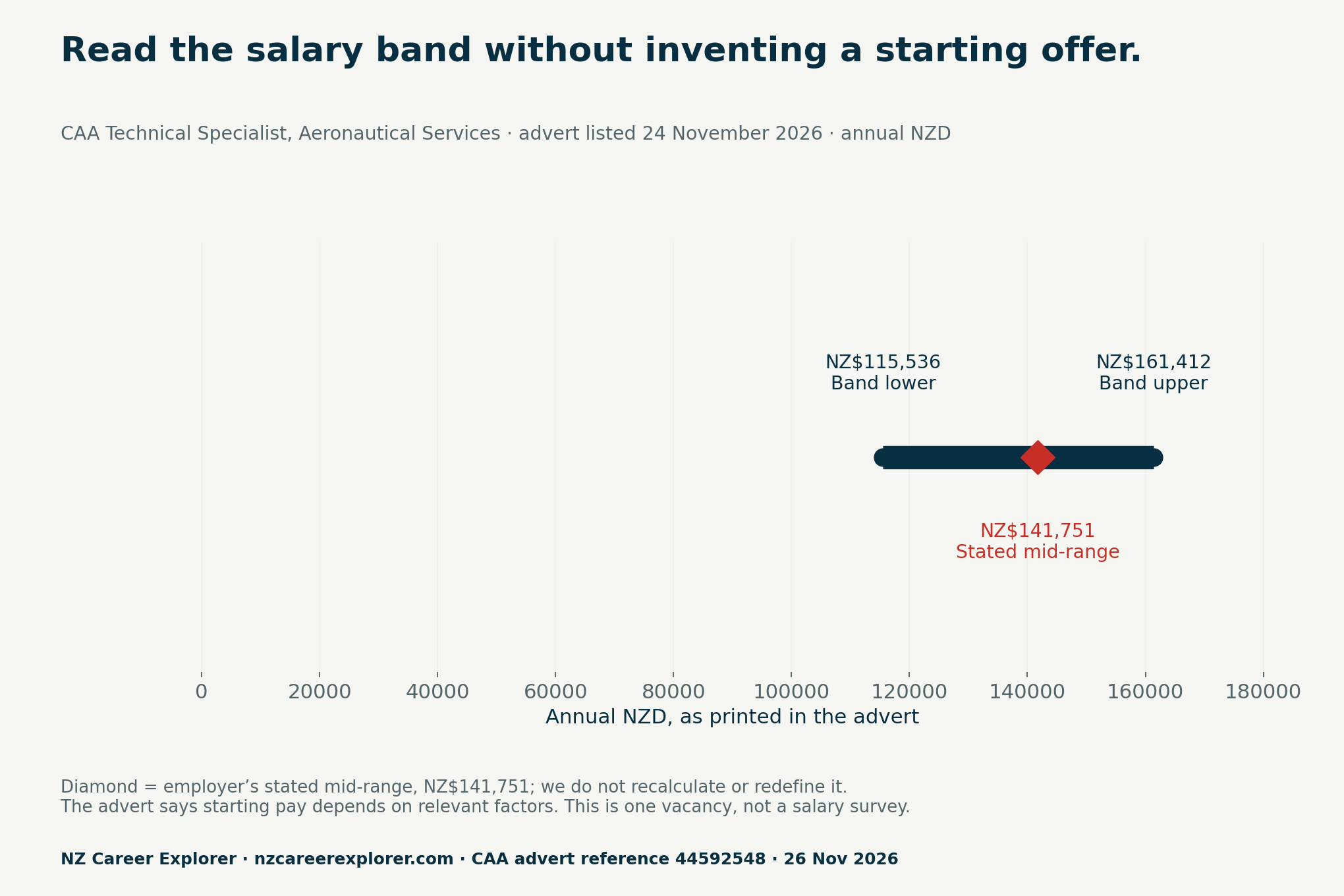
The employer says starting salaries depend on the knowledge, skills and experience brought to the role, as well as internal relativities. Ask how that applies to an actual offer. If you are comparing jobs, keep the stated band, confirmed offer and your own budget in different fields. They answer different questions.
| Published measure | NZD per year | Use it as |
|---|---|---|
| Band lower | 115,536 | Advertised annual salary band lower point |
| Stated mid-range | 141,751 | Employer’s stated figure; not recalculated |
| Band upper | 161,412 | Advertised annual salary band upper point |
Build an observation-to-decision evidence table
Begin with a non-identifying description of an issue you actually encountered. Next, state what you personally checked. Record the evidence you passed on, the role that owned the decision and your own authority boundary. Finally, identify what you may share. This makes your contribution inspectable without presenting a confidential file.
For example, a fictional specialist notices that two submitted records use different versions. They compare the records, document the unresolved question and brief an authorised decision-maker. A clear account explains the review method. They should not claim to have approved the proposal unless that approval was genuinely theirs to make.
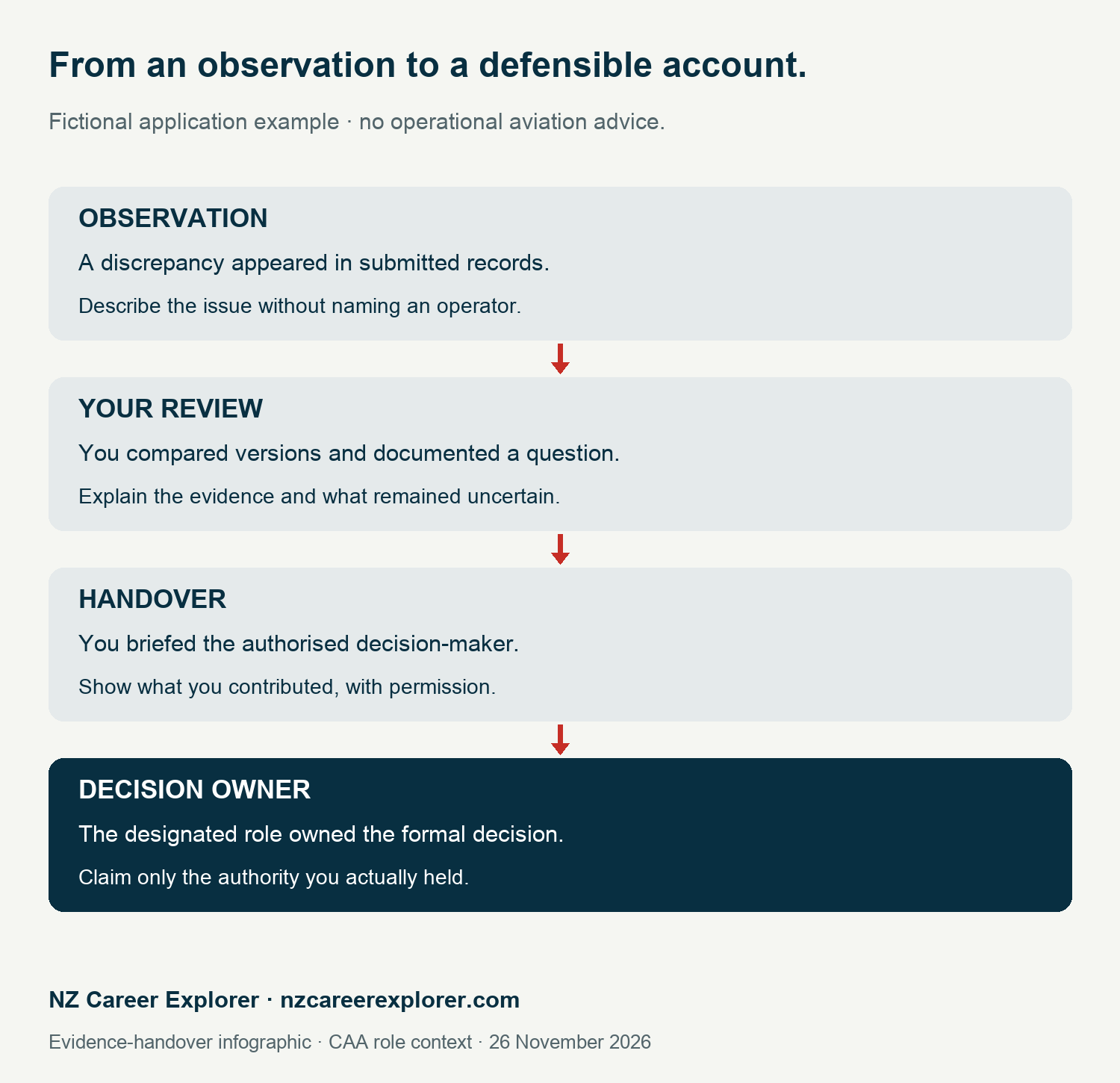
In your own example, replace every fictional detail with a supportable fact. A statement such as “I prepared the discrepancy summary for review” can be stronger than “I ensured safety” when the latter has no measurable outcome behind it. Show the question you resolved, or the uncertainty you accurately preserved.
Technical knowledge does not automatically grant authority
CAA’s aviation life-cycle overview distinguishes entry into the system from ongoing assurance and the handling of risks or non-compliance. That helps explain why regulatory work extends beyond performing an operational task. The role requires you to understand the system and communicate evidence within it.
The position description connects delegated functions with competence and an instrument of delegation. For a career example, identify the power you actually held and the point at which another role took over. Do not copy a regulator’s possible powers into your CV as though your technical background already conferred them.
This distinction also protects a useful team story. You may have supplied the key comparison, while someone else owned the formal outcome. State both. A reader can then assess your reasoning and collaboration without confusing the team’s responsibilities with your individual authority.
Location wording is not a remote-work guarantee
The listing is categorised as Multiple Locations, but its body says Wellington is preferred and applications from elsewhere will be considered case by case. Keep the body qualification in view. A broad location label should not become a promise that you can work remotely from any city.
Before making a move, ask about office attendance, travel, the relevant functional specialty and the evidence expected in the cover letter. Keep the employer’s answers dated. The advert’s closing date is a reason to prepare a focused application, not to skip checks that materially affect your decision.
Personalized Career Consulting
Unlock your potential with expert career advice tailored to your goals. Get personalized guidance and actionable steps toward your dream career in New Zealand.
Get StartedWrite a cover letter around one defensible contribution
Choose an example closely related to the role, then describe the context in plain language. Explain your action, what information you considered and what you could conclude. Name a limitation where it matters. End with the contribution you can demonstrate, rather than an unsupported safety outcome or a vague claim of leadership.
Use the claim-audit worksheet to challenge verbs such as approved, led and guaranteed. Ask whether the evidence supports that exact word. If your part was review, advice or handover, use that word instead. The aim is clarity, not modesty for its own sake. A precise contribution is easier to assess.
Download the source audit and application worksheets
The salary file preserves the three advertised figures. A terms register records the location and authority qualifications. The blank table has no fields for names, security details or confidential operating records. The fictional claim audit illustrates wording choices; it must not be presented as your experience.
- Advertised salary band and stated mid-range (CSV)
- Source terms and interpretation boundaries (CSV)
- Blank application evidence and decision-owner table (CSV)
- Fictional application claim audit (CSV)
Method and limits: sources were checked on 26 November 2026. Salary values are transcribed, with the employer’s mid-range retained as stated. One chart is appropriate because this vacancy supplies a pay band, not a dataset on hiring, demand or safety outcomes. The infographic explains a separate evidence relationship. No real confidential case is reproduced.
For a related comparison of technical contribution and assessment authority, read our NZ scaffolding assessment evidence guide. More reports appear in Research & Reports. Suggested citation: NZ Career Explorer, “Aeronautical Services Technical Specialist NZ: Show Regulatory Evidence”, 26 November 2026.


