





An NZ school payroll EdPay interview example should show how you route uncertainty, not suggest you can process real pay without authority. Our four fictional handovers separate a returning fixed-term teacher, an unchanged ongoing teacher, a new support hire and a term-time-worker hours discrepancy.
Education Payroll’s 18 November 2026 Start of Year update supplies the seasonal context. For the 2027 process, the screen opens on 9 December 2026 and closes on 25 February 2027 at 5pm New Zealand local time. That screen closure is not a universal first-pay deadline.
NZ school payroll EdPay interview example: keep the source date visible
The 2026–27 key dates flyer distinguishes task dates from the overall screen window. Meanwhile, the step-by-step webpage still displays a February 2026 closure date despite linking the 2027 guide. We flag that stale text and use the dated update and current-year flyer for the window above.
This report is a career learning exercise, not an instruction sheet for school payroll operations. An applicant should not seek employee files or enter a system to make a sample. Use invented aliases and clearly label every approval, date, status and hour figure as fictional.
Four rows show why one seasonal label is not enough
| Case | Fictional situation | Question to hand over |
|---|---|---|
| A | Returning fixed-term teacher; approved extension supplied | Which restart route and effective date apply? |
| B | Permanent teacher in the same ongoing role | Is any change actually required? |
| C | New support hire; approval date absent | Who confirms authority and effective date? |
| D | Term-time worker;12 versus10 hours | Who checks the two-hour difference and records closure? |
Case A has an extension document within the invented packet. The preparer still identifies the relevant dates and requests confirmation of routing. The public update distinguishes returning fixed-term teachers and term-time-only employees from permanent teachers who remain in the same ongoing role.
Case B therefore avoids assuming that every teacher needs the same restart action. Record that the scenario describes no change to the ongoing role, then refer any uncertainty to the authorised school owner. The sample does not decide an actual employee’s status.
Case C is different again: it concerns a new support hire, not a restart. The approval date is missing. Name the person who must clarify that evidence and keep the proposed action unconfirmed. Missing authority is not permission to invent a date or to describe work as completed.
Calculate the hours gap without turning it into a pay finding
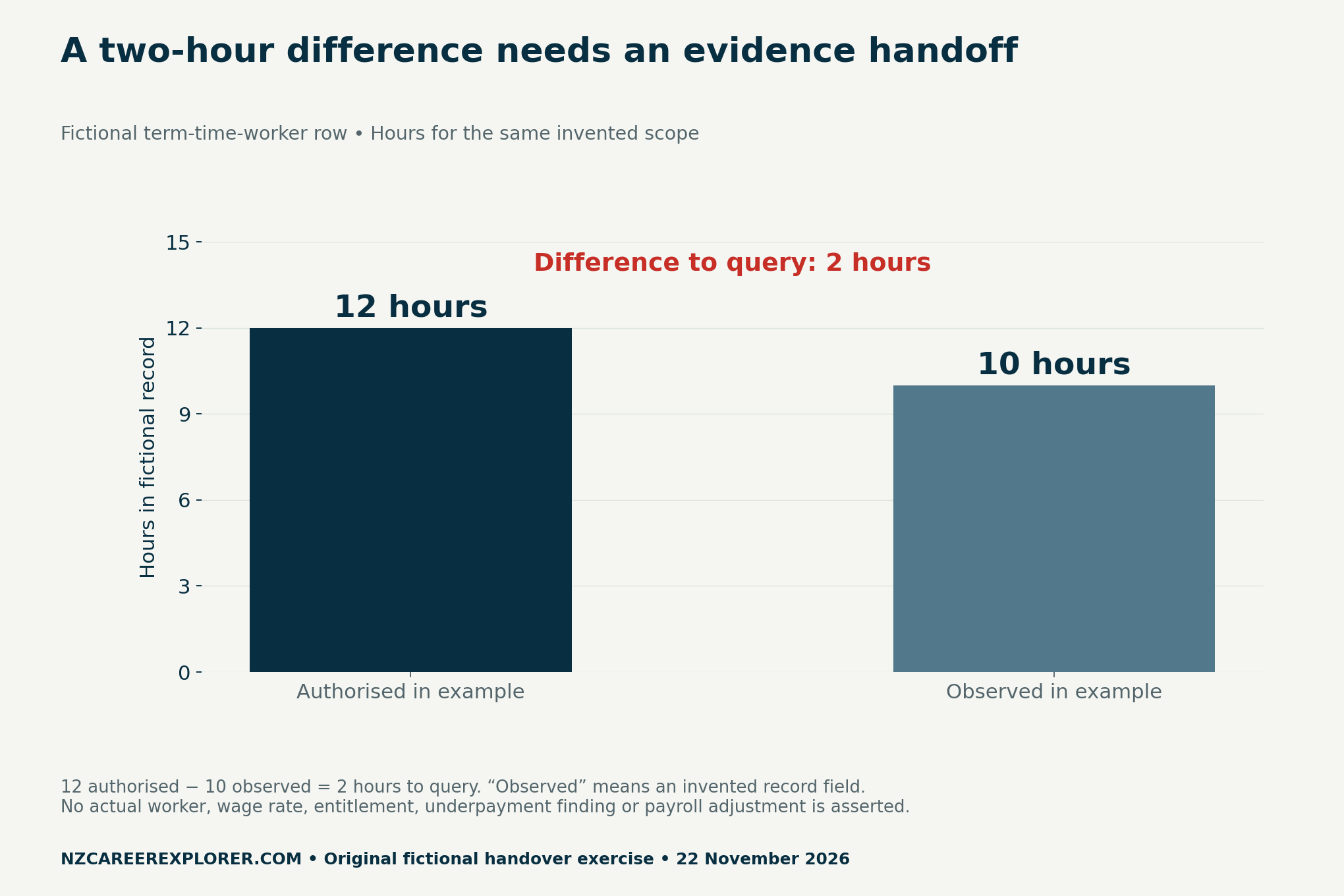
In case D, the fictional authorisation says 12 hours while another invented record shows 10. Subtracting gives 12 − 10 = 2 hours. Keep the original sources and scope beside that difference so a checker can see what needs explanation.
There is no wage rate, actual timesheet or verified processing history. Consequently, the example cannot establish a dollar underpayment, an entitlement or a correction. Do not advise withholding earned pay, changing hours or waiting until a generic deadline because of this worksheet.
A good handoff states the discrepancy, the named exception owner and the confirmation required. For example: “Two-hour difference in this fictional packet; source and effective scope need checking; no adjustment or closure has been recorded.” The next step belongs to the authorised school process.
Separate preparation, checking and closure
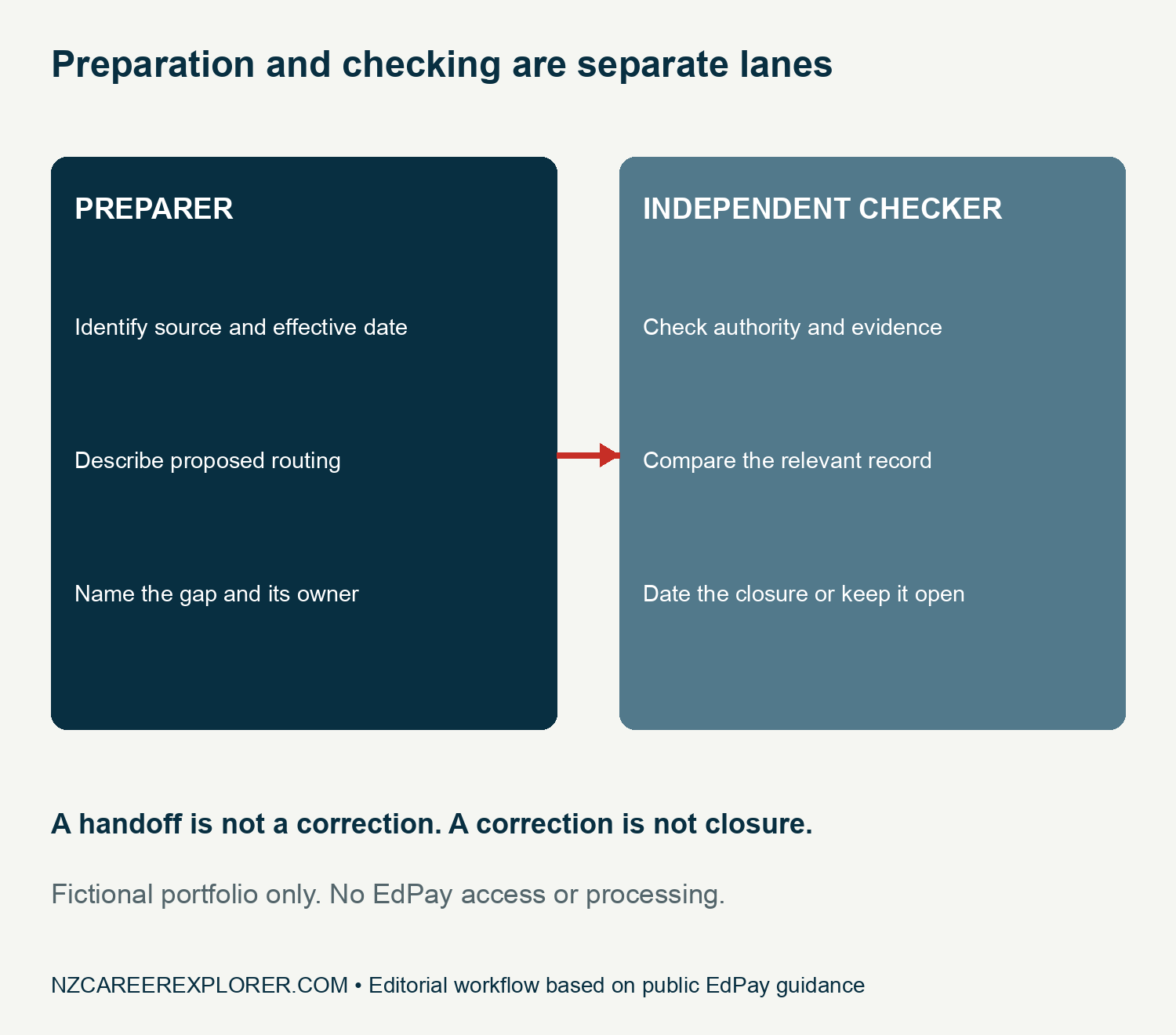
The official SUE report explanation distinguishes the first report, used to review and correct errors before a run, from the final report, which reflects the actual run and forms part of the school’s records. It also recommends checking independently of changes. Only authorised users may access those reports.
For the portfolio, use that distinction to label the evidence you would need. A request sent to an owner is not confirmation that a correction happened. Likewise, a corrected draft is not proof that a final independent check took place. Keep the status open until the stated closure evidence exists.
Our blank ledger therefore includes source, effective date, proposed route, owner, confirmation, checker and closure evidence. The fields are prompts for a fictional demonstration. They do not replace a school’s controls, official task instructions or current payroll advice.
What to say when an interviewer asks what you did
Describe the exercise in plain terms: “I separated the four cases, showed the two-hour difference and recorded who needed to confirm each gap. I did not process pay or mark an exception resolved without evidence.” That makes the boundary between preparation and authority easy to assess.
Then show one row and trace it from input to proposed handoff. If asked about a real case, refer to the employer’s authorised process. An applicant’s task is to explain their reasoning honestly, not to borrow real employee information to make the portfolio look more convincing.
Personalized Career Consulting
Unlock your potential with expert career advice tailored to your goals. Get personalized guidance and actionable steps toward your dream career in New Zealand.
Get StartedFor a related distinction between records and outcomes, see our training coordination work-sample comparison. A scheduled learning place is not completion; similarly, a proposed payroll handoff is not a processed or independently closed change.
Method, limits and reusable interview tools
We checked the dated Education Payroll update, 2026–27 flyer and public SUE guidance on 22 November 2026. The four cases and all values are invented. The only numerical calculation is the two-hour difference; no pay amount, salary rate, entitlement or employer hiring requirement is inferred.
The downloads preserve unknown approval and closure fields rather than filling them with plausible-looking facts. Use the rubric to ask whether the learner separates authority, routing, arithmetic and closure. It is an editorial reflection tool, not an employer score or proof of EdPay competence.
- Four fictional exception handovers (CSV)
- Blank private handover ledger (CSV)
- Source, date and stale-text register (CSV)
- Interview explanation rubric (CSV)
Sources: Education Payroll 18 November update, 2026–27 key dates, SUE report explanation and step-by-step page with the stale date noted. Suggested citation: NZ Career Explorer, “NZ School Payroll Jobs: Practise an EdPay Exception Handover”, 22 November 2026.


